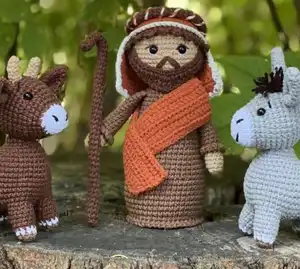
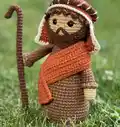
Create a heartwarming nativity scene with this enchanting crochet pattern featuring a shepherd, bull, and donkey. This intermediate-level project brings the timeless story to life through beautifully crafted amigurumi figures that capture the essence of the Christmas story. Perfect for holiday decorating or as a meaningful handmade gift, this pattern includes detailed instructions for creating a 20cm shepherd complete with traditional headscarf, cloak, and shepherd's stick, alongside adorable 15-16cm animal companions.
Progress Tracker
0% Complete
— Shepherd - Arms (make 2):
Info:
Start with beige yarn, hook 2.25mm
Info:
Change to brown yarn. Cut the beige yarn.
Rnd 9-20:
10 sc (12 rounds)
Info:
Stuff only the lower 2/3 of the arm. Fold the arm in half and crochet through two layers, 5 sc. Fasten off and weave in the yarn tail inside the piece.
Sleeves decoration:
Hold the arm with the hand pointing up, attach brown yarn color to the first unused front loop of round 7.
Rnd 1:
(1 sc, ch 2)*10, slst
Info:
Fasten off and weave in the yarn tail inside the piece. Crochet the 2nd arm the same way.
— Shepherd - Body:
Info:
Start with brown yarn, hook 2.25mm
Rnd 5:
2 sc, inc, (4 sc, inc)*5, 2 sc (36)
Rnd 7:
(13 sc, inc)*3 (45)
Info:
Trace the bottom of the piece on a cardboard and cut it out.
Rnd 9-15:
45 sc (7 rounds)
Rnd 16:
(13 sc, dec)*3 (42)
Rnd 17-18:
42 sc (2 rounds)
Rnd 19:
6 sc, dec, (12 sc, dec)*2, 6 sc (39)
Rnd 20-21:
39 sc (2 rounds)
Info:
Apply some glue to the cardboard. Place the cardboard inside the bottom of the piece.
Rnd 22:
(11 sc, dec)*3 (36)
Rnd 23-24:
36 sc (2 rounds)
Rnd 25:
5 sc, dec, (10 sc, dec)*2, 5 sc (33)
Rnd 26-27:
33 sc (2 rounds)
Info:
Start stuffing as you go.
Rnd 28:
(9 sc, dec)*3 (30)
Rnd 29-30:
30 sc (2 rounds)
Rnd 31:
4 sc, dec, (8 sc, dec)*2, 4 sc (27)
Info:
Join the arms to the body in next round symmetrically on the sides.
Rnd 33:
4 sc on the body, through both stitches of the 1st arm and the body crochet 5 sc, then on body 8 sc, through both stitches of the 2nd arm and the body crochet 5 sc, then 5 sc on the body (27)
Rnd 34:
(7 sc, dec)*3 (24)
Rnd 35:
(6 sc, dec)*3 (21)
Info:
Change to beige yarn. Cut the brown yarn.
Rnd 36:
(5 sc, dec)*3 (18)
Info:
Stuff the body with fiberfill. Continue crocheting the head beige yarn.
— Shepherd - Head:
Rnd 39:
(5 sc, inc)*6 (42)
Rnd 40:
(13 sc, inc)*3 (45)
Rnd 41-47:
45 sc (7 rounds)
Rnd 48:
(7 sc, dec)*5 (40)
Rnd 49:
3 sc, dec, (6 sc, dec)*4, 3 sc (35)
Info:
Insert the eyes between round 44 and 45 with 7 sts apart.
Rnd 50:
(5 sc, dec)*5 (30)
Rnd 51:
(4 sc, dec)*5 (25)
Rnd 52:
(3 sc, dec)*5 (20)
Info:
Stuff the head with fiberfill.
Rnd 53:
(2 sc, dec)*5 (15)
Rnd 54:
(1 sc, dec)*5 (10)
Info:
Fasten off, pull the hole closed and weave in the yarn tail inside the piece.
Body bottom decoration:
Hold the body upside down, and attach brown yarn to the first unused front loop of round 7. Rnd 1: FLO - (1 sc, ch1)*45, slst. Fasten off and weave in ends.
Infos:
Make the head sculpting. Embroider highlights around the eyes with white thread. Pull the thread ends and tie a knot. Embroider eyelashes and eyebrows with brown thread. The top point of the eyebrow should be located, leaving 2.5 rounds up from the eyes, and the lower point - leaving 2 rounds up from the eyes. The length of one eyebrow is 2 stitches. The distance between the eyebrows is 4 stitches. Pull the thread ends and tie a knot. The nose is located between round 43-44, width is about 3 sts. Embroider the nose with several horizontal stitches.
— Shepherd - Beard:
Info:
Use dark brown yarn, hook 2.25mm
Rnd 1:
ch 24. Start in the second chain from the hook: 23 sc, ch 1, turn
Rnd 2:
3 sc, 3 hdc, 3 dc, 2 tr, 1 inc-tr, 2 tr, 3 dc, 3 hdc, 3 sc
Info:
Fasten off, leaving a long tail for sewing. Embroider the mustache with three stitches long. Sew or glue the top part of the beard to face. Fasten off and weave in the ends.
— Shepherd - Headscarf:
Info:
Use terracotta yarn, hook 2.25mm
Rnd 6:
2 sc, inc, (4 sc, inc)*5, 2 sc (36)
Rnd 8:
3 sc, inc, (6 sc, inc)*5, 3 sc (48)
Rnd 9-12:
48 sc (4 rounds)
Rnd 13:
FLO - 20 sc, change to terracotta yarn and cut the milk yarn - FLO - 28 sc (48)
Info:
Continue crocheting in turning rows.
Row 1:
ch 2, 28 hdc, turn (28)
Row 2:
ch 2, 1 hdc, inc-hdc, 24 hdc, inc-hdc, 1 hdc, turn (30)
Row 3-5:
ch 2, 30 hdc, turn (3 rows)
Info:
Fasten off and weave in the yarn tail inside the piece. Now we are going to make a list along the side of the headscarf, attach milk yarn right after the last milk yarn of round 13. Make 9 sc along the side edge. In the corner, make 3 sc into the same stitch. Continue crocheting 29 sc along the bottom. In the corner, make 3 sc into the same stitch. Finally, 10 sc along the side edge, and slst in the first ch. Fasten off and cut the yarn.
Hair:
Attach dark brown yarn to back loops of the 12th round.
Rnd 2:
start crocheting the strands (ch 3, start in the second chain from the hook 2 sc, 3 slst in the base)*16. Finish crochet slst in the next stitch.
Info:
Fasten off and weave in the ends.
— Shepherd - Roll headpiece:
Info:
Use dark brown yarn, hook 2.25mm. Do not stuff.
Info:
Then continue crocheting 5 sс without counting the rows. Crochet a tube around the circumference of the head (I made a tube 23 cm long). Twist terracotta and milk yarn together, then use them to wrap the tube. Put the headscarf on head. The back side of the hair should be placed lower than the front side. Sew on or glue. Put the second piece around the headscarf.
— Shepherd - Cloak:
Info:
Use terracotta yarn. Crochet in turning rows, at the end of the row, do ch 2 and turn. Hook 2.25mm
Row 1:
ch 55, start in the third chain from the hook: 53 hdc
Row 2:
inc-hdc, 52 hdc (54)
Row 4:
inc-hdc, 53 hdc (55)
Info:
Fasten off and cut the yarn. Leave a long tail for sewing. Sling the cloak on the shepherd's shoulders. Connect the ends of the robe.
— Shepherd - Stick:
Info:
Use dark brown yarn, hook 2.25mm. Do not stuff.
Info:
Then continue crocheting 6 sс without counting the rows. Crochet total 20 cm long, finish with slst. Fasten off and cut the yarn. Leave a long tail for sewing. Take a piece of wire about 20 cm long. Wrap the ends of the wire with duct tape to prevent any sharp edges. Insert the wire into the shepherd's stick and sew up the hole. Sew the stick to the shepherd's hand.
— Bull - Legs (make 4):
Info:
Use brown yarn, hook 2.00mm
Info:
Change to white yarn. Cut the brown yarn.
Info:
Change to dark brown yarn. Cut the white yarn.
Info:
Fasten off and cut the yarn. Crochet three more legs in the same way.
— Bull - Body:
Info:
Use dark brown yarn, hook 2.00mm. We start crocheting body from tummy. Ch 9. Stitches are worked around both sides of the foundation chain.
Rnd 1:
Start in the second chain from the hook: - 7 sc, crochet 3 sc into last stitch. Continue on the other side of the foundation chain - 6 sc, inc (18)
Rnd 2:
inc, 6 sc, 3 inc, 6 sc, 2 inc (24)
Info:
Now we should join tummy to legs. Lean the details face to face side.
Rnd 3:
1 sc on the tummy, through both stitches of the 1st leg and the tummy crochet 3 sc, then on tummy 4 sc, through both stitches of the 2nd leg and the tummy crochet 3 sc, then 2 sc on the tummy, through both stitches of the 3rd leg and the tummy crochet 3 sc, then on tummy 4 sc, through both stitches of the 4th leg and the tummy crochet 3 sc, then on tummy 1 sc (24)
Rnd 4:
continue crocheting using the remaining stitches of the legs: 1 sc in a tummy, 9 sc in the first leg, 4 sc in a tummy, 9 sc in the second leg, 2 sc in a tummy, 9 sc in the third leg, 4 sc in a tummy, 9 sc in the fourth leg, 1 sc in a tummy (48)
Rnd 5-10:
48 sc (6 rounds)
Info:
Stuff the legs firmly.
Rnd 11:
dec, 13 sc, (2 sc, dec)*5, 13 sc (42)
Rnd 12:
10 sc, (2 sc, dec)*5, 10 sc, dec (36)
Rnd 13:
10 sc, (2 sc, dec)*4, 10 sc (32)
Rnd 14:
8 sc, (2 sc, dec)*4, 8 sc (28)
Rnd 15:
6 sc, (2 sc, dec)*4, 6 sc (24)
Info:
Stuff the body firmly.
Rnd 16:
(2 sc, dec)*6 (18)
Rnd 18:
6 sc, 6 hdc, 6 sc (18)
Info:
Fasten off and cut the yarn, leave a long tail for sewing.
— Bull - Head:
Info:
Start with white yarn, hook 2.00mm. Ch 6. Stitches are worked around both sides of the foundation chain.
Rnd 1:
Start in the second chain from the hook: - 4 sc, crochet 3 sc into last stitch. Continue on the other side of the foundation chain - 3 sc, inc (12)
Rnd 2:
inc, 3 sc, 3 inc, 3 sc, 2 inc (18)
Info:
Change to dark brown yarn. Cut the white yarn.
Rnd 9:
2 sc, inc, (4 sc, inc)*5, 2 sc (36)
Rnd 10-15:
36 sc (6 rounds)
Rnd 16:
(4 sc, dec)*6 (30)
Rnd 17:
(3 sc, dec)*6 (24)
Info:
Insert the eyes between round 9 and 10 with 10 sts apart. Stuff the head with fiberfill.
Rnd 18:
(2 sc, dec)*6 (18)
Rnd 19:
(1 sc, dec)*6 (12)
Info:
Do not close the hole. Make the head sculpting. Insert a long threaded needle into the head opening (point 5) and pull it out from the point 1. Then insert the needle into the point 2 and and pull out from the point 3. Insert again the needle into the point 4 and pull out from the head opening (point 5). Pull the thread ends and tie a knot. Now weave in yarn end through the front loops of Rnd 20, pull the hole to close and weave in the yarn tail inside the piece. Embroider the nostrils and eyebrows with black thread. Pull the ends of the threads and tie a knot. Weave in ends.
— Bull - Ears (make 2):
Info:
Use dark brown yarn, hook 2.00mm. Do not stuff.
Rnd 9:
(2 sc, dec)*3 (9), slst
Info:
Fasten off and cut the yarn, leave a long tail for sewing.
— Bull - Horns (make 2):
Info:
Use beige yarn, hook 2.00mm. Do not stuff.
Info:
Fasten off and cut the yarn, leave a long tail for sewing.
— Bull - Assembly:
Infos:
Fix the body to bottom of the head over round 10-14 with pins, sew around with a strong seam. When there is a small opening left, add some more fiberfill between the head and the neck, then sew closed. Pin the ears symmetrical on the sides of head between 13th and 15th rounds, 10sts apart and sew them. Sew the horns between the ears.
— Bull - Tail:
Info:
Attach the brown yarn in the center of the back. The tail are sewn 6 rounds above the leg. Make ch 11. Start in the second chain from the hook 10 slst. Fasten off and cut the yarn. Make a tassel at the end of the tail by attaching a few pieces of beige yarn.
— Donkey - Legs (make 4):
Info:
Use brown yarn, hook 2.00mm
Info:
Change to white yarn. Cut the brown yarn.
Info:
Change to grey yarn. Cut the white yarn.
Info:
Fasten off and cut the yarn. Crochet three more legs in the same way.
— Donkey - Body:
Info:
Use grey yarn, hook 2.00mm. We start crocheting body from tummy. Ch 9. Stitches are worked around both sides of the foundation chain.
Rnd 1:
Start in the second chain from the hook: - 7 sc, crochet 3 sc into last stitch. Continue on the other side of the foundation chain - 6 sc, inc (18)
Rnd 2:
inc, 6 sc, 3 inc, 6 sc, 2 inc (24)
Info:
Now we should join tummy to legs. Lean the details face to face side.
Rnd 3:
1 sc on the tummy, through both stitches of the 1st leg and the tummy crochet 3 sc, then on tummy 4 sc, through both stitches of the 2nd leg and the tummy crochet 3 sc, then 2 sc on the tummy, through both stitches of the 3rd leg and the tummy crochet 3 sc, then on tummy 4 sc, through both stitches of the 4th leg and the tummy crochet 3 sc, then on tummy 1 sc (24)
Rnd 4:
continue crocheting using the remaining stitches of the legs: 1 sc in a tummy, 9 sc in the first leg, 4 sc in a tummy, 9 sc in the second leg, 2 sc in a tummy, 9 sc in the third leg, 4 sc in a tummy, 9 sc in the fourth leg, 1 sc in a tummy (48)
Rnd 5-10:
48 sc (6 rounds)
Info:
Stuff the legs firmly.
Rnd 11:
dec, 13 sc, (2 sc, dec)*5, 13 sc (42)
Rnd 12:
10 sc, (2 sc, dec)*5, 10 sc, dec (36)
Rnd 13:
10 sc, (2 sc, dec)*4, 10 sc (32)
Rnd 14:
8 sc, (2 sc, dec)*4, 8 sc (28)
Rnd 15:
6 sc, (2 sc, dec)*4, 6 sc (24)
Info:
Stuff the body firmly.
Rnd 16:
(2 sc, dec)*6 (18)
Rnd 18:
6 sc, 6 hdc, 6 sc (18)
Info:
Fasten off and cut the yarn, leave a long tail for sewing.
— Donkey - Head:
Info:
Start with white yarn, hook 2.00mm.
Info:
Change to grey yarn. Cut the white yarn.
Rnd 10:
2 sc, inc, (4 sc, inc)*5, 2 sc (36)
Rnd 11-15:
36 sc (5 rounds)
Rnd 16:
(4 sc, dec)*6 (30)
Rnd 17:
(3 sc, dec)*6 (24)
Info:
Insert the eyes between round 9 and 10 with 10 sts apart. Stuff the head with fiberfill.
Rnd 18:
(2 sc, dec)*6 (18)
Rnd 19:
(1 sc, dec)*6 (12)
Info:
Do not close the hole. Make the head sculpting. Insert a long threaded needle into the head opening (point 5) and pull it out from the point 1. Then insert the needle into the point 2 and and pull out from the point 3. Insert again the needle into the point 4 and pull out from the head opening (point 5). Pull the thread ends and tie a knot. Now weave in yarn end through the front loops of Rnd 20, pull the hole to close and weave in the yarn tail inside the piece. Embroider the nostrils, the mouth and eyebrows with black thread. Pull the ends of the threads and tie a knot. Weave in yarn ends.
— Donkey - Ears (make 2):
Info:
Use grey yarn, hook 2.00mm. Do not stuff.
Rnd 8-11:
18 sc (4 rounds)
Rnd 12:
(4 sc, dec)*3 (15)
Info:
Fasten off and cut the yarn, leave a long tail for sewing.
— Donkey - Assembly:
Infos:
Pin the ears symmetrical on the sides of head between 14th and 16th rounds, 6sts apart and sew them. Fix the head on the body with pins, sew around with a strong seam. When there is a small opening left, add some more fiberfill between the head and the neck, then sew closed.
— Donkey - Mane:
Infos:
Cut 40-50 pieces of black yarn about 10 cm long. Attach the mane from round 13 until round 20, 3 stitches wide. Fold a cut of yarn in half, forming a loop. Insert hook into the desired stitch and pull up that loop. Yarn over with both ends of the hair strand and pull all the way through. Attach all remained cuts of yarn the same way. Trim the mane to keep a neat shape.
— Donkey - Tail:
Info:
Attach the gray yarn in the center of the back. The tail are sewn 6 rounds above the leg. Make ch 11. Start in the second chain from the hook 10 slst. Fasten off and cut the yarn. Make a tassel at the end of the tail by attaching a few pieces of black yarn.
This heartwarming Nativity Scene pattern brings the timeless Christmas story to life through the art of amigurumi, creating treasured figures that will become cherished family heirlooms. The shepherd stands with dignified grace in his flowing robes, while the gentle bull and donkey add authentic stable charm to your holiday display. Each figure is crafted with attention to traditional details and realistic proportions that honor the sacred narrative. Whether displayed on your mantle, under the tree, or as part of a larger nativity collection, these handmade figures radiate warmth and meaning. 🎄✨ Happy crocheting and blessed holidays! 🧶🌟