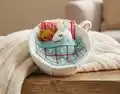
Bring the magic of Christmas Eve to life with this enchanting felt ornament featuring a sleepy little mouse tucked into a beautifully embroidered teacup. Complete with a tiny stuffed pillow, patchwork quilt, and an itty-bitty Teddy Bear, this heirloom-quality ornament is designed to spark a beloved family tradition. You'll work with wool felt, embroidery floss, sequins, seed beads, and pipe cleaners to craft every cozy detail by hand. Whether you choose a free-range, tethered, or permanently fixed mouse, this pattern gives you everything you need to create something truly special. Perfect as a heartfelt handmade gift or a treasured addition to your own holiday tree.
Progress Tracker
0% Complete
— Preparation :
Step 1 :
Review the resource page at mmmcrafts.blogspot.com/p/twas-night-ornament-series.html for helpful tips and supply links.
Step 2 :
Plan your felt colors: pastels, cream, or white work well for the teacup; white, gray, or tan for the mouse. Repeat embroidery accent colors between pieces for a cohesive look.
Step 3 :
Pre-shrink all wool or wool-blend felt by soaking each color separately in cold water until saturated. Do not wring — lay flat on towels and air dry completely. Do not use heat or agitation.
Step 4 :
Test sequins and seed beads for water safety: soak a few in water for 20 minutes. Discard any that fade, peel, or curl.
Step 5 :
Print all three pattern sheets at actual size (no scaling) on regular paper. Verify the bold reference line measures 4 inches. Then print Pattern Sheets 1 and 2 onto Sulky Stick 'n Stitch stabilizer.
— Pillow Front & Back :
Step 6 :
Rough cut the Pillow Front and Pillow Back from the stabilizer sheet. Peel the paper backing and adhere the stabilizer smoothly to pre-shrunk wool felt. Do not trim the outlines yet.
Step 7 :
Using 4 strands of contrasting floss and backstitch, embroider the five bolder lines on the Pillow Front. Stitch exactly on the lines, stopping short of the edges. Knot on the wrong side to begin; secure the end with three tiny shallow stitches on the wrong side within the outline.
Step 8 :
Using 2 strands of contrasting floss and backstitch, embroider the remaining thinner lines on the Pillow Front. You may use the same color or a different one.
Step 9 :
Using small sharp scissors, carefully cut out the Pillow Front and Pillow Back on the printed outlines. Set the Pillow Back aside. Do not soak the Pillow Back yet.
Step 10 :
Soak the embroidered Pillow Front face down in a bowl of cool water for approximately 20 minutes. Rinse face-up on your palm using a gentle faucet spray. Do not rub, pull, or stretch the wet felt. Soak longer if stabilizer is stubborn.
Step 11 :
Place the wet Pillow Front face up on a dry folded towel. Air dry completely while continuing with other pieces.
— Remaining Embroidered Pieces :
Step 12 :
Rough cut all remaining pattern pieces from Pattern Sheets 1 and 2. Adhere pieces labeled Peltex onto Pellon 70 Peltex stabilizer and set aside. Adhere all other pieces to your chosen colors of wool felt. Use the same felt color for all teacup pieces unless using a contrasting handle and foot.
Step 13 :
Using 4 strands of contrasting floss and backstitch, embroider the double lines on all eight panels of the Outer Cup.
Step 14 :
Using 4 strands of contrasting floss and running stitch, embroider the dashed line on all eight panels of the Outer Cup.
Step 15 :
Using 3 strands of contrasting floss and backstitch, embroider the sprigs on all seven panels (the handle panel has no sprig). Use a single stitch for the smallest branches. Optionally, use a different color for the top three branches of each sprig.
Step 16 :
Using metallic sewing thread, sew a sequin and seed bead combo on each circle on all panels. Use 4 mm or 5 mm sequins. Optionally use a 6–8 mm sequin for the flower at the top of each sprig, or layer two sizes. After each bead or sequin, take a tiny shallow stitch on the wrong side to keep them snug.
Step 17 :
Using 4 strands of contrasting floss and backstitch, embroider the decorative midlines on both Cup Handles and also the Cup Foot.
Step 18 :
Using 3 strands of contrasting floss and backstitch, embroider the year on the Foot Bottom. Use very small stitches for a neat result.
Step 19 :
Using 4 strands of contrasting floss and backstitch, embroider the crisscross lines on the Quilt, stopping just short of all edges.
Step 20 :
Using 4 strands of contrasting floss, French knots, and 5 mm clear or translucent sequins, attach sequins at the marked dots by coming up through each sequin and forming a French knot. Seed beads may be substituted for the knots.
Step 21 :
Using 3 strands of black floss and backstitch, embroider the eyes on Mouse Front and Mouse Back. Then using 1 strand only, add a single stitch for each eyelash.
Step 22 :
Using 3 strands of black floss, make French knots at the marked dots for Teddy Bear eyes.
Step 23 :
Using 2 strands of contrasting floss and single stitches, embroider Teddy's tiny nose with three or four horizontal stitches and his mouth with two single stitches.
Step 24 :
Carefully cut around the outlines of all embroidered wool felt pattern pieces. Do not soak them yet. Set aside all unembroidered pieces to cut later. Note: if the mouse will be permanently glued, trim off his legs at this step.
— Optional Year Tracing :
Step 5 (Optional) :
Use Pattern Sheet 3 and a fine tip permanent pen or sharp pencil to trace the desired year onto the Foot Bottom stabilizer using a light table or window. A name or initials may be substituted.
— Peltex Pieces :
Step 25 :
Carefully cut out all Peltex pieces around their printed outlines. Peel off the Sulky stabilizer. Set aside pieces needed for upcoming steps.
Step 26 :
Apply a thin coat of Fabri-Tac to the Peltex (not the felt) and glue one Peltex Handle to the wrong side of each felt Cup Handle, flush with the straight edges.
Step 27 :
Use Fabri-Tac to glue the Peltex Foot centered on the wrong side of the embroidered felt Cup Foot.
Step 28 :
Flip the Outer Cup to the wrong side and use Fabri-Tac to securely glue one Peltex Bottom Brace exactly in the center. Mark the center with permanent ink if needed for accuracy. Let dry completely.
— Soaking Embroidered Pieces :
Step 29 :
After all glue is completely dry, soak all embroidered pieces in plenty of water. Separate brights and darks from lights. Ensure Sulky is fully removed from under sequins when rinsing. Lay all pieces face up on a towel and air dry completely — usually several hours or overnight. Some stiffness after drying is normal.
— Unembroidered Pieces :
Step 30 :
While embroidered pieces dry, carefully cut out all remaining unembroidered wool felt pieces and gently peel off the Sulky. Keep tiny pieces in a safe location.
— Inner Cup :
Step 31 :
Using 2 strands of matching floss and whipstitch with a 2 mm seam allowance, sew the felt Inner Cup panels together with all visible knots and tails on the outside of the bowl (they will be hidden later). Bring two panels right sides together, sew from rim to center, then repeat for all seams to form a floppy bowl shape.
— Tether (Optional) :
Step 32 (Optional) :
If adding a tether, use an embroidery needle to pull 9 inches (23 cm) of knotted pink embroidery floss (all 6 strands) through a 5–8 mm sequin, then through the wrong side of the Inner Cup. Pull the knot and sequin snug against the felt.
— Peltex Cup Lining :
Step 33 :
Using doubled white sewing thread and whipstitch, sew the Peltex Cup Lining panels into a bowl shape using the same method as the Inner Cup. Knot placement does not matter on this hidden layer.
Step 34 :
Use Fabri-Tac to securely glue a Peltex Bottom Brace inside the bowl of the lining, centered with the points aligned with the seams. Press firmly against a flat surface and let dry completely.
— Mouse Arms :
Step 35 :
If your mouse will have arms, cut two 3/4 inch (2 cm) pieces of cotton pipe cleaner using wire snips or old scissors. Curve them slightly to match the arm pattern shape.
Step 36 :
Using 2 strands of matching floss and whipstitch, center one pipe cleaner piece on top of a mouse arm with a minimal smear of Tacky Glue. Place another arm piece on top with a minimal smear of glue to form a sandwich. Sew around all edges. Repeat for the second arm.
— Mouse Ears :
Step 37 :
Add a dot of Tacky Glue near the bottom of a Mouse Ear and fold it in half. Pin it into a pin cushion or stack of felt to hold while drying. Let dry completely. Repeat for the second ear.
— Outer Cup Assembly :
Step 38 :
Using 2 strands of matching floss and whipstitch, sew all eight Outer Cup panels together with all knots and tails kept on the inside of the bowl. Align the embroidery designs as you sew around all seams.
Step 39 :
Test the Peltex Cup Lining inside the Outer Cup with all seams aligned. Use gentle finger pressure to smooth the outer felt cup around the liner. The fit should be snug with at least 1/8 inch (3 mm) of felt showing above the liner rim evenly all around.
Step 40 :
Remove the liner and add Tacky Glue to the entire Peltex octagon at the cup bottom and up the center of the handle panel. Reinsert the liner with seams aligned, smoothing and pressing firmly against the bottom and handle panel. Let dry.
Step 41 :
Snip a 1 1/4 inch (3.2 cm) piece of pipe cleaner and trim it to be quite slender. This will reinforce the rim.
Step 42 :
Glue the pipe cleaner piece on the panel to the LEFT of the handle panel, right at the top of the Peltex liner. This reinforces the rim at the point where the hanging loop will be attached.
Step 43 :
Pop the felt Inner Cup inside with seams aligned and smooth it down into the bowl. The inner rim should be approximately even with the outer rim. Remove it, add Tacky Glue to the Peltex octagon at the bottom, reinsert with seams aligned, and press firmly down. Let dry.
Step 44 :
Using 2 strands of matching floss and whipstitch, hiding the starting knot between layers, neatly sew the outer and inner felt rims together all the way around, lining up all seams.
— Cup Handles :
Step 45 :
Use Fabri-Tac to glue just the Peltex layers of both Cup Handles together, sandwiching the double Peltex between the felt layers. Using 2 strands of matching floss and whipstitch, sew the felt margins tightly around the outside curve. Leave the straight edges (where handles attach to the cup) unsewn.
— Cup Foot :
Step 46 :
Using 2 strands of matching floss and whipstitch, glue the Cup Foot Back to the wrong side of the Cup Foot so Peltex is sandwiched between them. Trim the back if slightly too long. Sew the felt margins together all the way around.
Step 47 :
Fold the foot in half, align the straight edges, and sew them tightly together.
Step 48 :
Turn the assembled cup upside down on a flat surface. Press gently to level it. Use Fabri-Tac to glue the last Peltex Bottom Brace to the felt bottom of the teacup, aligning the octagon points with the cup seams, centered and level. Let dry.
Step 49 :
Round the Cup Foot with your fingers to make it roughly circular. Add a thin line of Fabri-Tac around all cut Peltex edges. With the seam centered on the handle panel, fit the smaller opening of the foot around the octagon and press firmly against the felt. Flip the cup over and press the foot flat to ensure the cup sits level. Let dry.
Step 50 :
Glue the Foot Bottom (with the embroidered year) inside the foot, hiding the Peltex. Orient the numbers so they face the panel next to the handle panel, ensuring the year reads correctly when the ornament is hung.
— Attaching the Handle :
Step 51 :
Align the handle ends with your fingers. Coat both raw ends with Fabri-Tac. Press the handle firmly in place on the cup, centered side to side, with the top end just below the rim. Hold firmly until the glue sets, then let dry completely.
— Pillow :
Step 52 :
Using 2 strands of matching floss and whipstitch, gently stretch the Pillow Front to match the back if needed. Align Pillow Front and Back wrong sides together. Sew around the edges, pausing to lightly stuff the pillow so it remains squashy. Sew the opening closed.
— Quilt :
Step 53 :
Using 2 strands of matching floss and whipstitch, attach the Quilt Edge aligned with the top edge of the Quilt using dots of Tacky Glue to position it first. Trim the edge if it is too wide. Sew around three sides.
— Teddy Bear :
Step 54 :
Using 2 strands of matching floss and whipstitch, align Teddy's front and back wrong sides together. Sew around the head, pausing to lightly stuff the head for dimension. Continue around the body, pausing after the legs to stuff the body (not the arms or legs). Finish sewing closed.
Step 55 :
Using 2 strands of matching floss, glue baste both Teddy Bear Ears in place on the back of his head using tiny dots of glue, then secure each ear with a few single stitches around the base.
— Mouse :
Step 56 :
Using 2 strands of matching floss and whipstitch, unskewer the dried mouse ears. Using the dashed guides on the pattern, glue baste the ears in place on both Mouse Front and Mouse Back with a dot of glue at the base of each. Sew only around the ear base to secure.
Step 57 :
Using 2 strands of matching floss and whipstitch, glue the mouse arms in place on the Front and Back using the dashed guides for placement. Attach with glue and stitches around the shoulder area only.
Step 58 :
Cut a 2 inch (5 cm) and a 2 1/2 inch (6.4 cm) piece of cotton pipe cleaner for mouse bones. Curve each to match the shapes shown in the pattern. Use Tacky Glue to attach them to the wrong side of the Mouse Back.
Step 59 (Optional — Tail) :
Using all 6 strands of pink embroidery floss, pull a few inches of knotted floss through a 5 mm sequin, then through the wrong side of the Mouse Back at the marked X. Add a drop of glue to secure the knot. Tie an overhand knot at approximately 1 1/2 inches (3.8 cm) from the body and trim the end neatly.
Step 60 (Tethered Mouse) :
If a tether was added in Step 32, attach the free end to the Mouse Back at the tail location. Pull it through a 5 mm sequin on the wrong side, add a knot at the end, trim neatly, and add a drop of glue to secure.
Step 61 :
Using 2 strands of matching floss and whipstitch, align Mouse Front and Back wrong sides together. Sew around the body, folding ears and arms out of the way. Pause to firmly stuff the mouse, getting filling into the nose and legs first with a dowel or stuffing fork, then stuffing the body. Sew the opening closed.
Step 62 :
Use a pink or red colored pencil to lightly color a small nose, rosy cheeks, and the inside of both ears.
— Final Assembly :
Step 63 :
Use either type of glue to securely attach the pillow to the panel next to the handle, centered with the pillow's top edge just above the cup rim. Let set.
Step 64 :
Apply a thin line of glue on the wrong side to secure just the left edge of the quilt approximately 1/2 inch (1.2 cm) down from the rim of the cup. Let dry completely.
Step 65 (Tethered or Free Range) :
Bend Mouse's legs up and curve his body so he nestles naturally into the curved bowl of the teacup.
Step 66 (Tethered) :
Glue or sew Teddy tucked into Mouse's left arm so he doesn't get separated.
Step 67 (Glued Option) :
To permanently fix mouse and Teddy, glue them side by side on the pillow with Mouse's chin over the quilt edge. Glue the remaining right quilt edge to the cup. The ornament assembly is now complete — skip ahead to the hanging loop.
Step 68 (Tethered or Free Range) :
Tuck Teddy into Mouse's left arm, then place both on the pillow with the mouse body angled into the bowl. Bunch the tether underneath if needed. Tuck the quilt under Mouse's chin and around his body. The natural texture of felt will keep them in place.
— Hanging Loop :
Step 69 :
Cut one 9 inch (23 cm) length of silver or gold pearl embroidery floss. Fold it in half and tie an overhand knot near the cut ends by looping it through itself. Trim the tail of the knot neatly and evenly.
Step 70 :
Thread a needle with doubled silver, gold, or matching sewing thread — no knot. Enter the teacup from a random spot below and exit through the rim at the center of the pillow panel, leaving a tail. Make a couple of small tight stitches on the spot, then sew the hanging loop on with several more neat stitches in the same spot. Do not sew through the loop floss — sew around it so the loop can slide to center the knot.
Step 71 :
Re-enter the cup at the loop spot and exit at another random spot further down. Pull both thread tails taut and carefully trim them so they disappear inside the cup.
Step 72 :
Recommended: apply a tiny drop of Fray Check on the loop attachment point and the overhand knot at the end of the loop to prevent raveling with regular use.
This little ornament holds more heart than you might expect from something that fits in the palm of your hand. Every stitch, every sequin, every tiny pipe cleaner arm is an act of love — and once it's finished and nestled on your tree, it has a way of making people stop and smile. Whether you're making it for yourself or gifting it to someone who still believes in a little Christmas magic, the Not Even a Mouse ornament is one of those projects you'll be proud of for years. Pick up your needle, brew something warm, and enjoy every slow, satisfying stitch. 🧵✨🎄