🧶 Beautiful ✨ Detailed 💝 Adorable

Floral Fairy House Crochet Pattern

Floral Fairy House Crochet Pattern
4.3★ Rating
15-20 Hours Time Needed
1.2K Made This
✂️

Advanced Level

Designed for experienced knitters, these patterns involve intricate designs and complex techniques to challenge and inspire.

⏱️

Slow & Steady

A 10-12 hour project—great for savoring the process over several sessions.

🏡

Cozy Accent

A warm touch for your space that transforms ordinary corners into inviting nooks filled with handmade charm.

About This Floral Fairy House Crochet Pattern

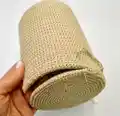
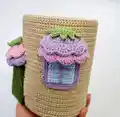
Floral Fairy House Crochet Pattern crochet pattern - detailed view of completed project

The pattern requires patience and attention to detail as you work with both traditional crochet techniques and innovative construction methods using fishing line for structure. The result is a durable, three-dimensional piece that stands beautifully on display.

Why You'll Love This Floral Fairy House Crochet Pattern

I absolutely love this pattern because it's unlike any typical crochet project—it's truly architectural art! The way the fishing line adds structure to the roof petals is genius, creating a firm yet delicate flower-like canopy. I adore how each window gets its own custom visor and how the door actually hinges open. The combination of construction techniques with decorative crochet makes this feel like you're building a real miniature house. The layered petal roof in gradient colors is simply breathtaking, and adding personalized touches like the balcony and climbing vines makes each house unique. This pattern challenges your skills while rewarding you with an absolutely magical finished piece.

Floral Fairy House Crochet Pattern step 1 - construction progress Floral Fairy House Crochet Pattern step 2 - assembly progress Floral Fairy House Crochet Pattern step 3 - details and accessories Floral Fairy House Crochet Pattern step 4 - final assembly and finishing

Switch Things Up

I love experimenting with different color palettes for this magical house! Instead of the traditional pastel shades, I've created versions with deep jewel tones—imagine a roof with emerald, sapphire, and amethyst petals cascading down like precious gemstones. The dramatic effect is absolutely stunning and gives the house a more mystical, enchanted forest vibe.

Another fun variation I've tried is adding small LED fairy lights inside the house before attaching the roof. I drilled tiny holes in the canvas behind the windows and carefully threaded battery-operated micro lights through, creating a warm glow that makes the house look truly inhabited. It transforms the piece into a functional night light that's perfect for a child's room or as ambient lighting.

I've also played with seasonal themes—a winter version with white and icy blue petals dusted with silver thread looks like it's covered in snow, while an autumn house with burnt orange, rust, and golden yellow petals captures the essence of fall perfectly. Adding tiny crocheted accessories like a miniature mailbox, a welcome mat, or even a small garden with flowers around the base personalizes each creation.

For those who want extra stability, I've experimented with adding a weighted base by incorporating small river stones or craft weights between the canvas layers of the bottom piece. This prevents the house from tipping if displayed on an uneven surface and makes it more durable for homes with curious pets or children.

Common Mistakes & How to Fix Them

✗ Skipping the plastic canvas reinforcement leads to a floppy structure that won't stand properly—always use the recommended canvas thickness ✗ Not securing the fishing line properly in the roof can cause petals to lose shape over time—make sure to burn and press ends carefully ✗ Crocheting the walls too loosely makes the fabric bubble when attached to canvas—maintain consistent tension throughout all wall sections ✗ Forgetting to mark rounds with contrast thread causes confusion when assembling pieces—use stitch markers religiously for accurate construction

Floral Fairy House Crochet Pattern

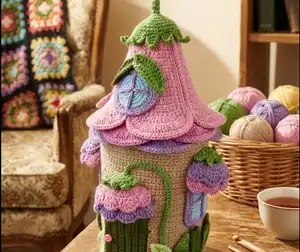
Transform yarn into an enchanting fairy dwelling with this magical Floral Fairy House pattern! Standing 29cm tall with an 11cm base, this whimsical creation features a charming door, adorable windows with visors, a delightful balcony, and a stunning petal roof that blooms like a flower. Perfect for home décor or as a special gift, this pattern combines structure and creativity to bring your fairy garden dreams to life. Each element is carefully designed to create a sturdy, beautiful piece that will become a cherished keepsake.

Advanced 15-20 Hours

Materials Needed for Floral Fairy House Crochet Pattern

— Main Fabric

  • 01
    Alize Cotton Gold Hobby yarn in colors 262 (beige, 3 skeins), 98, and 166
  • 02
    Yarn Art Jeans in colors 36, 11, 69, 82, 75 (choose pink, yellow, blue, or lilac shades in 3 different saturations)
  • 03
    Green yarn for leaves and sepals (various shades recommended)
  • 04
    1mm diameter fishing line (100-meter skein)

— Tools Required

  • 01
    2.25mm crochet hook (adjust based on personal tension)
  • 02
    Hard plastic canvas 26×33cm (1 sheet)
  • 03
    Scissors
  • 04
    Big-eyed needle for sewing
  • 05
    Lighter for melting fishing line ends
  • 06
    Hot glue gun with glue sticks
  • 07
    Stitch markers or contrast thread for marking rounds
  • 08
    Small button or bead for door handle

Progress Tracker

0% Complete

— House Bottom :

Round 1 :

6 sc in AR

Round 2 :

inc*6=12 sc

Round 3 :

(1 sc, inc)*6=18 sc

Round 4 :

1 sc, inc, (2 sc, inc)*5, 1 sc=24 sc

Round 5 :

(3 sc, inc)*6=30 sc

Round 6 :

2 sc, inc, (4 sc, inc)*5, 2 sc=36 sc

Round 7 :

(5 sc, inc)*6=42 sc

Round 8 :

3 sc, inc, (6 sc, inc)*5, 3 sc=48 sc

Round 9 :

(7 sc, inc)*6=54 sc

Round 10 :

4 sc, inc, (8 sc, inc)*5, 4 sc=60 sc

Round 11 :

(9 sc, inc)*6=66 sc

Round 12 :

5 sc, inc, (10 sc, inc)*5, 5 sc=72 sc

Round 13 :

(11 sc, inc)*6=78 sc

Round 14 :

6 sc, inc, (12 sc, inc)*5, 6 sc=84 sc

Round 15 :

(13 sc, inc)*6=90 sc

Info :

After the last increase, crochet another 1 sc and then 1 sl st. Leave a long end of the thread.

Info :

Cut a circle from the canvas with a diameter slightly smaller than crocheted. Sew the canvas to the circle with small stitches.

Info :

Crochet the second circle in the same way. Put 3 layers together and sew over the edge. Stitch several times through the center.

— House Walls :

Info :

Cut a strip along the entire length (33 cm) 15 cm wide from a sheet of canvas. Roll it into a cylinder.

Info :

Chain 91 and crochet back and forth rows 90 sc in a row. Crochet half the height of the canvas (21 rows).

Info :

Next crochet only from one side in a height of 38 sc to the end of the canvas. Cut the thread.

Info :

Skip 14 loops in the middle of the canvas and crochet from the other side also 38 sc to the end of the canvas.

Info :

Attach to the canvas and stitch with small stitches vertical lines at a distance of 1.5-2 cm from each other. On the short side of the canvas, retreat 3 cm on both sides.

Info :

Carefully cut out the door opening. Do not discard the cut piece.

Info :

Crochet the second piece for the outer side in the same way. Fold the wall with the plastic canvas outward and sew the edges end-to-end.

Info :

Cut a strip about 4 cm wide from the canvas and overlap the seam with it. Sew the strip on both sides through the crocheted fabric.

Info :

Sew the second piece outside. Better start from the door opening, sew over the edge. Then sew vertical seam on the back side.

Info :

Sew the top and the bottom sides over the edge. Sew the bottom to the wall.

— Roof Base :

Round 1 :

6 sc in AR

Info :

From the second round add a fishing line and crochet so that it is under the stitches. Burn the end of the fishing line with a lighter so that a ball forms at the end.

Round 2 :

inc*6=12 sc

Round 3 :

12 sc

Round 4 :

(1 sc, inc)*6=18 sc

Round 5 :

18 sc

Round 6 :

(2 sc, inc)*6=24 sc

Round 7 :

24 sc

Round 8 :

(3 sc, inc)*6=30 sc

Round 9 :

30 sc

Round 10 :

(4 sc, inc)*6=36 sc

Round 11 :

36 sc

Round 12 :

(5 sc, inc)*6=42 sc

Round 13 :

42 sc

Round 14 :

(6 sc, inc)*6=48 sc

Round 15 :

48 sc

Round 16 :

(7 sc, inc)*6=54 sc

Round 17 :

54 sc

Round 18 :

(8 sc, inc)*6=60 sc

Round 19 :

60 sc

Round 20 :

(9 sc, inc)*6=66 sc

Round 21 :

66 sc

Round 22 :

(10 sc, inc)*6=72 sc

Round 23 :

72 sc

Round 24 :

(11 sc, inc)*6=78 sc

Round 25 :

78 sc

Round 26 :

(12 sc, inc)*6=84 sc

Round 27 :

84 sc

Round 28 :

(13 sc, inc)*6=90 sc

Round 29 :

90 sc. Cut the fishing line leaving a short end.

Info :

Gently melt the end of the fishing line, protruding it from crocheting, and quickly press it to crocheting. Crochet a few more sc to close the line, finish with a sl st and cut the thread.

— Roof Petals :

Round 1 :

3 sc in AR. Adjust the ring and then crochet back and forth rows with turning ch.

Round 2-3 :

3 sc

Round 4 :

1 sc, inc, 1 sc=4 sc

Round 5-6 :

4 sc

Round 7 :

2 sc, inc, 1 sc=5 sc

Round 8-9 :

5 sc

Round 10 :

2 sc, inc, 2 sc=6 sc

Round 11-12 :

6 sc

Round 13 :

2 sc, inc, 3 sc=7 sc

Round 14-15 :

7 sc

Round 16 :

2 sc, inc, 4 sc=8 sc

Round 17-18 :

8 sc

Round 19 :

2 sc, inc, 5 sc=9 sc

Round 20-21 :

9 sc

Round 22 :

2 sc, inc, 6 sc=10 sc

Round 23-24 :

10 sc

Round 25 :

1 sc, 2 htr, (2 dc in every st)*4, 2 htr, 1 sc

Info :

Sc along the straight sides. Make 3 inc at the narrow end. Along the wide end: 2 ch, 2 dc in every st, (1 dc, 2 ch, sl st) in the last st. Cut the yarn.

Info :

Join yarn to the narrow end and sc around without inc adding a fishing line. Make 5 petals.

Info :

Crochet 5 more pieces of two other shades.

Info :

Fasten the petals to the base of the roof. Apply glue with a thin line in the center of the petals and glue one at a time. About the 25th row of petals should fall on the edge of the base.

Info :

Gently lift the edges of each petal and glue completely. Glue the second layer of petals in the same way, placing them a little higher and with an offset. Glue the third row.

— Roof Sepal :

Round 1-4 :

6 sc in AR, 3 rounds of 6 sc

Round 5 :

inc*6=12 sc

Round 6 :

(1 sc, inc)*6=18 sc

Round 7 :

(2 sc, inc)*6=24 sc

Round 8 :

(3 sc, inc)*6=30 sc

Round 9-10 :

2 rounds of 30 sc

Info :

Crochet an angle: 7 ch, 2 sl st, 1 sc, 1 htr, 2 dc, skip 2 st of the base, 1 sl st. Repeat around.

Info :

Put the sepal on the top of the roof and sew or glue. The roof is not attached to the house, it is simply put on top.

— Door :

Info :

Cut the door leaf so that it is 5 mm smaller than the opening in height and width.

Info :

With dark green yarn crochet a rectangle of such a size as to cover the door from 2 sides. The number of sc and rows will depend on your crocheting density.

Info :

Sew the door along 3 sides over the edge. Sew the door to the opening making a several stitches through the canvas in 2 points.

Info :

Sew a small button or a bead for doorknob.

— Door Visor (Lilac Layer) :

Round 1 :

6 sc in AR

Round 2 :

inc*6=12 sc

Round 3 :

(1 sc, inc)*6=18 sc

Round 4 :

(2 sc, inc)*6=24 sc

Round 5 :

(3 sc, inc)*6=30 sc

Round 6 :

(4 sc, inc)*6=36 sc

Round 7 :

(5 sc, inc)*6=42 sc

Round 8-9 :

2 rounds of 42 sc

Info :

Crochet shells along the edge: skip 1 st, 6 dc in 1 st, skip 1 st, 1 sc. Make 10 such shells. Since there are 42 sc in the circle, 2 st will be excess. In 2 places skip 2 st instead of one. Leave a long end.

Info :

Fold the part in half, aligning the shells, and glue inside, giving the shape of a dome. Sew over the edge with the end of the thread.

— Door Visor (Pink Layer) :

Round 1 :

3 sc in AR. Then crochet back and forth rows with a turning ch, not spiral rounds.

Round 2 :

inc*3=6 sc

Round 3 :

(1 sc, inc)*3=9 sc

Round 4 :

(2 sc, inc)*3=12 sc

Round 5 :

(3 sc, inc)*3=15 sc

Round 6 :

(4 sc, inc)*3=18 sc

Round 7 :

(5 sc, inc)*3=21 sc

Info :

Crochet 5 shells of 5 dc. Skip 2 st before the first shell instead of 1, because 1 st will be excess.

Info :

Apply glue to the fold of the lilac visor and glue it over the door. Do not fasten too low so that the visor does not interfere with the opening of the door. Additionally sew the visor to the wall.

Info :

Glue the pink layer over the lilac one.

— Door Visor Sepal :

Round 1 :

3 sc in AR. Then crochet back and forth rows with a turning ch.

Round 2 :

inc*3=6 sc

Round 3 :

(1 sc, inc)*3=9 sc

Info :

Crochet angles: 4 ch, 1 sl st, 2 sc down the chain, sl st in the next st. Make total 5 angles.

Info :

Glue the sepal to the visor.

— Windows :

Info :

Crochet a rectangle 10 sc wide and 12 rows high with light blue yarn.

Info :

Join lilac yarn and sl st around all 4 sides.

Info :

Now sc around inserting hook into the lilac sl st. Crochet 3 sc in 1 st in corners. Sl st around, leave a long end.

Info :

Embroider an inner cross frame with the end of the yarn.

Info :

Glue the window on the wall, stepping 10 rows from the top edge of the wall.

Info :

Make the window visor in the same way as for the door, just change the colors.

Info :

Make 2 more windows with different frame colors. Place the second window symmetrically to the first one relative to the door, and the third on the back of the house.

— Balcony :

Round 1 :

7 sc in AR

Round 2 :

inc*7=14 sc

Round 3 :

(1 sc, inc)*7=21 sc

Round 4 :

(2 sc, inc)*7=28 sc

Round 5 :

(3 sc, inc)*7=35 sc

Round 6 :

(4 sc, inc)*7=42 sc

Round 7 :

(5 sc, inc)*7=49 sc. Leave a long end.

Info :

If you fold this circle in half, it will not be an even semicircle, but slightly curved, like a crescent moon. Cut out such a detail from the canvas.

Info :

Put the canvas inside and sew over the edge.

Balcony Side :

Crochet a strip 25 sc wide and 8 rows high. Leave a long end. Cut a half-height strip from the canvas.

Info :

Fold and sew over the edge. Sew the side to the bottom of the balcony.

Info :

Glue and additionally sew the balcony under the back window.

— Leaves :

Info :

Chain 15. First 3 loops: 1 sl st, 1 sc, 1 htr.

Info :

Then crochet dc, leaving 3 loops in the end of the chain. Last 3 loops: 1 htr, 1 sc, 1 sl st.

Info :

Make 1 turning ch and crochet in the same way along the bottom side of the chain. Cut and fix the ends.

Info :

Crochet such leaves of different lengths from 10 to 15 ch. All are crocheted in the same way, except for the number of dc in the middle of the leaf. Leaves can be crocheted in 3 different shades.

Stem :

Chain 50, sl st along the chain.

Info :

Glue the curved stem to the door visor. Apply glue in small areas, as the glue hardens quickly.

Info :

Glue the leaves in random order along the bottom of the house.

— Attic Window :

Round 1 :

6 sc in AR

Round 2 :

inc*6=12 sc

Round 3 :

(1 sc, inc)*6=18 sc

Round 4 :

1 sc, inc, (2 sc, inc)*5, 1 sc=24 sc

Round 5 :

(3 sc, inc)*6=30 sc, finish with sl st, fasten off.

Info :

Join lilac yarn and sl st around.

Info :

Crochet through lilac sl st: (4 sc, inc)*6. Sl st around. Leave a long end.

Info :

Embroider an inner cross frame with the end of the yarn.

Info :

Glue the window to the roof. Glue 2 leaves over the window instead of visor.

Assembly Instructions

  • Cut two circles from plastic canvas slightly smaller than the crocheted bottom pieces, sew canvas to crocheted circles, then layer all three pieces together and sew firmly around edges.
  • Roll the 33cm × 15cm canvas strip into a cylinder matching your bottom diameter, crochet wall pieces to fit, and attach them to the canvas with vertical stitching lines every 1.5-2cm.
  • Cut out the door opening carefully from the wall, sew both inner and outer wall pieces to the canvas, then join edges end-to-end and reinforce the seam with a 4cm canvas strip.
  • Attach the completed bottom to the wall structure by sewing around the edge through the crocheted fabric only, without grabbing the internal canvas.
  • Create roof petals in three shades (5 petals per shade), attach them to the fishing line-reinforced base using hot glue in layers with offset placement for dimensional effect.
  • Glue the lilac door visor dome over the door at proper height, attach the pink decorative layer on top, then add the green sepal embellishment.
  • Attach all three windows to the walls at appropriate spacing, embroider cross frames, add color-coordinated visors, and glue the balcony platform under the back window.

Important Notes

  • 💡Use a marking thread in contrast color throughout the project to track round beginnings and endings for accurate construction
  • 💡Maintain consistent tension when crocheting walls to prevent bubbling when attaching to plastic canvas framework
  • 💡Always burn the fishing line ends with a lighter to create a secure ball at the start and melted seal at the finish
  • 💡Hot glue is essential for structural integrity even if you prefer sewing—it adds rigidity and durability to the house
  • 💡The roof sits on top of the house without attachment, allowing easy access to the interior for display purposes
  • 💡When gluing petals to the roof base, work with one petal at a time and apply glue in thin lines to prevent messy overflow
  • 💡Cut the door leaf 5mm smaller than the opening in both height and width to ensure smooth opening and closing functionality

This enchanting Floral Fairy House pattern was designed to bring magical woodland charm into your home through the art of crochet! Combining architectural construction techniques with delicate decorative elements, this pattern transforms yarn and canvas into a sturdy, three-dimensional dwelling worthy of any fairy resident. The layered petal roof creates a stunning flower-like canopy, while charming details like working doors, window visors, and climbing vines add whimsical character. Perfect as a decorative centerpiece, a special gift, or a creative challenge for experienced crocheters looking to expand their skills beyond traditional projects. 🧶 Happy crocheting! 🏡✨

You ask,

we answer.

FAQs

What makes this pattern different from regular amigurumi projects?

This pattern uses hard plastic canvas as a structural framework covered with crocheted fabric, creating a true three-dimensional architectural piece rather than a stuffed toy. The fishing line reinforcement in the roof petals provides firm structure, and the combination of construction and decorative techniques makes this more like building a miniature house than typical crochet projects.

Can I use different colors than the ones specified in the pattern?

Absolutely! The pattern recommends choosing pink, yellow, blue, or lilac for the roof petals in three different saturations, but you can select any color family you prefer. Just maintain the gradient effect by choosing three shades of the same color with different intensities. The beige walls and green accents can also be customized to your preference.

How do I ensure the fishing line stays secure in the roof?

Start by burning the end of the fishing line with a lighter to create a small ball that prevents it from slipping through stitches. Crochet with the line positioned under your stitches from round 2 onward. When finishing, gently melt the protruding end and quickly press it against the yarn to create a secure bond before crocheting a few more stitches over it.

What if my canvas cylinder diameter doesn't match the crocheted bottom?

If the cylinder is slightly larger, trim the excess canvas carefully. If there's about 3cm overlap, leave it as is—you'll cover it with additional canvas strips during assembly. If the diameter is too small, leave it and plan to cover gaps with extra strips when attaching the wall pieces.

Do I need to make all three windows, or can I modify the design?

You can customize the window placement and quantity to suit your vision! The pattern includes three windows (two on sides, one on back) with a balcony under the back window, but you can add more, reduce the number, or change their positions. Just maintain structural integrity when cutting openings in the canvas.

How do I prevent the crocheted walls from bubbling when attached to canvas?

The key is maintaining consistent, firm tension throughout your wall pieces and attaching them with small vertical stitching lines spaced 1.5-2cm apart. The bubbling occurs because the inner diameter is naturally smaller than the outer, so proper stitching technique distributes the fabric evenly across the canvas surface.