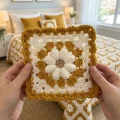
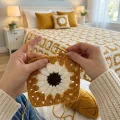
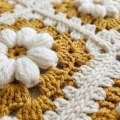
🧶 Beautiful ✨ Detailed 💝 Adorable

Crochet Mustard and White Daisy Granny Square Blanket Pattern

Crochet Mustard and White Daisy Granny Square Blanket Pattern
3.9★Rating
10-15 HoursTime Needed
1.5KMade This
✂️

Intermediate Level

Ideal for those with basic crocheting experience, featuring slightly more advanced stitches and techniques to expand your skills.

⏱️

Slow & Steady

A 10-12 hour project—great for savoring the process over several sessions.

🏡

Cozy Accent

A warm touch for your space that transforms ordinary corners into inviting nooks filled with handmade charm.

About This Crochet Mustard and White Daisy Granny Square Blanket Pattern

Crochet Mustard and White Daisy Granny Square Blanket Pattern crochet pattern - detailed view

Wrap it up as a housewarming or wedding gift, or keep it for your own guest room. It makes a bed feel bright and welcoming, and the squares are easy to make a few at a time.

Why You'll Love This Crochet Mustard and White Daisy Granny Square Blanket Pattern

I love how forgiving these squares are. There are only six rounds and just two color swaps, and the little daisy still makes me grin every single time I finish one. They’re perfect for odd moments, like waiting rooms and TV evenings, and I never get bored because each block comes out with its own tiny personality once the petals settle into place.

Crochet Mustard and White Daisy Granny Square Blanket Pattern step 1 Crochet Mustard and White Daisy Granny Square Blanket Pattern step 2 Crochet Mustard and White Daisy Granny Square Blanket Pattern step 3 Crochet Mustard and White Daisy Granny Square Blanket Pattern step 4

Switch Things Up

I made my first sunny-yellow blanket in the middle of a gloomy January, and I swear it changed my mood before it was even half done. Mustard and white is a combination I’d been nervous about, worried it would look dated, but once those little daisies started piling up on my lap I couldn’t stop smiling.

Here’s what I learned along the way. Make all your flower centers first, maybe ten at a time, then add the mustard rounds, and finish with the white frame. It keeps you in a rhythm and stops you from constantly swapping skeins. Pull the petals gently forward as you go so they sit proud of the mustard ring instead of hiding behind it.

When I reach the joining stage, I lay the squares out on the floor and walk around them with a cup of tea. Moving a few around so any slightly darker or lighter squares don’t clump together takes five minutes and saves me a lot of squinting later.

If you fancy another mood, try a dusty rose center with a soft grey frame, or deep teal with cream. The daisy shape works in nearly any pair of colors.

Common Mistakes & How to Fix Them

✗ Working the petal round into both loops instead of the front loops only leaves nothing for the mustard round to grow from, so keep the back loops free and work Round 2 in FLO only.✗ In Round 3 it’s easy to work into the petals by accident, which hides the daisy and throws off the 32 dc count, so push the petals forward and work only into the back loops of Round 1.✗ The corners in Round 4 fall every 8 stitches, and a single miscount turns the square into a lopsided diamond, so drop a stitch marker into each ch2 corner space as you work.✗ A tight joining seam puckers the squares and bows the edges of the whole blanket, so switch to a hook one size larger for the white slip stitch seams and keep them loose.✗ If the border Round 1 stitch count doesn’t match the totals given, the final scallop in Round 3 will land awkwardly, so count your sc along each edge before you start Round 2.✗ Forgetting to sc into the joined corner spaces at each seam in border Round 1 makes the edge ripple, so make exactly one sc at every seam, including where four corners meet.

Crochet Mustard and White Daisy Granny Square Blanket Pattern

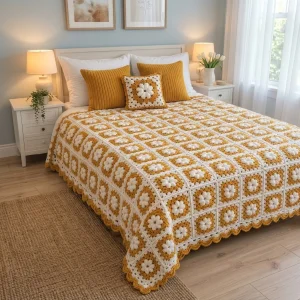
Imagine a bed dressed in rows of cheerful white daisies, each one sitting inside a golden mustard ring and framed in crisp white. You’ll make the blocks one at a time, so this is a project you can pick up for twenty minutes or a whole evening. Once the squares are joined with neat white seams, a rippling mustard scalloped border pulls everything together. The finished bedspread has a sunny, farmhouse feel that suits a double or queen bed.

Intermediate 10-15 Hours

Materials Needed for Crochet Mustard and White Daisy Granny Square Blanket Pattern

— Main Fabric

  • 01
    Approximately 1,900 g of worsted weight cotton or cotton blend yarn in bright white for the daisy centers, two frame rounds, joining seams, and the first border round
  • 02
    Approximately 1,350 g of worsted weight cotton or cotton blend yarn in golden mustard for the ring around each daisy, the second border round, and the scalloped edge

— Tools Required

  • 01
    4.5 mm crochet hook (approximately, adjust to reach an 18 cm square)
  • 02
    5 mm crochet hook for working the joining seams loosely (optional)
  • 03
    Tapestry needle for weaving in ends
  • 04
    Sharp scissors
  • 05
    Stitch markers for marking corners
  • 06
    Blocking mats and rust-proof pins
  • 07
    Measuring tape
  • 08
    Spray bottle for wet blocking

Progress Tracker

0% Complete

— 1. Daisy Square (make 90) :

Info :

Each square measures approximately 18 cm (7 in) across with worsted cotton and a 4.5 mm hook. The finished blanket is approximately 168 x 186 cm (66 x 73 in), made from 90 squares set 9 across and 10 down, including the border. The ch3 at the start of a round counts as a dc. Work every round with the right side facing you and do not turn.

Round 1 :

With white, make an MR, ch1, work 16 sc in the ring, join with sl st to first sc and pull the ring closed (16)

Round 2 :

Working in FLO only and starting in the first sc, (sl st, ch2, 3 dc, ch2, sl st) in FLO of next st, sl st in FLO of next st, repeat from * to * 8 times (8 petals). Fasten off white. Push the petals forward, away from the unworked back loops.

Round 3 :

Join mustard with a sl st in the BLO of any Round 1 sc, ch3, dc in the same loop, 2 dc in the BLO of each remaining Round 1 st around, join with sl st to top of beginning ch3 (32 dc)

Round 4 :

ch3 (counts as first dc, worked in the same st as the join), dc in each of next 6 sts, (dc, ch2, dc) in next st, dc in each of next 7 sts, (dc, ch2, dc) in next st, repeat from * to * 2 more times, join with sl st to top of beginning ch3 (36 dc and 4 ch2 corner sps, 9 dc per side). Fasten off mustard.

Round 5 :

Join white in any ch2 corner sp, ch3, 2 dc in same sp, ch2, 3 dc in same sp, dc in each of next 9 dc, (3 dc, ch2, 3 dc) in next ch2 sp, repeat from * to * 3 more times, dc in each of next 9 dc, join with sl st to top of beginning ch3 (60 dc and 4 ch2 corner sps, 15 dc per side)

Round 6 :

sl st in each of next 2 dc and in the next ch2 corner sp, ch3, 2 dc in same sp, ch2, 3 dc in same sp, dc in each of next 15 dc, (3 dc, ch2, 3 dc) in next ch2 sp, repeat from * to * 3 more times, dc in each of next 15 dc, join with sl st to top of beginning ch3 (84 dc and 4 ch2 corner sps, 21 dc per side between corner sps). Fasten off and weave in ends.

— 2. Joining the Squares :

Info :

Lay out the squares 9 across and 10 down, all facing the same direction. Each side of a square has a ch2 corner sp at each end with 21 dc between them. Join with white yarn and a loose tension, going up a hook size if needed.

Join Rows :

Hold two squares with wrong sides together and corner sps matching. Join white in the corner ch2 sps of both squares, then sl st through the BLO of both squares in each of the next 21 dc, ending with a sl st in the next pair of corner ch2 sps. Add each new square the same way until you have a row of 9 squares (8 seams). Make 10 rows.

Join Strips :

With wrong sides together, join row to row the same way along all 9 squares of the row, working 21 sl sts between corner sps. Where four corners meet, sl st once through all four corner ch2 sps, then carry on. Add each row in turn until all 10 rows are joined (9 seams). Fasten off and weave in ends.

— 3. Scalloped Border :

Info :

The 9 and 10 square counts below match this blanket. To resize, use a as the number of squares across and b as the number of squares down. Round 1 totals 44 x (a + b) + 8 sc, and Round 3 makes 11 x (a + b) + 2 scallops.

Round 1 :

Join white with a sl st in any outer corner ch2 sp, ch1, 3 sc in the same sp. sc in each of next 21 dc, sc once in the joined corner sps at the seam, repeat across the edge, ending with sc in each of the last 21 dc, then 3 sc in the next outer corner sp. Work all four edges the same way (197 sc on each 9-square edge, 219 sc on each 10-square edge, plus 3 sc in each of the 4 corners). Join with sl st to first sc (844 sc). Fasten off white.

Round 2 :

Join mustard with a sl st in any st, ch1, sc in the same st and in each st around, join with sl st to first sc (844 sc)

Round 3 :

ch1, sk 1 st, 5 dc in next st, sk 1 st, sl st in next st, repeat from * to * all the way around, ending with the final sl st in the joining st (211 scallops). Fasten off and weave in the end.

Assembly Instructions

  • Weave in every tail on the wrong side of each square before joining, running white tails through the white dc and mustard tails through the mustard dc for at least 4 stitches.
  • Wet block all 90 squares to 18 cm (7 in), pinning each one flat so the 4 corners are square and the daisy petals lie forward over the mustard round.
  • Lay the squares out on the floor in 10 rows of 9, with every daisy facing the same way, and shuffle any slightly lighter or darker squares so they don’t clump together.
  • Join each row of 9 squares with white sl sts through the back loops, wrong sides together, working 21 sl sts between the corner spaces on every seam.
  • Join the 10 rows together the same way, sl st through all four corner spaces where the corners meet so the junctions stay flat and tidy.
  • Work border Round 1 in white, Round 2 in mustard, and Round 3 scallops, placing 3 sc in each outer corner space so the corners lie flat.
  • Weave in the remaining ends, then wet block the finished blanket to approximately 168 x 186 cm (66 x 73 in), pinning each scallop out so the edge lies smooth.

Important Notes

  • 💡Make a test square first and measure it, because a loose or tight tension changes the size of all 90 squares and the border totals.
  • 💡Hold the petals forward with your thumb while you work Round 3, and your mustard ring will form neatly behind the daisy instead of covering it.
  • 💡Use the same dye lot of white and mustard for the entire blanket, since a slight color shift shows up clearly across the grid once the squares are joined.
  • 💡Mark the first corner of every square with a stitch marker when you block, so you lay them all out in the same orientation.
  • 💡Keep your joining tension a little looser than your normal crochet tension, since tight seams pull the blanket into bowed edges.
  • 💡Count your sc along each edge before starting border Round 2, and fix any difference now so the scallops fit exactly.

Every little daisy you finish brings you one square closer to a blanket worth wrapping up in. 🧶 Keep a bag of yarn by the sofa, stitch a block or two whenever you have a free half hour, and watch the pile grow. Soon you’ll be laying them out across the floor, joining the seams, and finishing that scalloped edge. Then comes the best bit: spreading it over the bed and stepping back to admire your work. ✨ Enjoy every stitch, and happy crocheting!

You ask,

we answer.

FAQs

Can I use a different yarn weight for this blanket?

You can, but the squares were designed around worsted weight cotton and a 4.5 mm hook. DK yarn makes smaller squares, so you would need more of them to cover the bed, and bulky yarn makes bigger ones. Make one test square, measure it, and recalculate the number of squares and the border totals.

How many squares do I need for a throw or twin size?

A throw of roughly 108 x 126 cm (43 x 50 in) uses 6 squares across and 7 down, so 42 squares in total. A twin of roughly 126 x 180 cm (50 x 71 in) uses 7 across and 10 down. For the border, use 44 x (squares across + squares down) + 8 sc in Round 1.

How much yarn does one square use?

Roughly 18 g of white and 12 g of mustard per square, including your share of the seams. The border takes about 250 g of each color on top of that, so buy a little extra of both.

Do I join the squares as I go or at the end?

This pattern joins everything at the end with slip stitches through the back loops. You can block every square first and lay the daisies out before you commit to a seam.

My daisy petals hide behind the mustard ring. What’s going wrong?

The petals only sit forward if Round 2 is worked in the front loops only and Round 3 goes into the back loops of Round 1. Push the petals toward you as you work Round 3, and the mustard ring will stay behind them.

Why do my squares curl or come out different sizes?

Uneven corner chains and changing tension between rounds are the usual causes. Keep every ch2 corner the same size and block each square to 18 cm (7 in) before you join them.