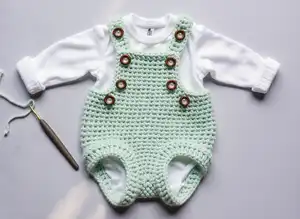
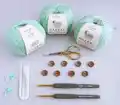
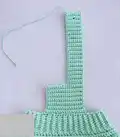
Create an adorable handmade baby romper with this detailed crochet pattern! Perfect for newborns through 12 months, this charming one-piece features a classic bib-style design with button closures and adjustable straps. The pattern uses soft sport-weight cotton yarn worked in simple single crochet stitches, making it comfortable for delicate baby skin. With ribbed borders and customizable sizing, you'll craft a timeless piece that combines vintage charm with modern functionality. This versatile romper works beautifully as a photo prop, special occasion outfit, or everyday wear for your little one.
Progress Tracker
0% Complete
— Bib Part :
Note :
At the end of each row, the Ch1 made does not count as a stitch
Row 1 :
ch27(29, 31, 33, 35) sc into the 2nd ch from your hook. Sc into each chain, ch1 and turn. =26(28, 30, 32, 34)sts
Row 2 :
sc into each stitch, ch1 and turn. =26(28, 30, 32, 34)sts
Row 3 (inc) :
sc in the next 6sts, 2sc into the next st, sc in the next 12(14, 16, 18, 20)sts, 2sc into the next st, sc in the next 6st, ch1 and turn. =28(30, 32, 34, 36)sts
Rows 4-5 :
sc into each stitch, ch1 and turn. =28(30, 32, 34, 36)sts
Row 6 (inc) :
sc in the next 6sts, 2sc into the next st, sc in the next 14(16,18, 20, 22)sts, 2sc into the next st, sc in the next 6sts, ch1 and turn. =30(32,34, 36, 38)sts
For size 6-9m, 9-12m only :
Continue increasing as follows
Rows 7-8 :
sc into each stitch, ch1 and turn. =36(38)sts
Row 9 (inc) :
sc in the next 6sts, 2sc into the next st, sc in the next 22(24)sts, 2sc into the next st, sc in the next 6sts, ch1 and turn. =38(40)sts
For newborn size :
Rows 7-19: sc into each stitch, ch1 and turn. =30sts
For size 0-3m, 3-6m :
Rows 7-21: sc into each stitch, ch1 and turn. =32,34sts
For size 6-9m :
Rows 10-26: sc into each stitch, ch1 and turn. =38sts
For size 9-12m :
Rows 10-29: sc into each stitch, ch1 and turn. =40sts
— Front Part with Button Holes :
Note :
In rows 20(22, 22, 27, 30), 28(31,31,36, 39), 36(40,40,45, 48) - that is, after every 7(8,8,8,8) rows make two holes for buttons
For newborn size Row 20 :
sc in the next 3sts, 2ch, skip 2sts, sc in the next 20sts, 2ch, skip 2sts, sc in the next 3sts, ch1 and turn. =30sts
Rows 21-27 :
sc into each stitch, ch1 and turn. =30sts
Row 28 (holes) :
repeat Row 20
Rows 29-35 :
sc into each stitch, ch1 and turn. =30sts
Row 36 (holes) :
repeat Row 20
Rows 37-42 :
sc into each stitch, ch1 and turn. =30sts
For size 0-3m, 3-6m Row 22 (holes) :
sc in the next 3sts, 2ch, skip 2sts, sc in the next 22,24, sts, 2ch, skip 2sts, sc in the next 3sts, ch1 and turn. =32,34sts
Rows 23-30 :
sc into each stitch, ch1 and turn. =32,34sts
Row 31 (holes) :
repeat Row 22
Rows 32-39 :
sc into each stitch, ch1 and turn. =32,34sts
Row 40 (holes) :
repeat Row 22
For size 0-3m Rows 41-47 :
sc into each stitch, ch1 and turn. =32sts
For size 3-6m Rows 41-49 :
sc into each stitch, ch1 and turn. =34sts
For size 6-9m Row 27 (holes) :
sc in the next 3sts, 2ch, skip 2sts, sc in the next 28 sts, 2ch, skip 2sts, sc in the next 3sts, ch1 and turn. =38sts
Rows 28-35 :
sc into each stitch, ch1 and turn. =38sts
Row 36 (holes) :
repeat Row 27
Rows 37-44 :
sc into each stitch, ch1 and turn. =38sts
Row 45 (holes) :
repeat Row 27
Rows 46-54 :
sc into each stitch, ch1 and turn. =38sts
For size 9-12m Row 30 (holes) :
sc in the next 3sts, 2ch, skip 2sts, sc in the next 30 sts, 2ch, skip 2sts, sc in the next 3sts, ch1 and turn. =40sts
Rows 31-38 :
sc into each stitch, ch1 and turn. =40sts
Row 39 (holes) :
repeat Row 30
Rows 40-47 :
sc into each stitch, ch1 and turn. =40sts
Row 48 (holes) :
repeat Row 30
Rows 49-60 :
sc into each stitch, ch1 and turn. =40sts
— Front Part with Decrease Stitches :
Note :
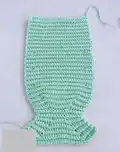
Now start decreasing the stitches to form the leg openings
Row with decreases :
sc in the next 6sts, sc2tog, work sc into each stitch along the row until you have 8sts remaining and then sc2tog, sc in the next 6sts, ch1 and turn
For newborn size :
Decrease 12 stitches evenly: 2 stitches in each row 6 times
Rows 43-48 :
repeat row with decreases until 18sts are left
Row 49-51 :
sc into each stitch, ch1 and turn. =18sts
For size 0-3m :
Decrease 14 stitches evenly: 2 stitches in each row 7 times
Rows 48-54 :
repeat row with decreases until 18sts are left
Row 55-56 :
sc into each stitch, ch1 and turn. =18sts
For size 3-6m :
Decrease 16 stitches evenly: 2 stitches in each row 8 times
Rows 50-57 :
repeat row with decreases until 18sts are left
Row 58-60 :
sc into each stitch, ch1 and turn. =18sts
For size 6-9m :
Decrease 16 stitches evenly: 2 stitches in each row 8 times
Rows 55-62 :
repeat row with decreases until 22sts are left
Row 63-65 :
sc into each stitch, ch1 and turn. =22sts
For size 9-12m :
Decrease 18 stitches evenly: 2 stitches in each row 9 times
Rows 61-69 :
repeat row with decreases until 22sts are left
Row 70-72 :
sc into each stitch, ch1 and turn. =22sts
— Front Part with Increase Stitches :
Row with increase :
sc in the next 6sts, 2 sc in the next st, work sc into each stitch along the row until you have 7 sts remaining, 2 sc in next st, sc in next 6sts, ch1 and turn
For newborn size Rows 52-60 :
repeat row with increase for the front until there are 36 stitches. Total of 60 rows completed, measuring 23 cm (9 inches)
For size 0-3m Rows 57-65 :
repeat row with increase for the front until there are 36 stitches. Total of 65 rows completed, measuring 25 cm (10 inches)
For size 3-6m Rows 61-70 :
repeat row with increase for the front until there are 38 stitches. Total of 70 rows completed, measuring 27 cm (11 inches)
For size 6-9m Rows 66-75 :
repeat row with increase for the front until there are 42 stitches. Total of 75 rows completed, measuring 29 cm (12 inches)
For size 9-12m Rows 73-85 :
repeat row with increase for the front until there are 48 stitches. Total of 85 rows completed, measuring 33 cm (13 inches)
— Back Part :
Note :
For the back part, continue to increase 2 sts each row till the number obtain 76(88, 92, 92, 98)sts
For newborn size :
work Rows 61-80 (inc). Next Rows 81-92: sc into each stitch, ch1 and turn. =76sts
For size 0-3m :
work Rows 66-91(inc). Next Rows 92-100: sc into each stitch, ch1 and turn. =88sts
For size 3-6m :
work Rows 71-97(inc). Next Rows 98-110: sc into each stitch, ch1 and turn. =92sts
For size 6-9m :
work Rows 76-100(inc). Next Rows 101-115: sc into each stitch, ch1 and turn. =92sts
For size 9-12m :
work Rows 86-110(inc). Next Rows 111-134: sc into each stitch, ch1 and turn. =98sts
Then :
evenly decrease 10(8, 10, 8, 10) stitches in every second row twice
For newborn size Row 93 (dec) :
sc in the next 10 sts, repeat (sc2tog, sc in next 4sts) 9 more times, sc2tog, sc in the next 10 sts, ch1 and turn. =66 sts
Row 94 :
sc into each stitch, ch1 and turn. =66sts
Row 95 (dec) :
sc in the next 10 sts, repeat (sc2tog, sc in next 3sts) 9 more times, sc2tog, sc in the next 9 sts, ch1 and turn. =56 sts
Row 96 :
sc into each stitch, ch1 and turn. Total 96 rows worked. Do not fasten off
For size 0-3m Row 101 (dec) :
sc in the next 8 sts, repeat (sc2tog, sc in next 8sts) 8 more times, ch1 and turn. =80sts
Row 102 :
sc into each stitch, ch1 and turn. =80sts
Row 103 (dec) :
sc in the next 8 sts, repeat (sc2tog, sc in next 7sts) 8 more times, ch1 and turn. =72sts
Row 104 :
sc into each stitch, ch1 and turn. Total 104 rows worked. Do not fasten off
For size 3-6m Row 111 (dec) :
sc in the next 9 sts, repeat (sc2tog, sc in next 6sts) 9 more times, sc2tog, sc in the next 9 sts, ch1 and turn. =82 sts
Row 112 :
sc into each stitch, ch1 and turn. =82sts
Row 113 (dec) :
sc in the next 9 sts, repeat (sc2tog, sc in next 5sts) 9 more times, sc2tog, sc in the next 8 sts ch1 and turn. =72 sts
Row 114 :
sc into each stitch, ch1 and turn. Total 114 rows worked. Do not fasten off
For size 6-9m Row 116 (dec) :
sc in the next 10 sts, repeat (sc2tog, sc in next 8sts) 7 more times, sc2tog, sc in the next 10 sts, ch1 and turn. =84 sts
Row 117 :
sc into each stitch, ch1 and turn. =84sts
Row 118 (dec) :
sc in the next 10 sts, repeat (sc2tog, sc in next 7sts) 7 more times, sc2tog, sc in the next 9 sts ch1 and turn. =76 sts
Row 119 :
sc into each stitch, ch1 and turn. Total 119 rows worked. Do not fasten off
For size 9-12m Row 135 (dec) :
sc in the next 7 sts, repeat (sc2tog, sc in next 8sts) 9 more times, ch1 and turn. =88 sts
Row 136 :
sc into each stitch, ch1 and turn. =88sts. Do not fasten off
— Ribbed Border :
Note :
Work with the hook of smaller size - 3mm
Row 1 :
ch9, into the 2nd chain from your hook, sc into each chain. Join to the back with a sl st stitch: do sl st in the next 2 sts, turn without ch
Row 2 :
skip two sl st, sc in the next 8 sts, ch1 and turn
Row 3 :
sc into each chain. Join to the back with a sl st stitch: do sl st in the next 2 sts, turn without ch
Repeat :
Row 2 and 3 until you work 56(72, 72, 76, 88) rows
Finishing :
Fasten off. You could leave your yarn longer to use it when sewing on a button on this side
— Straps :
Note :
Use the smaller hook 3mm again to make the straps tighter than the main pattern
Preparation :
Count the central 17(17, 17, 21, 21)sts on the back and mark it with stitch markers. One row counts as one stitch
Row 1 :
join with a sl st to the first marked st, ch1, sc in each of next 17(17, 17, 21, 21)sts, ch1 and turn. =17(17, 17, 21, 21)sts
Row 2 :
sc in each stitch, ch1 and turn. =17(17,17,21, 21)sts
Repeat :
Row 2 until you work 14(14, 16 ,20, 22) rows. Do not fasten off
Continue :
Continue to work one of the narrower straps
Row 1 :
sc in each stitch, ch1 and turn. =8sts
Repeat :
Row 1 until you work 33(41, 38, 41, 45) rows
In Row 34(42, 39, 42, 46) make button holes :
sc in the next 3 sts, ch2, skip 2sts, sc in next 3 sts
Rows 35-37(43-45, 40-42, 43-45, 47-49) :
repeat Row 1
Second Strap :
Work the second strap in the same way
Final Steps :
Weave in all the ends and sew on the buttons. The romper is ready. Congratulations!
This classic baby romper pattern combines vintage charm with modern construction techniques to create a truly special handmade garment. The clever design works from the bib down, using strategic increases and decreases to shape perfectly around baby's legs while maintaining comfort. With five complete sizes and clear row-by-row instructions, you'll create an heirloom-quality piece that works beautifully for photo sessions, special occasions, or everyday wear. The ribbed texture from working in back loops only adds a professional touch that makes this romper look store-bought! 🧶 Happy crocheting! 👶✨