🧢 Beautiful ✨ Detailed πŸ’ Adorable

Succulent Turtle Amigurumi Pattern

Succulent Turtle Amigurumi Pattern
4.6β˜… Rating
4-5 Hours Time Needed
2.1K Made This
βœ‚οΈ

Intermediate Level

Ideal for those with basic knitting experience, featuring slightly more advanced stitches and techniques to expand your skills.

⏱️

Weekend Treat

Takes 5-7 hours, making it an enjoyable project to finish over a couple of days.

🧸

Cute Companion

An adorable friend to cherish, handcrafted with love to bring comfort and joy for years to come.

About This Succulent Turtle Amigurumi Pattern

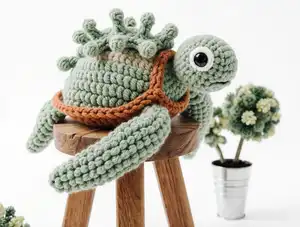
This Succulent Turtle pattern is a delightful fusion of two beloved themes - adorable turtles and trendy succulents! What makes this pattern special is the innovative technique of working in back loops only to create unworked front loops, which then become the foundation for your dimensional succulent top. The pattern uses super bulky chenille yarn that gives your turtle a soft, plush texture that's irresistible to touch. With careful color changes between Agave, Sand, and Terracotta, you'll create beautiful depth and realistic plant-inspired tones that make this piece truly stand out.
Succulent Turtle Amigurumi Pattern crochet pattern - detailed view of completed project

The construction method attaches all the limbs and tail directly into the body rounds, eliminating excessive sewing and creating a sturdy finished piece. The succulent leaves are formed using a combination of half double crochet, double crochet, and treble crochet stitches with chain peaks, resulting in 16 beautiful dimensional leaves that truly capture the essence of a real succulent plant.

Why You'll Love This Succulent Turtle Amigurumi Pattern

I absolutely love how this pattern combines two of my favorite things into one adorable creation! The succulent turtle is such a unique concept that stands out from typical amigurumi designs. I'm particularly fond of how the back loop only technique creates those perfect unworked loops for the succulent - it's such a clever construction method that makes the dimensional leaves possible. The use of super bulky yarn means this project works up relatively quickly compared to standard amigurumi, so you get that satisfying finished product without spending days on tiny stitches. Plus, there's something so charming about a turtle carrying a little garden on its back - it's whimsical, it's creative, and it makes people smile every time they see it. The chunky texture of the chenille yarn adds an extra cozy, huggable quality that makes this turtle perfect for display or cuddling!

Succulent Turtle Amigurumi Pattern step 1 - construction progress Succulent Turtle Amigurumi Pattern step 2 - assembly progress Succulent Turtle Amigurumi Pattern step 3 - details and accessories Succulent Turtle Amigurumi Pattern step 4 - final assembly and finishing

Switch Things Up

I love experimenting with different color combinations for this succulent turtle! Instead of the earthy Agave and Sand tones, I've tried making a pastel version with soft pink for the shell and mint green for the succulent - it gives such a sweet, dreamy vibe that's perfect for nursery decor. You could also go bold with jewel tones like deep purple for the body and bright coral for the succulent leaves.

Another fun modification I enjoy is adjusting the succulent style itself. Instead of the standard leaf pattern, I sometimes make smaller, tighter leaves by reducing the chain spaces and stitch heights, which creates a more compact rosette succulent look. Or go wild and make longer, more dramatic leaves by adding extra chains and treble stitches!

Size variations are super fun too - I've made tiny keychain versions using sport weight yarn and a 2.5mm hook, and giant floor cushion versions with jumbo yarn and a 12mm hook. Each size has its own charm! The mini ones make adorable gifts or bag charms, while the large ones become beloved room decorations.

For a more realistic touch, I sometimes add a subtle color gradient to the succulent leaves by working the first few rounds in a darker green and gradually switching to lighter shades as I work outward. This mimics how real succulents often have darker centers and lighter tips. You can also add tiny French knots in contrasting colors at the base of leaves for flower bud details!

Common Mistakes & How to Fix Them

βœ— Forgetting to place stitch markers in the front loops when working back loops only, which makes it difficult to find them later for the succulent βœ— Pulling the succulent leaf stitches too tight, which flattens the dimensional effect - keep tension loose for fuller, more realistic leaves βœ— Attaching limbs and tail without checking placement first, resulting in an unbalanced turtle - always pin pieces in place before securing them permanently βœ— Overstuffing the body which distorts the shell shape and makes the succulent sit awkwardly - stuff firmly but not so tight that it loses its natural form

Succulent Turtle Amigurumi Pattern

Create this adorable succulent turtle with a unique twist on classic amigurumi design! This charming pattern features a sweet turtle with a beautiful succulent growing right on its shell, making it the perfect blend of nature and crochet art. Using super bulky chenille yarn, this project works up quickly and results in a plush, huggable friend that's approximately 7 inches long. The detailed instructions guide you through creating the dimensional succulent leaves that crown the turtle's shell, along with sturdy legs, a cute tail, and an expressive face with safety eyes. Perfect for plant lovers and turtle enthusiasts alike, this pattern brings together two beloved themes into one delightful creation!

Intermediate 4-5 Hours

Materials Needed for Succulent Turtle Amigurumi Pattern

β€” Main Fabric

  • 01
    Size 6 Super Bulky Chenille Yarn in Terracotta color
  • 02
    Size 6 Super Bulky Chenille Yarn in Sand color
  • 03
    Size 6 Super Bulky Chenille Yarn in Agave color
  • 04
    Chenille Home Slim yarn recommended in Terracotta, Sand, and Agave colors

β€” Tools Required

  • 01
    6mm crochet hook
  • 02
    18mm safety eyes
  • 03
    Tapestry needle
  • 04
    Scissors
  • 05
    Poly-Fil stuffing
  • 06
    Stitch markers (highly recommended for fluffy yarn)
  • 07
    White yarn for eye detail (optional)

Progress Tracker

0% Complete

β€” Front Legs :

Info :

Using Agave, Make 2

R1 :

8SC in MR

R2 :

Inc (16)

R3 :

SC, Inc (24)

R4 :

3SC, Inc (30)

Info :

Fold your circle in half to make a half circle. Working around the half circle and through both sides, SC through both stitches (about 15 SC). Continue until you reach the end of the half circle. FO, there is no need to leave a tail for sewing, you will SC the legs into a round of the body.

β€” Back Legs :

Info :

Using Agave, Make 2

R1 :

8SC in MR

R2 :

Inc (16)

R3 :

SC, Inc (24)

Info :

Fold your circle in half to make a half circle. Working around the half circle and through both sides, SC through both stitches (about 12 SC). Continue until you reach the end of the half circle. FO, there is no need to leave a tail for sewing, you will SC the legs into a round of the body.

β€” Tail :

Info :

Using Agave

R1 :

6SC in MR

R2-3 :

SC (6)

Info :

FO, there is no need to leave a tail for sewing, you will SC the tail piece into a round of the body.

β€” Head :

Info :

Using Agave

R1 :

8SC in MR

R2 :

Inc (16)

R3 :

SC, Inc (24)

R4-6 :

SC (24)

R7 :

SC, Dec (16)

R8 :

2SC, Dec (12)

Info :

FO, leave a long tail for sewing (about 8-9 inches). Add eyes and stuff the head. Eyes should be placed at around rounds 5-6 and about 8 stitches apart across the front of the face.

β€” Shell/Body :

Info :

Part of the top of the shell is worked in the BLO (back loops only) of the previous round. The succulent is formed in the front unworked loops once the top of the shell is completed. Using Agave

R1 :

8 SC in MR

R2 :

Working in BLO: Inc (16)

Info :

Highly suggest stitch markers to mark your front loops, at least one in the front loop of the first stitch of each round

R3 :

Working in BLO: SC, Inc (24)

R4 :

Working in BLO: 3SC, Inc (30)

Info :

Color change to Sand

R5 :

Working in BLO: 4SC, Inc (36)

R6 :

SC (36)

Info :

Drop your working yarn, the rest of the body will be finished after we complete the succulent top

β€” Succulent Top :

Info :

To make the succulent, you will be working in a continuous spiral on top of the shell in the unworked front loops of each round. Grab your Agave yarn and attach it with a SS in the very first unworked front loop of round 2. Working into the remaining front loops repeat the following pattern (Each stitch is placed into individual stitches)

Pattern :

[HDC, DC, CH2 SS into 2nd CH from the hook, DC, HDC, SS, HDC, TC, CH2 SS into 2nd CH from the hook, TC, HDC, SS] x 8

Info :

You should have 16 leaves at the end. If you do not and you missed or skipped some stitches that is ok as long as you are happy with how your succulent looks. Feel free to pull on the leaves and move them how you like them to look. FO, weave in the ends.

β€” Body Continued :

Info :

Picking up where you left off in round 6. Color change to Terracotta

R7 :

Working in FLO of round 6: SC (36)

Info :

It will help for the next round to place a stitch marker in the first back loop of round 6

R8 :

Working in BLO of round 6, that were left behind from round 7: SC (36)

R9-10 :

SC (36)

R11 :

Grab your legs and tail, this is the round you will SC your pieces into. You place your pieces in front of the stitches of the body, pushing your hook through the leg/tail first then through the body stitch: 4SC, Grab the first front (big) leg and attach using 3SC (the curve of the leg should be on your right), 5SC, Grab the first back (small) leg and attach using 2SC (the curve of the leg should be on your right), 3SC, Grab your tail and using 3SC attach the tail, 3SC, Grab the second back (small) leg and attach using 2SC (the curve of the leg should be on your left), 5SC, Grab the second front (big) leg and attach using 3SC (the curve of the leg should be on your left), 3SC (36)

R12 :

Working in BLO: 4SC, Dec (30)

R13 :

3SC, Dec (24)

Info :

Stuff the body to your desired firmness

R14 :

SC, Dec (16)

R15 :

Dec (8)

Info :

SS, cut yarn leaving a short tail to sew the hole closed. Weave the yarn tail back and forth into the stitches around then pull tight to close. Tie to secure and weave the rest of the yarn tail into the body.

Assembly Instructions

  • Sew the head onto the body, positioning it mostly over the bottom part of the body around rounds 6-10
  • For eye detail: If desired, use white yarn to embroider a line up the side of each safety eye by inserting needle at the middle bottom and bringing it up to the top middle of the eye
  • Ensure all limbs and tail are securely attached from round 11 construction
  • Adjust and fluff the succulent leaves on top of the shell to achieve your desired look
  • Weave in all remaining yarn ends securely throughout the piece

Important Notes

  • πŸ’‘Use stitch markers liberally when working with fluffy/chunky yarn to help locate stitches and track rounds
  • πŸ’‘Mark the front loops in rounds 2-5 before starting the succulent - this is crucial for construction
  • πŸ’‘Keep tension loose when creating the succulent leaves to maintain their dimensional, realistic appearance
  • πŸ’‘Pin all limbs and tail in place during round 11 before crocheting them in to ensure proper positioning
  • πŸ’‘Stuff the body firmly but not too tightly to maintain the proper shell shape and succulent positioning
  • πŸ’‘The curve direction of the legs matters - right-side legs curve right, left-side legs curve left for natural appearance

This charming Succulent Turtle pattern brings together the cuteness of amigurumi turtles with the trendy appeal of succulent plants! The innovative back loop only technique creates the perfect foundation for dimensional succulent leaves that crown the turtle's shell beautifully. Using super bulky chenille yarn means this adorable friend works up quickly and has an irresistibly soft, plush texture. The clever construction method of attaching limbs directly into body rounds makes assembly a breeze. Perfect for plant lovers, turtle enthusiasts, or anyone who appreciates unique amigurumi designs! 🐒🌡✨

You ask,

we answer.

FAQs

Can I use regular worsted weight yarn instead of super bulky?

Absolutely! If you use worsted weight yarn with a smaller hook (around 3.5-4mm), your turtle will be much smaller, approximately 3-4 inches instead of 7 inches. Just maintain consistent tension and adjust stuffing accordingly for the smaller size.

How do I work the back loops only technique for the shell?

When working in back loops only (BLO), insert your hook only through the loop of the stitch that's furthest from you, leaving the front loop unworked. These unworked front loops will become the foundation for your succulent leaves, so mark them with stitch markers as you go.

My succulent leaves look flat - what am I doing wrong?

This usually happens when tension is too tight. When working the succulent pattern with all those different stitches (HDC, DC, TC), keep your tension loose and relaxed. After finishing, you can gently pull and fluff each leaf to give them more dimension and shape.

Can I make this turtle without the succulent on top?

Yes! Simply work all rounds in regular crochet instead of back loops only, and skip the succulent section entirely. You'll have a smooth-shelled turtle. You could also add different decorative elements like spots or patterns if desired.

How do I attach the limbs in round 11 without it looking messy?

Place your limb piece in front of your working stitches, then insert your hook through the edge stitch of the limb first, then through the body stitch, and complete your single crochet. This secures the limb while maintaining neat, even stitches. Pin everything in place first to check positioning before crocheting.