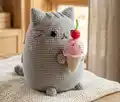
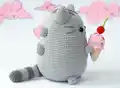
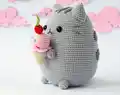
About This Pusheen Cat with Ice Cream Amigurumi Pattern
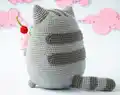
This Pusheen with Ice Cream amigurumi pattern brings the internet's favorite chubby gray tabby cat to life in an utterly charming crocheted form. The pattern is worked primarily in continuous spiral rounds, with the head and body created as one seamless piece for a sturdy construction. What makes this pattern special is the attention to detail - from Pusheen's distinctive tabby stripes on the back and tail to the adorable ice cream cone complete with textured waffle cone, creamy scoops, colorful sprinkles, and a bright red cherry on top.
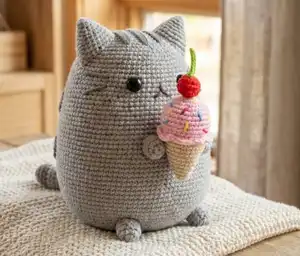
Standing at approximately 17cm tall when finished, this cuddly creation uses a combination of light and dark gray yarn to capture Pusheen's classic coloring, while the ice cream adds pops of pink, brown, red, and green. The pattern includes clear instructions for all components including ears, tail, paws, stripes, and the delightful ice cream accessory.
Why You'll Love This Pusheen Cat with Ice Cream Amigurumi Pattern
I absolutely love this pattern because it combines two of my favorite things - adorable cats and sweet treats! The way Pusheen holds that ice cream cone just melts my heart every time. What I really appreciate is how the pattern breaks down what seems like a complex design into manageable, easy-to-follow steps. The continuous spiral technique makes the main body work up surprisingly quickly, and I find the color changes for the stripes oddly satisfying to complete. The ice cream cone is such a fun bonus element - I love how you can actually make it removable so Pusheen can hold different accessories if you want to get creative later. Plus, there's something incredibly rewarding about seeing this beloved internet character come to life stitch by stitch in your own hands.
Switch Things Up
I love experimenting with color variations on this Pusheen pattern! While the classic grey tabby is absolutely adorable, I've made versions in orange for a ginger cat vibe, or even pastel colors for a more kawaii aesthetic. The ice cream is where you can really let your creativity shine - I've done chocolate brown with vanilla swirls, mint green with chocolate chips, and even rainbow sherbet using multiple colors.
For a seasonal twist, I sometimes swap the ice cream for other accessories. I've made a Pusheen holding a pumpkin for fall, a heart for Valentine's Day, or a tiny wrapped present for Christmas. You could even make a donut, coffee cup, or slice of pizza instead! The hands are positioned perfectly to hold all sorts of small props.
If you want to make a bigger or smaller version, simply change your yarn weight and hook size accordingly. I've made tiny keychain-sized Pusheens using sport weight yarn and a 2mm hook, and giant cuddle-sized ones using bulky yarn with a 5mm hook. The proportions stay perfect no matter what size you make.
For embroidery details, I sometimes add little pink cheeks with embroidery or felt, or give Pusheen different expressions - closed happy eyes, surprised eyes, or sleepy eyes. You can also add more stripes, change the stripe pattern, or even make spots instead for a completely different cat personality while using the same basic body construction.
Common Mistakes & How to Fix Them
✗ Forgetting to place stitch markers at the end of each round leads to losing track of where rounds begin and end, especially during increases and decreases
✗ Not stuffing the head and body firmly enough as you work results in a floppy finished piece that won't hold its shape properly over time
✗ Placing safety eyes too early before rounds 42-43 can make it difficult to position them correctly with the proper spacing of eleven stitches between them
✗ Skipping the invisible decrease technique and using regular decreases creates visible holes and an unprofessional finish on the rounded surfaces of the body
✗ Not leaving long enough yarn tails when fastening off parts like ears, tail, and stripes makes sewing them onto the body securely much more difficult
✗ Attempting to embroider facial features before attaching all the parts can lead to misaligned or asymmetrical placement when everything is assembled together