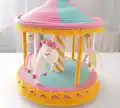
🧶 Beautiful ✨ Detailed 💝 Adorable

Merry-Go-Round Carousel Crochet Pattern

Merry-Go-Round Carousel Crochet Pattern
3.9★ Rating
15-20 Hours Time Needed
3.0K Made This
✂️

Advanced Level

Designed for experienced knitters, these patterns involve intricate designs and complex techniques to challenge and inspire.

⏱️

Slow & Steady

A 10-12 hour project—great for savoring the process over several sessions.

🎠

Whimsical Buddy

Playful characters full of personality, designed to spark imagination and become cherished playtime favorites.

About This Merry-Go-Round Carousel Crochet Pattern

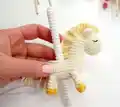
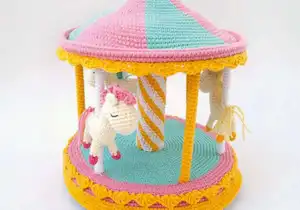
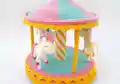
This magical carousel pattern is a true showstopper that combines traditional crochet techniques with structural engineering. You'll create three colorful horses with flowing manes, a rotating platform with decorative scalloped edges, and a striped central post topped with a fishing-line reinforced roof. The carousel actually spins on a carefully constructed wooden base with ball bearings, making it both a beautiful decoration and an interactive piece.

Merry-Go-Round Carousel Crochet Pattern crochet pattern - detailed view of completed project

Using a clever combination of plywood clock blanks, hardware store findings, and colorful yarn, this pattern transforms simple materials into an heirloom-quality piece that captures the nostalgic magic of vintage carousels.

Why You'll Love This Merry-Go-Round Carousel Crochet Pattern

I absolutely love how this pattern pushes the boundaries of what crochet can become! It's not just about making something pretty—you're actually building a functional mechanical toy that spins and delights. The satisfaction of watching those little horses rotate on their platform is incredible. I love the engineering aspect combined with the soft artistry of crochet, and the way each colorful detail comes together. The fishing line technique for the roof is genius, and seeing those striped poles spiral up is so rewarding. This is the kind of project that makes people say 'You made that?!' and becomes a treasured conversation piece that brings joy for years.

Merry-Go-Round Carousel Crochet Pattern step 1 - construction progress Merry-Go-Round Carousel Crochet Pattern step 2 - assembly progress Merry-Go-Round Carousel Crochet Pattern step 3 - details and accessories Merry-Go-Round Carousel Crochet Pattern step 4 - final assembly and finishing

Switch Things Up

I absolutely love experimenting with color combinations for this carousel! While the pattern calls for turquoise, pink, yellow, and white, I've had beautiful results creating themed versions—imagine a pastel rainbow carousel with lavender, mint, peach, and cream, or a bold carnival version with red, royal blue, and gold. You could even make it seasonal with autumn oranges and browns, or winter whites and silvers with sparkly yarn.

For the horses, I enjoy varying not just their body colors but also giving each one a distinct personality through mane and tail choices. Try using ombré yarn for flowing rainbow manes, or add tiny crocheted flowers or bows to create 'fancy' carousel horses. Some crafters have even embroidered decorative saddles or added tiny fabric blankets.

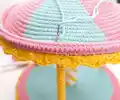
The roof offers amazing customization potential too. Instead of the two-color striped pattern, you could create a solid roof with contrasting scallops, or work in three or four colors for a more complex pattern. I've seen beautiful versions where crafters used variegated yarn for a watercolor effect, or added small crocheted flags or pennants hanging from the roof edge for extra carnival flair.

If you want to adjust the difficulty, you could simplify by using a solid-colored central post instead of the spiral stripes (just crochet in one color without the pattern calculation), or skip the fishing line in the roof and use wire instead, though this changes the technique significantly. For an extra challenge, try adding more horses—five or six instead of three—though you'll need to recalculate your column spacing carefully.

Common Mistakes & How to Fix Them

✗ Not checking the screw diameter against the plywood hole before assembly—always test fit your hardware components before gluing anything permanently in place ✗ Pulling the fishing line too tight throughout the entire roof which creates a cone instead of allowing it to flatten toward the edges for proper carousel shape ✗ Gluing the carousel base to the plywood before sewing all the support posts which makes it nearly impossible to access the underside for secure attachment ✗ Forgetting to stuff the horse bodies and central post firmly enough before closing which results in floppy, unstable figures that don't hold their shape well ✗ Using the wrong color yarn when sewing the top of support columns to the roof—always match the roof color not the column color for invisible seams

Merry-Go-Round Carousel Crochet Pattern

Create an enchanting spinning carousel complete with three adorable horses that actually rotates! This detailed pattern guides you through crocheting a fully functional merry-go-round with a striped central post, decorative scalloped roof, and charming crocheted horses. Perfect for nursery decor or as a magical gift, this intricate project combines crochet artistry with structural craftsmanship to bring childhood wonder to life.

Advanced 15-20 Hours

Materials Needed for Merry-Go-Round Carousel Crochet Pattern

— Main Fabric

  • 01
    Yarn Art Jeans (55% cotton, 45% acrylic, 160 m/50 g) in turquoise (76), pink (78), white (62), yellow (35)
  • 02
    Small amounts of dark turquoise, light pink, and light yellow yarn for horse manes and hooves
  • 03
    Alize Cotton Gold Hobby (55% cotton, 45% acrylic, 165 m/50 g) ivory (01) for horse bodies
  • 04
    Thin black yarn for embroidering horse eyes
  • 05
    Fishing line with 1mm diameter for roof structure reinforcement

— Tools Required

  • 01
    2.25mm crochet hook
  • 02
    2 round plywood blanks for clocks with 20cm diameter
  • 03
    8 wooden beads with 1cm diameter
  • 04
    Screw 8mm x 100mm with 3 nuts (8mm), 2 large washers, 1 small washer
  • 05
    5 plastic pipe couplings 20mm inner diameter (28mm outer diameter) or cardboard tube from stretch film
  • 06
    Synthetic fiberfill stuffing
  • 07
    Adhesive tape
  • 08
    6 wooden manicure sticks 15cm long
  • 09
    Fishing line 1mm diameter
  • 10
    Big eyed needle
  • 11
    Sewing pins
  • 12
    Lighter
  • 13
    Glue gun
  • 14
    Superglue
  • 15
    Pruner or wire cutters
  • 16
    Stitch markers or contrasting yarn for marking rounds
  • 17
    Scissors

Progress Tracker

0% Complete

— Horses (Make 3):

Horse Muzzle:

Round 1:

6 sc in AR

Round 2:

inc*6=12 sc

Round 3:

(1 sc, inc)*6=18 sc

Rounds 4-6:

3 rounds of 18 sc. Finish with sl st, leave long end, set aside

Horse Body:

Round 1:

Chain 7. Work 3 sc in second loop from hook, 4 sc along chain, 3 sc in last loop. Turn and crochet along bottom side of chain 4 sc=14 sc around

Round 2:

inc*3, 4 sc, inc*3, 4 sc=20 sc

Round 3:

(1 sc, inc)*3, 4 sc, (1 sc, inc)*3, 4 sc=26 sc

Round 4:

(1 sc, inc, 1 sc)*3, 4 sc, (1 sc, inc, 1 sc)*3, 4 sc=32 sc

Rounds 5-8:

4 rounds of 32 sc

Round 9:

Work only 14 sc

Rounds 10-12:

Do not continue round, go to first st after marker and work spiral rounds of 14 sc. Sc 3 rounds up for neck

Info:

Thread yarn end from muzzle into needle and sew to neck center, joining 2 sc of neck and 2 sc of muzzle

Round 13:

Work around both parts 28 sc

Round 14:

Make decrease at junction of neck with muzzle on both sides=26 sc

Round 15:

Make 1 more decrease on both sides in same place=24 sc

Round 16:

24 sc

Round 17:

(2 sc, dec)*6=18 sc. Stuff neck and muzzle

Round 18:

(1 sc, dec)*6=12 sc

Round 19:

Dec every st until opening closes, adding fiberfill as needed. Cut yarn, hide end. Stuff body and sew opening on back

Horse Legs (Make 4):

Round 1:

With colored yarn: 6 sc in AR

Round 2:

1 round of 6 sc with colored yarn

Rounds 3-6:

4 rounds of 6 sc with ivory yarn. Finish with sl st, leave long end. Do not stuff

Info:

Sew legs to body

Horse Ears (Make 2):

Row 1:

Chain 5, work 4 sc

Row 2:

Do not make turning ch, insert hook right into second st=3 sc

Row 3:

Do not make turning ch, insert hook right into second st=2 sc

Row 4:

Do not make turning ch, insert hook right into second st=1 sc. Leave long end

Info:

Thread yarn end into needle, sew together 2 corners of triangle. Sew ear to horse head. Repeat for second ear

Horse Mane:

Info:

Use yarn lighter than hooves. Attach yarn to forehead, crochet 3 ch and 2 dc in same point. Crochet along neck working 3 dc from each point, inserting hook under posts along imaginary line. At end, crochet 2 dc and 3 ch, finish with sl st. Cut and hide end

Horse Tail:

Info:

Cut 4 pieces of yarn 10cm each. Fasten one thread at a time to back of horse

Horse Eyes:

Info:

Embroider eyes with thin black yarn

Info:

Crochet 2 more horses in other colors

— Carousel Frame Assembly:

Info:

Glue 5 plastic sleeves together with tape, or cut cardboard tube/plastic pipe to 28mm diameter and 17.5cm length

Info:

Glue 4 beads on one wooden circle at equal distances apart

Info:

Glue 4 more beads between them on other side of circle

Info:

Insert screw into hole, fix with nut on reverse side applying superglue drop under nut

Info:

Put washers on screw in this order: large, small, large

Info:

Put second wooden circle on screw. Check it spins freely without touching beads while beads prevent it from falling sideways

— Carousel Base:

Round 1:

With turquoise yarn: Chain 12, sl st in 1st loop

Round 2:

(1 sc, inc)*6=18 sc

Round 3:

1 sc, inc, (2 sc, inc)*5, 1 sc=24 sc

Round 4:

(3 sc, inc)*6=30 sc

Round 5:

2 sc, inc, (4 sc, inc)*5, 2 sc=36 sc

Round 6:

(5 sc, inc)*6=42 sc

Round 7:

3 sc, inc, (6 sc, inc)*5, 3 sc=48 sc

Round 8:

(7 sc, inc)*6=54 sc

Round 9:

4 sc, inc, (8 sc, inc)*5, 4 sc=60 sc

Round 10:

(9 sc, inc)*6=66 sc

Round 11:

5 sc, inc, (10 sc, inc)*5, 5 sc=72 sc

Round 12:

(11 sc, inc)*6=78 sc

Round 13:

6 sc, inc, (12 sc, inc)*5, 6 sc=84 sc

Round 14:

(13 sc, inc)*6=90 sc

Round 15:

7 sc, inc, (14 sc, inc)*5, 7 sc=96 sc

Round 16:

(15 sc, inc)*6=102 sc

Round 17:

8 sc, inc, (16 sc, inc)*5, 8 sc=108 sc

Round 18:

(17 sc, inc)*6=114 sc

Round 19:

9 sc, inc, (18 sc, inc)*5, 9 sc=120 sc

Round 20:

(19 sc, inc)*6=126 sc

Round 21:

10 sc, inc, (20 sc, inc)*5, 10 sc=132 sc

Info:

Change to pink yarn and continue to edge of wooden circle. May need more or fewer rounds depending on gauge

Round 22:

(21 sc, inc)*6=138 sc

Round 23:

11 sc, inc, (22 sc, inc)*5, 11 sc=144 sc

Round 24:

(23 sc, inc)*6=150 sc

Round 25:

12 sc, inc, (24 sc, inc)*5, 12 sc=156 sc. Finish with sl st, do not fasten off

Round 26:

156 sc through back loops

Rounds 27-31:

5 rounds of 156 sc through both loops. Finish with sl st, cut yarn

Base Scalloped Edge:

Info:

Join yellow yarn to round 25, work through front loops: skip 2 st, (3 dc, 1 ch, 3 dc) in third st, skip 2 st, 1 sc in 6th st. Repeat around. Cut yarn and fix end

Info:

Join yellow yarn to end of last pink round and sc in pink st capturing ch loop on top of yellow corners. At corner points crochet 2 sc in 1 st creating (5 sc, inc)* pattern until end of round

Info:

Crochet 3 more rounds without inc

Info:

Put crocheted canvas on base, gluing to plywood around screw by about half the radius

Info:

Tighten 2 nuts leaving 1-2mm gap between floor and lower nut so top circle can rotate. Glue nuts with superglue

— Central Post:

Info:

Chain length necessary to wrap around pipe (24 loops for standard pipe). Calculate stripe pattern: for 2 yellow and 3 white sc need 25 sc per round, but for spiral need 1 loop less=24. Adjust pattern based on your chain count (multiple of pattern minus 1)

Info:

Crochet 2 yellow sc, 3 white sc, changing colors by leaving second yellow sc incomplete (2 loops on hook), finish yellow st with white yarn and continue with white

Info:

Due to missing one loop, stripes will shift and spiral. Crochet as high as pipe, insert pipe inside. Cut yarn and hide ends

Info:

Glue lower edge of pipe to base with glue gun, avoiding screw and nuts. Also sew bottom of pipe to base using white and yellow yarn alternately

— Carousel Roof:

Info:

Crochet with fishing line for structure. Clamp fishing line skein with hairpin to prevent tangling. Melt fishing line tip with lighter to form ball at end

Round 1:

With pink yarn: 6 sc in AR

Round 2:

inc*6=12 sc. From round 2 onward, apply fishing line to previous round and crochet over it

Round 3:

(1 sc, inc)*6=18 sc

Round 4:

Join turquoise yarn: (pink 2 sc, inc, turq 2 sc, inc)*3=24 sc

Round 5:

(pink 3 sc, inc, turq 3 sc, inc)*3=30 sc

Round 6:

(pink 4 sc, inc, turq 4 sc, inc)*3=36 sc

Round 7:

(pink 5 sc, inc, turq 5 sc, inc)*3=42 sc

Round 8:

(pink 6 sc, inc, turq 6 sc, inc)*3=48 sc

Info:

Pull fishing line tighter at beginning for conical shape. Farther from middle, let line lie looser for flatter edges. Stitches should hold line tightly without being too loose

Round 9:

(pink 7 sc, inc, turq 7 sc, inc)*3=54 sc

Round 10:

(pink 8 sc, inc, turq 8 sc, inc)*3=60 sc

Round 11:

(pink 9 sc, inc, turq 9 sc, inc)*3=66 sc

Round 12:

(pink 10 sc, inc, turq 10 sc, inc)*3=72 sc

Round 13:

(pink 11 sc, inc, turq 11 sc, inc)*3=78 sc

Round 14:

(pink 12 sc, inc, turq 12 sc, inc)*3=84 sc

Round 15:

(pink 13 sc, inc, turq 13 sc, inc)*3=90 sc

Round 16:

(pink 14 sc, inc, turq 14 sc, inc)*3=96 sc

Round 17:

(pink 15 sc, inc, turq 15 sc, inc)*3=102 sc

Round 18:

(pink 16 sc, inc, turq 16 sc, inc)*3=108 sc

Round 19:

(pink 17 sc, inc, turq 17 sc, inc)*3=114 sc

Round 20:

(pink 18 sc, inc, turq 18 sc, inc)*3=120 sc

Round 21:

(pink 19 sc, inc, turq 19 sc, inc)*3=126 sc

Round 22:

(pink 20 sc, inc, turq 20 sc, inc)*3=132 sc

Round 23:

(pink 21 sc, inc, turq 21 sc, inc)*3=138 sc

Round 24:

(pink 22 sc, inc, turq 22 sc, inc)*3=144 sc

Round 25:

(pink 23 sc, inc, turq 23 sc, inc)*3=150 sc

Round 26:

(pink 24 sc, inc, turq 24 sc, inc)*3=156 sc

Round 27:

(pink 25 sc, inc, turq 25 sc, inc)*3=162 sc

Info:

Cut fishing line, melt end and quickly press to crocheting to glue it to yarn. Crochet few more sc to close end, finish with sl st. Cut turquoise yarn, leave pink. Roof diameter should approximately equal base (may have more or fewer rows)

Info:

Turn work wrong side toward you, crochet with pink yarn in opposite direction through back loops of last round. Add new fishing line

Round 28:

(26 sc, inc)*6=168 sc

Rounds 29-31:

3 rounds of 168 sc with fishing line through both loops. Finish with sl st. Cut line, melt and glue end. Leave long yarn end

Info:

Fold pink side in half and sew with yarn end, forming thick edge of roof

Roof Scalloped Edge:

Info:

Turn work right side toward you. Join yellow yarn to round 27, sl st around through front loops

Info:

Crochet scallops through yellow sl st: skip 2 loops, 5 dc in 3rd loop, skip 2 loops, 1 sc in 6th loop. Repeat all around. Cut yarn and fix end

Central Post Top:

Round 1:

With yellow yarn: 6 sc in AR

Round 2:

inc*6=12 sc

Round 3:

(1 sc, inc)*6=18 sc

Round 4:

(2 sc, inc)*6=24 sc

Rounds 5-6:

2 rounds of 24 sc, leave long end

Info:

Stuff post tightly (upper half) and sew yellow part on top, stuffing it tightly too

Info:

Glue roof to post with glue gun so contact reaches plastic pipe—yellow top and upper edge of pipe completely glued for rigid join

— Support Columns:

Horse Support Sticks (Make 3):

Info:

Measure 15cm manicure sticks. Before cutting sharp ends, insert stick into horse body

Info:

Cut off all sharp ends with pruner. Adjust sticks so bottom length of all is 4cm

Bottom Part:

With white yarn: 8 sc in AR and sc spiral rounds without inc 4cm up. Finish with sl st, leave long end

Top Part:

Crochet upper part of stick in same way

Info:

Sew to horse body with yarn end. Repeat with all horses

Yellow Support Columns (Make 3):

Info:

Cut ends off 3 more sticks to exact same length as horse sticks

Info:

With yellow yarn: 8 sc in AR and sc spiral rounds without inc to full stick length. Insert stick inside, sew opening with yarn end, leave long end

— Final Assembly:

Info:

Distribute yellow columns evenly at edge of roof with yarn end down. Sew upper end of column with yarn matching roof color, not yellow

Info:

Fix lower end of yellow columns with pins

Info:

Distribute white columns with horses between yellow ones, fix with pins

Info:

Sew upper ends of white columns with yarn matching roof color

Info:

Neatly sew lower ends of all columns, lifting non-glued edge of base if necessary

Info:

After sewing all posts to base, glue base to plywood to very edge and to end of upper circle

Assembly Instructions

  • First assemble the mechanical base by gluing beads to wooden circles, inserting the screw with washers, and ensuring the top circle rotates freely on the ball bearing system created by the beads.
  • Crochet the turquoise and pink base circle to fit your wooden platform, then add the decorative yellow scalloped edge by working into the front loops of an earlier round.
  • Create the central striped post by calculating your color pattern (typically 2 yellow, 3 white in a 24-stitch round) and crocheting around the plastic pipe or cardboard tube, allowing the stripes to spiral.
  • Crochet the roof with fishing line reinforcement, starting tight for the cone shape and gradually loosening tension toward the edges for proper carousel shape, then add the thick folded edge and yellow scallops.
  • Prepare all support columns by cutting manicure sticks to proper length (4cm bottom portion for horses), crocheting white coverings for horse sticks and yellow for standalone posts.
  • Attach the roof permanently to the central post using hot glue for a rigid connection, ensuring glue reaches the plastic pipe completely for stability.
  • Pin all support columns in place first—yellow posts evenly spaced around roof edge, white horse posts distributed between them—then sew upper ends using roof-colored yarn for invisible seams, and finally sew lower ends to base while lifting the edge as needed for access.

Important Notes

  • 💡The fishing line tension in the roof is critical—start tight for cone shape and gradually loosen toward edges, but keep stitches tight enough to hold the line in place
  • 💡Always test the rotation mechanism before gluing anything permanently—the top circle should spin freely with 1-2mm gap from the lower nut
  • 💡Use superglue on all nuts and structural joints for stability, but be extremely careful not to get any glue on the screw threads or rotation mechanism
  • 💡When sewing support columns to the roof, always use yarn that matches the roof color (pink or turquoise), never the column color, for invisible attachment points
  • 💡The stripe pattern for the central post must calculate to one loop less than your chain count to create the spiral effect—test your math before committing
  • 💡Stuff the upper half of the central post and the yellow top piece very firmly to create a solid structure that can support the weight of the roof
  • 💡Pin all support columns in place and check the carousel's balance before sewing anything permanently—adjustments are nearly impossible after sewing

This spectacular Merry-Go-Round pattern brings the magic of vintage carousels into your home with a fully functional rotating design! Combining engineering precision with traditional crochet artistry, you'll create three adorable horses with flowing manes, a striped central post, and a fishing-line reinforced roof with decorative scallops. The carousel actually spins on a clever ball-bearing system, making it both a stunning display piece and an interactive treasure. Perfect for nursery decor or as an heirloom gift that will be cherished for generations. 🎠✨
You ask,

we answer.

FAQs

Can I use different yarn weights or colors for this pattern?

While you can customize colors to match your decor, it's important to maintain similar yarn weights (sport/DK weight) to ensure proper sizing and structural integrity. If you change yarn weight, you'll need to adjust your plywood base size and hardware accordingly, and your hook size will need to match your yarn for proper gauge.

What if I can't find the exact plywood clock blanks specified?

You can use any circular plywood pieces around 20cm diameter with an 8mm center hole, or have circles custom cut at a hardware store. The key is ensuring your screw diameter matches the hole size and that both circles are identical for proper rotation. You might find suitable options in craft sections or clock-making supplies.

How do I prevent the fishing line from showing through my roof stitches?

Keep your crochet stitches fairly tight so they fully encapsulate the fishing line—it should pass completely under each stitch. The fishing line should be sandwiched between the previous round and your current working round. If you see it peeking through, your tension may be too loose. Practice on a small swatch first to get the feel right.

Can I make this carousel larger or smaller?

Yes, but it requires mathematical adjustments to all components. For a larger carousel, you'll need bigger plywood bases, longer support poles, more rounds in the base and roof, and potentially thicker fishing line. For smaller versions, reduce all measurements proportionally. Keep in mind that structural stability becomes more challenging at larger sizes due to weight.

My roof is coming out too cone-shaped or too flat—what am I doing wrong?

This is entirely about fishing line tension control. If too cone-shaped, you're pulling the line too tight throughout—loosen it progressively as you work outward. If too flat, you're not pulling tight enough in the beginning rounds. The shape should gradually transition from tight cone at center to loose and flat at edges. Practice makes perfect with this technique.

Do I really need to use hot glue and superglue, or can I just sew everything?

The glues are essential for structural integrity and stability. Sewing alone won't provide enough support for the weight of the roof and the mechanical rotation system. Use superglue for the nuts and hardware to prevent loosening, and hot glue for attaching the roof to the post and the base to the plywood. Sewing is supplementary for fabric-to-fabric connections.

How long does this project typically take to complete?

Most crafters report 15-20 hours total, spread over several days or weeks. The horses take about 2-3 hours each, the base and roof each take 3-4 hours, and assembly with all the support columns takes another 3-4 hours. The fishing line technique for the roof may require practice, so budget extra time if you're new to that method.

Is this carousel safe for young children, or is it purely decorative?

This is primarily a decorative piece due to the structural components (screws, hot glue, wire sticks inside). While the rotation mechanism is gentle and the horses are soft, it's not designed as a toy for unsupervised young children. It's best displayed out of reach of toddlers, or under adult supervision for gentle interactive play with older children who understand it's a special handmade item.