🧢 Beautiful ✨ Detailed πŸ’ Adorable

Flower Bouquet C Crochet Pattern

Flower Bouquet C Crochet Pattern
4.4β˜… Rating
8-10 Hours Time Needed
4.2K Made This
βœ‚οΈ

Intermediate Level

Ideal for those with basic knitting experience, featuring slightly more advanced stitches and techniques to expand your skills.

⏱️

All-Day Adventure

Requires 8-10 hours, ideal for a full day of immersive knitting.

🌸

Spring Bloom

Light and fresh designs for warmer days, capturing the renewal and brightness of the season.

About This Flower Bouquet C Crochet Pattern

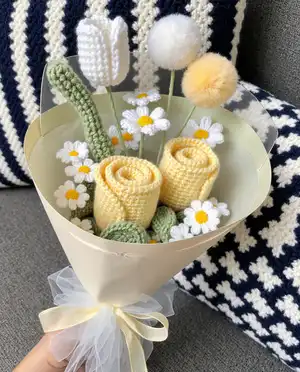
Flower Bouquet C Crochet Pattern crochet pattern - detailed view of completed project

The pattern is beginner-friendly with detailed explanations for each step, making it accessible even if you're new to wire-reinforced crochet flowers. You can customize colors to match any decor or create seasonal variations throughout the year.

Why You'll Love This Flower Bouquet C Crochet Pattern

I absolutely love this pattern because it lets me create beautiful, lasting flowers that bring joy year-round without any maintenance. The satisfaction of watching a simple ball of yarn transform into delicate petals and leaves is incredibly rewarding. What I appreciate most is the flexibility to customize each bloom with different color combinations, making every bouquet truly one-of-a-kind. The wire-reinforced petals mean I can pose and arrange the flowers exactly how I want them, and they'll stay that way forever. It's the perfect project for using up yarn scraps while creating something genuinely beautiful and gift-worthy.

Flower Bouquet C Crochet Pattern step 1 - construction progress Flower Bouquet C Crochet Pattern step 2 - assembly progress Flower Bouquet C Crochet Pattern step 3 - details and accessories Flower Bouquet C Crochet Pattern step 4 - final assembly and finishing

Switch Things Up

I absolutely love experimenting with color combinations when making these flowers! While the pattern shows traditional flower colors, I've created entire bouquets in pastel shades for spring weddings, deep jewel tones for autumn displays, and even monochromatic white arrangements that look incredibly elegant. You can also play with yarn texturesβ€”using a sparkly metallic yarn for special petals adds a magical touch, especially for holiday decorations.

For a different look, I sometimes make oversized versions using chunky yarn and larger hooks, which creates statement pieces perfect for nurseries or playrooms. On the flip side, using thread weight yarn with tiny hooks produces delicate miniature flowers that work beautifully for doll accessories or jewelry embellishments. I've even made flower crowns by attaching smaller versions to a headband base!

Don't be afraid to mix and match flowers from this pattern with other flower types you might know. I often combine these with my favorite poppy or sunflower patterns to create wildflower meadow arrangements. Adding small crocheted butterflies or bees perched on the petals brings extra whimsy to the display. The possibilities are truly endless once you master these basic techniques!

Common Mistakes & How to Fix Them

βœ— Not using thin enough wire for petals and leaves which makes them too stiff and difficult to shape naturally into realistic curves βœ— Forgetting to add wire during the specified rounds which requires unraveling the work and starting over to insert it properly βœ— Using yarn that's too thick for the hook size resulting in stiff petals that don't drape naturally or look delicate enough βœ— Not securing wire ends properly before crocheting over them which can cause the wire to slip out during assembly and shaping βœ— Overstuffing flower centers making them look bulky and unnatural instead of maintaining the delicate proportions of real flowers βœ— Skipping the yarn wrapping around stems which leaves visible wire or wooden sticks looking unfinished and less realistic

Flower Bouquet C Crochet Pattern

Create a stunning handmade flower bouquet with this comprehensive crochet pattern featuring tulips, daisies, roses, and beautiful leaves. This pattern guides you through crafting each individual flower with detailed instructions for petals, centers, and stems. Perfect for creating lasting decorative pieces or thoughtful handmade gifts, this bouquet brings the beauty of nature into your home year-round. Each flower can be customized with your favorite colors to make a truly unique arrangement.

Intermediate 8-10 Hours

Materials Needed for Flower Bouquet C Crochet Pattern

β€” Main Fabric

  • 01
    Cotton yarn in various colors (4 ply)
  • 02
    Milk yarn, cotton yarn, or acrylic yarn depending on preference
  • 03
    Yarn in colors for flowers: yellows, whites, reds, pinks, or your choice
  • 04
    Green yarn for leaves and stems

β€” Tools Required

  • 01
    Crochet hook size 2-2.5mm
  • 02
    Thin wire (approximately 0.6mm) for leaves and petals
  • 03
    Thick wire (approximately 2mm) or wooden sticks for stems
  • 04
    Hot glue
  • 05
    Scissors
  • 06
    Fibrefill or cotton for stuffing flower centers
  • 07
    Optional: Blush for adding color gradients

Progress Tracker

0% Complete

β€” Tulips :

Small petals (x3) :

R1 :

Chain 12

R2 :

(add wire) sk, sc, hdc, 7dc, hdc, w, hdc, 7dc, hdc, sc

R3 :

23 sc, sl, FO

Big petals (x3) :

R1 :

chain 13

R2 :

sk, 11 sc, w, 11 sc

R3 :

(add wire) sc, hdc, 9dc, hdc, w, hdc, 9dc, hdc, sc

R4 :

27sc, sl, FO

Big leaf :

R1 :

chain 31

R2 :

(add wire) sk, 3 sc, 3 hdc, 18 dc, 3 hdc, 2 sc, w, 2sc, 3 hdc, 18 dc, 3hdc, 3 sc, sl, FO

Info :

Start sticking with glue around the stick the small petals, and then add the bigger ones, in a circular way. Add the leaf in the down part of the stick, and roll yarn around the stick to secure the leaf and make the stem look more natural.

β€” Daisy flower :

Center of the flower :

R1 :

6 sc magic ring

R2 :

6 inc

R3 :

12 sc and FO

Info :

Make one yellow and with the same steps make a green one for the back of the flower, to connect with the stem. You will have to connect both and stitch it together, before completely closing the stitch add some fibrefill or cotton to fill the inside of the center. And then start with the petals:

Petals :

Pattern :

(3 ch, dc, 3 ch, sl st) Rep 12. There will be 12 petals in total.

Info :

Connect the wire or wooden stick to the flower, depending on how you want to put the daisies it will be better to put the stem right in the middle of the center in the back of the flower or as the other flowers in between the two centers. Both ways will look good. Don't forget to roll yarn over so the stem looks more realistic.

β€” Baby daisy flower :

R1 :

5 sc magic ring

R2 :

(2 ch, 3 dc, 2 ch) Rep 5 times

Info :

The center of the flower just pass the yarn making some stitches in the center. You can make a few baby daisies and connect them to a wire or wooden stick rolling green yarn to make the stem. If you use a light color, there is also the option to add some blush on the edges to make some gradient in the color.

β€” Rose flower type 1 :

Flower petals :

R1 :

chain 53

R2 :

52 sc

R3 :

chain 5, dc, sk2, to begin with. The rest rep (dc, 2ch, dc) sk2 until the end. The part inside of the parenthesis has to be worked in the same stitch

R4 :

chain 3, in the next hole work (2dc, 2ch, 2dc); Work on the hole of the upper part (2dc, 2ch, 2dc) Rep until the end

R5 :

*ch 1, and in the hole of the upper part work 8dc. In the next hole work 1 sc. And repeat from* until the end and sl, FO.

Info :

To finish the rose, roll it up starting with the first chain at the center of the rose, then stick it together with glue.

Flower bottom :

R1 :

(3 ch, 20 dc, sl st) magic ring

R2 :

8ch, ((sk, 2sc, 2hdc, 2dc, 1 tc) on chain) sk3, sl st. Repeat 5 times and sl, FO, making a similar to star figure to put in the bottom of the rose.

Rose leaf :

R1 :

12ch, sk, sc, hdc, 7dc, hdc; on the other side of the chain: w, hdc, 7dc, hdc, sc

R2 :

(add wire), sc, 2ch. Rep until reached the end and sl, FO.

Info :

Stick every part together and roll yarn around a wooden stick to make the stem.

β€” Rose flower type 2 :

Small petal (x4) :

R1 :

10 dc magic ring

R2 :

10 hdc inc

R3 :

6 sc, 8 hdc inc, 6 sc

Midi petal (x4) :

R1 :

10 dc magic ring

R2 :

10 hdc inc

R3 :

(2 sc, sc inc) rep

R4 :

8 sc, 9 hdc inc, 9 sc

Big petal (x5) :

R1 :

10 dc magic ring

R2 :

10 hdc inc

R3 :

(hdc, hdc inc) rep

R4 :

8 sc, 6 hdc inc, (hdc, dc in same st), 3 ch, (dc, hdc in same st), 6 hdc inc, 8 sc

Flower bottom :

R1 :

6 sc magic ring

R2 :

6 inc

R3 :

6 (sc, inc)

R4 :

18sc

R5 :

[9 ch, (sk1 backward, 2 sl st, 2sc, 2 hdc, dc, tc in chain), sk 2, sl st] rep 6 times.

Rose leaf :

R1 :

12ch, sk, sc, hdc, 7dc, hdc; on the other side of the chain: w, hdc, 7dc, hdc, sc

R2 :

(add wire), sc, 2ch. Rep until reached the end and sl, FO.

Info :

Start sticking and rolling the petals as the image, in order, from the small petals to the big petals. Stick every part together and roll yarn around a wooden stick to make the stem. To add gradient to the flower you can add some blush.

β€” Leafs :

R1 :

Chain 12

R2 :

(add metallic wire to secure the position) sk, sc, hdc, dc, 5 tc, dc, hdc, w, hdc, dc, 5 tc, dc, hdc, sc, sl, FO.

Info :

Make 5 or 7 leaves (depending if you want to make the leaves branch bigger or smaller), and connect all as the picture to the wooden stick, making leaves coming out of the stem. Don't forget to roll yarn over to wooden stick to make it more realistic.

Assembly Instructions

  • For tulips, glue small petals around the wooden stick first, then add bigger petals in a circular arrangement overlapping slightly for a natural look.
  • Attach the tulip leaf at the bottom of the stick and wrap green yarn tightly around the entire stem to secure and create a seamless finish.
  • For daisies, stitch the yellow center to the green back piece with fiberfill inside before attaching to the stem.
  • Insert the wire or wooden stick into the daisy center and wrap green yarn around the stem for a polished appearance.
  • For type 1 roses, roll the petal strip starting from the first chain end, gluing as you go to form the rose shape, then attach the star-shaped bottom.
  • For type 2 roses, layer and glue petals from smallest to largest in a spiral formation, attach the flower bottom, then secure to stem.
  • Create leaf branches by connecting multiple leaves to one stem with wire visible at different heights, then wrap with green yarn to hide connections and create natural-looking stems.

Important Notes

  • πŸ’‘Wire must be inserted during the specified rounds as indicated in the pattern, not after completion
  • πŸ’‘Use hot glue sparingly to avoid visible glue marks on the finished flowers
  • πŸ’‘Keep tension consistent throughout to ensure all petals and leaves match in size and shape
  • πŸ’‘Moldable wire allows you to reshape petals and leaves multiple times to achieve the perfect arrangement
  • πŸ’‘Color combinations are completely customizable so feel free to create seasonal variations or match your home decor
  • πŸ’‘Pattern is beginner friendly but feedback is welcomed to improve clarity for future crafters

This beautiful Flower Bouquet C pattern brings together the elegance of multiple flower types to create a stunning arrangement that will last forever. With detailed instructions for tulips, daisies, roses, and leaves, you'll craft a dimensional bouquet that looks freshly picked. The wire-reinforced petals and leaves allow you to shape and style your creation perfectly, making each bouquet truly unique. Perfect for home decor, gifts, or special occasions, these flowers require no water and will never wilt. 🌸 Happy crocheting! 🧢✨

You ask,

we answer.

FAQs

What wire thickness should I use for the petals and leaves?

Use approximately 0.6mm thin moldable wire for petals and leaves, and a thicker 2mm wire or wooden stick for the main flower stems. The wire must be bendable enough to shape naturally but sturdy enough to hold its position.

Can I make this bouquet without using wire inside the petals?

While you can technically skip the wire, it's highly recommended as it allows you to shape and pose the petals and leaves realistically. Without wire, the flowers will be flat and won't hold dimensional shapes.

How many flowers should I make for a full bouquet?

The pattern includes multiple flower types. A nice balanced bouquet typically includes 3-5 tulips, 3-4 regular daisies, 5-7 baby daisies, 2-3 roses, and multiple leaf branches. Adjust quantities based on your desired bouquet size.

What's the difference between Rose Type 1 and Rose Type 2?

Rose Type 1 is created from a long strip of connected petals that you roll up, creating a more open, ruffled appearance. Rose Type 2 uses individually crocheted petals in three sizes that are layered together for a fuller, more structured rose.

Can I use different yarn weights for this pattern?

The pattern is designed for 4-ply yarn with a 2-2.5mm hook. Using thicker yarn and a larger hook will create bigger flowers, while thinner yarn makes delicate miniature versions. Adjust your hook size to match your yarn choice.

How do I prevent the wire from poking through the crochet work?

Make sure to fold or bend the wire ends before inserting them, and crochet tightly around the wire as indicated in the pattern. Apply a small amount of hot glue to secure wire ends if needed.