🧢 Beautiful ✨ Detailed πŸ’ Adorable

Crochet Lily Flower Pattern

Crochet Lily Flower Pattern
4.8β˜… Rating
8-10 Hours Time Needed
1.9K Made This
βœ‚οΈ

Intermediate Level

Ideal for those with basic knitting experience, featuring slightly more advanced stitches and techniques to expand your skills.

⏱️

All-Day Adventure

Requires 8-10 hours, ideal for a full day of immersive knitting.

🌸

Spring Bloom

Light and fresh designs for warmer days, capturing the renewal and brightness of the season.

About This Crochet Lily Flower Pattern

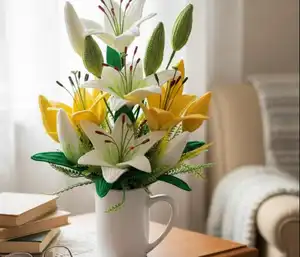
This beautiful lily flower pattern creates realistic botanical pieces using wire-framed petals and authentic-looking stamens. The pattern includes instructions for making both open blooms and closed buds, complete with leaves and stem assembly techniques. Each flower features carefully shaped petals with graduated stitches that create natural curves, while the wire framework allows you to pose and arrange your flowers exactly as you envision them.

Crochet Lily Flower Pattern crochet pattern - detailed view of completed project

The finished lilies can be displayed individually in vases or combined into stunning arrangements that bring lasting beauty to any room. With options for customization in color and size, you can create your own unique floral masterpiece.

Why You'll Love This Crochet Lily Flower Pattern

I absolutely love how this pattern brings together structure and delicacy to create flowers that look amazingly realistic! The wire-framing technique gives you complete control over shaping each petal, and watching the flower come together during assembly is incredibly satisfying. I find the process meditative yet engaging, and the end result is something you'll be proud to display or gift. There's something special about creating lasting beauty that never wilts or fades.

Crochet Lily Flower Pattern step 1 - construction progress Crochet Lily Flower Pattern step 2 - assembly progress Crochet Lily Flower Pattern step 3 - details and accessories Crochet Lily Flower Pattern step 4 - final assembly and finishing

Switch Things Up

I love experimenting with color combinations to create unique lily varieties! Try making white petals with pink or purple shading instead of green at the base for a more colorful look. You could also create gradient effects by gradually changing yarn colors as you work through the petal rounds.

For a more dramatic display, I sometimes make oversized lilies using bulky yarn and larger hooks - they make stunning statement pieces! Conversely, miniature versions with thread weight yarn create delicate decorations perfect for gift toppers or jewelry.

I've found that adding a light dusting of eye shadow or chalk pastels to the finished petals creates beautiful depth and realism. Just brush it on gently and seal with a light hairspray mist if desired.

Instead of traditional green leaves, try making them in variegated yarns for a more natural, sun-dappled effect. You can also adjust the leaf count - I sometimes add 3-4 leaves per stem for a fuller look.

For special occasions, I love incorporating metallic threads worked alongside the regular yarn for subtle shimmer. Gold or silver threads catch the light beautifully and add an elegant touch to wedding bouquets or holiday arrangements!

Common Mistakes & How to Fix Them

βœ— Using wire that's too thick or too thin can make petals difficult to shape or too flimsy to hold their form properly βœ— Not leaving enough wire tail at the beginning makes finishing and twisting the wire ends nearly impossible to secure properly βœ— Wrapping stitches too loosely around the wire in Round 3 creates gaps and an uneven edge along the petal βœ— Skipping the shaping step of pinching petal tips results in rounded ends instead of the characteristic pointed lily petal shape βœ— Adding too much stuffing to closed buds makes them look bulky rather than creating the elegant tapered bud appearance βœ— Not securing wire tails properly with hot glue causes petals to detach from the stem during handling or arranging

Crochet Lily Flower Pattern

Create stunning, lifelike lily flowers with this detailed crochet pattern! This intermediate-level project guides you through crafting elegant petals with wire frames, realistic stamens, and delicate leaves that can be arranged into beautiful floral displays. Perfect for home dΓ©cor, gift-giving, or adding a handmade touch to any space, these crochet lilies bring timeless beauty and charm. Whether you're making a single bloom or a full bouquet arrangement, this pattern provides comprehensive instructions for creating flowers that look remarkably real and will last forever.

Intermediate 8-10 Hours

Materials Needed for Crochet Lily Flower Pattern

β€” Main Fabric

  • 01
    DK (UK) / DK Light Worsted (USA) / 8 ply (AUS) yarn in flower colors (white and yellow shown)
  • 02
    DK (UK) / DK Light Worsted (USA) / 8 ply (AUS) yarn in green for leaves
  • 03
    Any yarn weight will work with appropriate hook size adjustments

β€” Tools Required

  • 01
    Crochet hook size 1.5mm (US size 8 / Canadian & UK size 4.5)
  • 02
    1.2mm (18 Gauge US) wire for stems, approximately 12-18 inches per stem
  • 03
    0.46mm (25 Gauge US) wire for petals and leaves, approximately 12 inches per petal and 25 inches per leaf
  • 04
    Wire cutters
  • 05
    Scissors
  • 06
    Candle and flame source (if using acrylic yarn)
  • 07
    Glue gun and hot glue or dry clear craft glue (optional)
  • 08
    Paper floral tape in green and dark brown
  • 09
    Green crayon
  • 10
    Wool needle
  • 11
    Polyfill or stuffing material

Progress Tracker

0% Complete

β€” Petal A :

Info :

Make 3 per bloom. Make 2 per closed bud if making a smaller closed bud. Color: Flower color (yellow shown)

Foundation :

Slip knot (leave a 2-3" tail), ch 26

Round 1 :

sc in 2nd ch from hook and next 2 chs, hdc in next 3 chs, dc in next 8 chs, hdc in next 8 chs, sc in next 2 chs, (sc, ch 1, sc inc) in last ch, rotate work (hold the tail along the chain and wrap the new sts around the tail), sc in next 2 chs down opposite side of petal, hdc in next 9 chs, dc in next 9 chs, hdc in next 3 chs, sc in next 3 chs, sl st in turning ch

Round 2 :

ch 1, sc in next 2 sts, hdc in next 2 sts, [dc in next 2 sts, 2-dc inc in next st] x3, dc in next 3 sts, hdc in next 4 sts, sc in next 5 sts, (sc, ch 1, sc inc) in ch 1 space of Round 1, rotate work, sc in next 5 sts, hdc in next 4 sts, dc in next 3 sts, [2-dc inc in next st, dc in next 2 sts] x3, hdc in next 2 sts, sc in next 2 sts, sl st in turning ch

Round 3 :

ch 3, insert .46 mm (25 Gauge US) wire through ch on hook, leaving a 3" tail (work round by wrapping each st around wire all the way around the petal) sc in 2nd ch from hook and next ch, hdc in next 13 sts, sc in next 16 sts, (sc, hdc, ch 2, sc) in ch 1 space of Round 2, sc in next 16 sts, hdc in next 13 sts, sc in next 2 chs, sl st in turning ch with hook in front of wires and yarn behind wires, cut the wire leaving a second 3" tail

Finishing :

Pull both wire tails through the last st before tightening. Wrap the tail around the wires a few times and then again so it sits between the two wires. Twist the wires twice so the twists sit right up against the end of the petal. Cut the yarn close to the wire. Trim wire tails near the end of twists

Shaping :

Pinch the tip of the petal to a point

β€” Petal B :

Info :

Make 3 per open bloom. Make 2 per closed bud if making a larger closed bud. Color: Flower color (yellow shown)

Foundation :

Slip knot (leave a 2-3" tail), ch 28

Round 1 :

sc in 2nd ch from hook and next 2 chs, hdc in next 3 chs, dc in next 9 chs, hdc in next 9 chs, sc in next 2 chs, (sc, ch 1, sc) in last ch, rotate work (hold the tail along the chain and wrap the new sts around the tail), sc in next 2 chs down opposite side of petal, hdc in next 9 chs, dc in next 9 chs, hdc in next 3 chs, sc in next 3 chs, sl st in turning ch

Round 2 :

ch 1, sc in next 2 sts, hdc in next 2 sts, [dc in next 2 sts, 2-dc inc in next st] x3, dc in next 3 sts, hdc in next 5 sts, sc in next 6 sts, (sc, ch 1, sc) in ch 1 space of Round 1, rotate work, sc in next 6 sts, hdc in next 5 sts, dc in next 3 sts, [2-dc inc in next st, dc in next 2 sts] x3, hdc in next 2 sts, sc in next 2 sts, sl st in turning ch

Round 3 :

ch 3, insert .46 mm (25 Gauge US) wire through ch on hook, leaving a 3" tail (work round by wrapping each st around wire all the way around the petal), hdc in 2nd ch from hook and next ch, hdc in next 15 sts, sc in next 16 sts, (sc, hdc, ch 2, sc) in ch 1 space of Round 2, sc in next 16 sts, hdc in next 15 sts, hdc in next 2 chs, sl st in turning ch with hook in front of wires and yarn behind wires, cut the wire leaving a second 3" tail

Finishing :

Pull both wire tails through the last st before tightening. Wrap the tail around the wires a few times and then again so it sits between the two wires. Twist the wires twice so the twists sit right up against the end of the petal. Cut the yarn close to the wire. Trim wire tails near the end of twists

Shaping :

Pinch the tip of the petal to a point

β€” Leaf :

Info :

Make 2 per stem. Color: Green

Foundation :

Slip knot (leave a 2-3" tail), ch 35

Round 1 :

sc in 2nd ch from hook and in next 2 chs, hdc in next 3 chs, dc in next 15 chs, hdc in next 10 chs, sc in next 2 chs, (sc, ch 1, sc) in last ch, rotate work (hold the tail along the chain and wrap the sts down the 2nd side of the leaf around the tail), sc in next 2 chs, hdc in next 10 chs, dc in next 15 chs, hdc in next 3 chs, sc in next 3 chs, sl st in turning ch

Info :

Insert .46 mm (25 Gauge US) wire through st on hook, leaving a 3" tail. Work Round 2 with the loop of every st around the wire

Round 2 :

ch 1, sc in next 2 sts, hdc in next 2 sts, dc in next 3 sts, [tr in next 3 sts, 2-tr inc in next st] x2, tr in next 3 sts, dc in next 8 sts, hdc in next 4 sts, sc in next 4 sts, (sc, ch 1, sc) in ch 1 space, rotate work, sc in next 4 sts, hdc in next 4 sts, dc in next 8 sts, [tr in next 3 sts, 2-tr inc in next st] x2, tr in next 3 sts, dc in next 3 sts, hdc in next 2 sts, sc in next 2 sts, sl st in turning ch

Info :

Continue working around the wire in Round 3

Round 3 :

ch 1, sc in next 37 sts, (sc, hdc, ch 2, sc) in ch 1 space from Round 2, sc in next 37 sts, sl st in turning ch with hook in front of wires and yarn behind wires, cut the wire leaving a second 3" tail

Finishing :

Pull both wire tails through the last st before tightening. Wrap the tail around both the wires a few times and then place the yarn so it sits between the two wires. Twist the wires twice so the twists sit right up against the end of the wrapped yarn. Cut the yarn close to the wire and trim the tails near the twists

β€” Stigma :

Info :

Make 1 per bloom. Color: Green (light green shown)

Foundation :

Slip knot (leave a 2-3" tail), ch 3

Step 1 :

sc in 2nd ch from hook, sl st in next ch, ch 2, sc in 2nd ch from hook, sl st in same ch as previous sl st, ch 2, sc in 2nd ch from hook, sl st in same ch as previous sl st, cut yarn leaving about a 15" tail. Pull yarn through last st and pull tight to secure

Step 2 :

Tie both the tails in a knot twice. Trim short tail right up against knots

β€” Stamen :

Info :

Make 6 per bloom. Materials: 11" length of .46mm (25 Gauge US) wire, brown floral tape, green floral tape

Step 1 :

Start wrapping brown floral tape around the wire so that the wire is visible on both sides. Wrap several times around the wire

Step 2 :

Slide the wrapped tape into the middle of the wire and fold the wire in half so that the ends meet and the wrapped floral tape sits right next to the fold in the wire

Step 3 :

Continue wrapping the floral tape around the wires several times to build up volume. Then wrap the floral tape away from the ends of the wire a few times to double the length of the brown tape

Step 4 :

Fold the wrapped brown tape in half

Step 5 :

Continue wrapping the floral tape around the folded tape about 7 times. Cut the tape and secure the end by wrapping down over the bottom of the stamen head and the wires

Step 6 :

Start wrapping the green floral tape at the bottom of the stamen head

Step 7 :

Wrap the green floral tape down and around both wires until the wires are fully covered. Cut the green floral tape and secure the end

Assembly Instructions

  • If using acrylic yarn, hold each flower part a few inches above (not in) candle flame to melt fuzzy stray fibers. Don't get too close or hold in one place long or yarn may get smoke stained or burnt.
  • For leaves, hold the tip over the flame very briefly then pinch the end to form a point. Repeat for each leaf.
  • For stigma, hold each point over the flame very briefly then pinch to form a point. Repeat for all three points.
  • For petals, soften green crayon near (not in) flame and rub on the bottom of each petal to add green shading reaching slightly beyond the widest part. This shaded side is the right side.
  • Take 12-18 inch length of 1.2mm wire for stem, place dab of hot glue on end, and attach middle of underside of stigma to secure it. Wrap yarn tail around wire starting below stigma through hot glue while still hot.
  • Continue wrapping yarn around two thirds of wire length, secure with hot glue, and cut yarn close to stem.
  • Place 6 stamen around stigma with tops about 1/2 inch below stigma, hold about 6 inches down stem, wrap green yarn several times to secure, add hot glue dab, wrap once more through glue, smear glue and trim yarn.

Important Notes

  • πŸ’‘Calculate wire length needed per petal by measuring one petal length and multiplying by 2, adding extra 2-3 inches for safety. For leaves multiply length by 4 instead of 2.
  • πŸ’‘Remember that excess wire can be removed later, but adding more wire is difficult once you've started working.
  • πŸ’‘All stitches not made in foundation chain should be worked through both legs of the stitch unless otherwise stated.
  • πŸ’‘When wrapping stitches around wire, keep tension consistent to avoid gaps and ensure smooth edges along petals and leaves.
  • πŸ’‘Use stitch markers if needed to keep track of your rounds, especially during the petal shaping rounds with increases.
  • πŸ’‘Natural fiber yarns do not require the flame treatment step - skip directly to shading petals with green crayon.

This elegant Crochet Lily Flower pattern transforms simple yarn and wire into stunning botanical art that lasts forever! The pattern combines traditional crochet techniques with innovative wire-framing methods to create flowers with incredible realism and dimension. With detailed instructions for petals, leaves, stamens, and assembly, you'll craft beautiful lilies perfect for display, gifts, or home décor. Whether you make a single dramatic bloom or a full arrangement, these handmade flowers bring lasting natural beauty to any space. 🌸 Happy crocheting! 🧢✨

You ask,

we answer.

FAQs

Can I use different yarn weights for this pattern?

Yes! Any yarn weight will work, but you'll need to adjust your hook size accordingly to create firm, tight stitches. Heavier yarn may require longer wire pieces - calculate by measuring one petal length and multiplying by 2, plus 2-3 inches extra.

Where can I find the specific gauge wire needed for this pattern?

You'll need 0.46mm (25 Gauge US) wire for petals and leaves, and 1.2mm (18 Gauge US) wire for stems. These can be found at most craft stores in the floral or jewelry-making sections, or online from craft suppliers.

Do I have to use the flame technique if I'm using acrylic yarn?

The flame technique helps remove fuzzy fibers for a cleaner look, but it's optional. If you skip it, your flowers will still be beautiful, just with a slightly fuzzier texture. Never use flame with natural fiber yarns as they can burn.

How do I make the petals hold their shape and stay positioned?

The wire frame embedded in Round 3 allows you to bend and shape the petals. After assembly, gently curve and position each petal as desired. The wire holds the shape permanently, letting you create realistic curves and poses.

Can I make a bouquet with multiple lilies?

Absolutely! The pattern includes instructions for assembling a full arrangement with blooms, buds, and leaves. You can create as many flowers as desired and arrange them together using the stem assembly techniques provided.