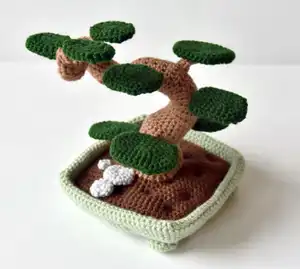
Create your own stunning miniature bonsai tree with this detailed crochet pattern! This charming decorative piece features a textured light green flower pot with supportive feet, realistic dark brown soil with dimensional details, and an intricately shaped light brown trunk with multiple branches. The tree comes alive with nine handcrafted leaves in dark green, ranging from large to small sizes, creating an authentic bonsai appearance. Complete with decorative light grey stones for added realism, this project combines multiple techniques to achieve a beautiful finished piece that stands approximately 22cm tall and 25cm wide. Perfect for home décor enthusiasts and plant lovers who want a low-maintenance green companion that will never need watering!
Progress Tracker
0% Complete
— The flower pot (in light green) :
Round 2 :
inc2sc in every st (12)
Round 3 :
Repeat 4x(1sc, inc2sc in next st, 1sc) (20)
Round 4 :
Repeat 4x(2sc, inc2sc in next st, 2sc) (28)
Round 5 :
Repeat 4x(3sc, inc2sc in next st, 3sc) (36)
Round 6 :
Repeat 4x(4sc, inc1sc in next st, 4sc) (40)
Round 7 :
Repeat 4x(5sc, inc1sc in next st, 4sc) (44)
Round 8 :
Repeat 4x(5sc, inc2sc in next st, 5sc) (52)
Round 9 :
Repeat 4x(6sc, inc1sc in next st, 6sc) (56)
Round 10 :
Repeat 4x(7sc, inc1sc in next st, 6sc) (60)
Round 11 :
Repeat 4x(7sc, inc2sc in next st, 7sc) (68)
Round 12 :
Repeat 4x(8sc, inc1sc in next st, 8sc) (72)
Round 13 :
Repeat 4x(9sc, inc1sc in next st, 8sc) (76)
Round 14 :
Repeat 4x(9sc, inc2sc in next st, 9sc) (84)
Round 15 :
Repeat 4x(10sc, inc1sc in next st, 10sc) (88)
Round 16 :
Repeat 4x(11sc, inc1sc in next st, 10sc) (92)
Round 17 :
Repeat 4x(11sc, inc2sc in next st, 11sc) (100)
Round 18 :
Repeat 4x(12sc, inc2sc in next st, 12sc) (108)
Round 19 :
Crochet 5 rounds of sc (108)
Round 20 :
Crochet 1sc and move your stitch marker/starting point of the round to this point. Continue to work on the next step, do not finish the round
Round 21 :
Repeat 4x(12sc, sc3tog, 12sc) (100)
Round 22 :
Crochet 4 rounds of sc (100)
Round 23 :
Crochet 1sc and move your stitch marker/starting point of the round to this point. Continue to work on the next step, do not finish the round
Round 24 :
Repeat 4x(11sc, sc3tog, 11sc) (92)
Round 25 :
Repeat 4x(11sc, sc2tog, 10sc) (88)
Round 26 :
Repeat 4x(10sc, sc2tog, 10sc) (84)
Round 27 :
Repeat 4x(9sc, sc3tog, 9sc) (76)
Round 28 :
Repeat 4x(9sc, sc2tog, 8sc) (72)
Round 29 :
Repeat 4x(8sc, sc2tog, 8sc) (68)
Round 30 :
Repeat 4x(7sc, sc3tog, 7sc) (60)
Round 31 :
Repeat 4x(7sc, sc2tog, 6sc) (56)
Round 32 :
Repeat 4x(6sc, sc2tog, 6sc) (52)
Round 33 :
Repeat 4x(5sc, sc3tog, 5sc) (44)
Round 34 :
Repeat 4x(5sc, sc2tog, 4sc) (40)
Round 35 :
Repeat 4x(4sc, sc2tog, 4sc) (36)
Round 36 :
Repeat 4x(3sc, sc3tog, 3sc) (28)
Round 37 :
Repeat 4x(2sc, sc3tog, 2sc) (20)
Round 38 :
Repeat 4x(1sc, sc3tog, 1sc) (12)
Round 39 :
Repeat 4x(sc3tog) (4)
Round 40 :
Crochet 1slst and fasten off
Info :
Do not stuff the flowerpot
Info :
Place the last slst you crocheted on top of the MR of step 1 and fold the flowerpot in shape
— The supports for the flowerpot :
Round 2 :
inc1sc in every st (12)
Round 3 :
1sc, inc1sc in next st. Repeat all round (18)
Round 4 :
1sc, sc2tog. Repeat all round (12)
Info :
Stuff the support a little bit, do not use too much stuffing
Round 5 :
sc2tog, repeat all round (6)
Round 6 :
sc3tog, skip 1st, crochet 1slst and fasten off
Info :
Sew the supports onto the bottom of the flowerpot underneath every corner. Keep a distance of 8 rounds of sc in between the top of the pot and the outside of the support
— The soil (in dark brown) :
Round 2 :
inc2sc in every st (12)
Round 3 :
Repeat 4x(1sc, inc2sc in next st, 1sc) (20)
Round 4 :
Repeat 4x(2sc, inc2sc in next st, 2sc) (28)
Round 5 :
Repeat 4x(3sc, inc2sc in next st, 3sc) (36)
Round 6 :
Repeat 4x(4sc, inc1sc in next st, 4sc) (40)
Round 7 :
Repeat 4x(5sc, inc1sc in next st, 4sc) (44)
Round 8 :
Repeat 4x(5sc, inc2sc in next st, 5sc) (52)
Round 9 :
Repeat 4x(6sc, inc1sc in next st, 6sc) (56)
Round 10 :
Repeat 4x(7sc, inc1sc in next st, 6sc) (60)
Round 11 :
Repeat 4x(7sc, inc2sc in next st, 7sc) (68)
Round 12 :
Repeat 4x(8sc, inc1sc in next st, 8sc) (72)
Round 13 :
Repeat 4x(9sc, inc1sc in next st, 8sc) (76)
Round 14 :
Repeat 4x(9sc, inc2sc in next st, 9sc) (84)
Round 15 :
Repeat 4x(10sc, inc1sc in next st, 10sc) (88)
Round 16 :
Repeat 4x(11sc, inc1sc in next st, 10sc) (92)
Round 17 :
Repeat 4x(11sc, sc2tog, 10sc) (88)
Round 18 :
Repeat 4x(10sc, sc2tog, 10sc) (84)
Round 19 :
Repeat 4x(9sc, sc3tog, 9sc) (76)
Round 20 :
Repeat 4x(9sc, sc2tog, 8sc) (72)
Round 21 :
Repeat 4x(8sc, sc2tog, 8sc) (68)
Round 22 :
Repeat 4x(7sc, sc3tog, 7sc) (60)
Round 23 :
Repeat 4x(7sc, sc2tog, 6sc) (56)
Round 24 :
Repeat 4x(6sc, sc2tog, 6sc) (52)
Round 25 :
Repeat 4x(5sc, sc3tog, 5sc) (44)
Round 26 :
Repeat 4x(5sc, sc2tog, 4sc) (40)
Round 27 :
Repeat 4x(4sc, sc2tog, 4sc) (36)
Round 28 :
Stuff the soil with fiberfill
Round 29 :
Repeat 4x(3sc, sc3tog, 3sc) (28)
Round 30 :
Repeat 4x(2sc, sc3tog, 2sc) (20)
Round 31 :
Stuff the soil with fiberfill
Round 32 :
Repeat 4x(1sc, sc3tog, 1sc) (12)
Round 33 :
Stuff the soil with fiberfill
Round 34 :
Repeat 4x(sc3tog) (4)
Round 35 :
Crochet 1slst and fasten off
Info :
Get a long strand of dark brown yarn and pull the yarn with your sewing needle or crochet hook through the soil, from top to bottom and back. Tighten the yarn, this way little dents will occur. Make two flat knots on top of each other to secure the yarn. Repeat this 16 times, or as much as you like. This will give the soil some strength and a more natural look
Info :
Place the soil in the flowerpot and sew it in place
— The tree (in light brown) :
Round 1 :
ch30, close the chain with a slst (30)
Round 3 :
8sc, sc2tog. Repeat all round (27)
Round 4 :
7sc, sc2tog. Repeat all round (24)
Round 5 :
6sc, sc2tog. Repeat all round (21)
Round 6 :
4sc, 3hdc, 7dc, 3hdc, 4sc (21)
Round 7 :
4sc, 3hdc, 7dc, 3hdc, 4sc (21)
Round 8 :
4sc, 3hdc, 7dc, 3hdc, 4sc (21)
Round 9 :
4sc, 3hdc, 7dc, 3hdc, 4sc (21)
Round 10 :
4sc, 3hdc, 7dc, 3hdc, 4sc (21)
Round 11 :
10sc, sc2tog, 9sc (20)
Round 12 :
9sc, sc2tog, 9sc (19)
Round 13 :
8sc, sc2tog, 9sc (18)
Round 14 :
Crochet 10sc and move your stitch marker/starting point of the round to this point. Continue to work on the next step, do not finish the round
Round 15 :
3sc, 3hdc, 6dc, 3hdc, 3sc (18)
Round 16 :
3sc, 3hdc, 6dc, 3hdc, 3sc (18)
Round 17 :
3sc, 3hdc, 6dc, 3hdc, 3sc (18)
Round 18 :
3sc, 3hdc, 6dc, 3hdc, 3sc (18)
Round 19 :
3sc, 3hdc, 6dc, 3hdc, 3sc (18)
Round 20 :
3sc, 3hdc, 6dc, 3hdc, 3sc (18)
Round 21 :
3sc, 3hdc, 6dc, 3hdc, 3sc (18)
Round 22 :
3sc, 3hdc, 6dc, 3hdc, 3sc (18)
Round 23 :
3sc, 3hdc, 6dc, 3hdc, 3sc (18)
Round 24 :
3sc, 3hdc, 6dc, 3hdc, 3sc (18)
Round 25 :
3sc, 3hdc, 6dc, 3hdc, 3sc (18)
Round 26 :
8sc, sc2tog, 8sc (17)
Round 27 :
7sc, sc2tog, 8sc (16)
Round 28 :
7sc, sc2tog, 7sc (15)
Round 29 :
Stuff the tree with fiberfill
Round 30 :
7sc, sc2tog, 6sc (14)
Round 31 :
Crochet 7sc and move your stitch marker/starting point of the round to this point. Continue to work on the next step, do not finish the round
Round 32 :
2sc, 2hdc, 6dc, 2hdc, 2sc (14)
Round 33 :
2sc, 2hdc, 6dc, 2hdc, 2sc (14)
Round 34 :
2sc, 2hdc, 6dc, 2hdc, 2sc (14)
Round 35 :
2sc, 2hdc, 6dc, 2hdc, 2sc (14)
Round 36 :
2sc, 2hdc, 6dc, 2hdc, 2sc (14)
Round 37 :
2sc, 2hdc, 2dc, dc2tog, 2dc, 2hdc, 2sc (13)
Round 38 :
2sc, 2hdc, 5dc, 2hdc, 2sc (13)
Round 39 :
Stuff the tree with fiberfill
Round 40 :
2sc, 2hdc, 1dc, dc2tog, 2dc, 2hdc, 2sc (12)
Round 41 :
2sc, 2hdc, 4dc, 2hdc, 2sc (12)
Round 42 :
Stuff the tree with fiberfill
Round 43 :
2sc, 2hdc, 4dc, 2hdc, 2sc (12)
Round 44 :
2sc, 2hdc, 4dc, 2hdc, 2sc (12)
Round 45 :
Stuff the tree with fiberfill
Round 46 :
2sc, 2hdc, 1dc, dc2tog, 1dc, 2hdc, 2sc (11)
Round 47 :
5sc, sc2tog, 4sc (10)
Round 48 :
4sc, sc2tog, 4sc (9)
Round 49 :
4sc, sc2tog, 3sc (8)
Round 50 :
Stuff the tree with fiberfill
Round 53 :
Crochet 4sc and move your stitch marker/starting point of the round to this point. Continue to work on the next step, do not finish the round
Round 54 :
1sc, 1hdc, 4dc, 1hdc, 1sc (8)
Round 55 :
2sc, 1hdc, 2dc, 1hdc, 2sc (8)
Round 56 :
Stuff the tree with fiberfill
Round 57 :
2sc, 1hdc, 2dc, 1hdc, 2sc (8)
Round 58 :
2sc, 1hdc, 2dc, 1hdc, 2sc (8)
Round 59 :
Stuff the tree with fiberfill
Round 60 :
6sc, sc2tog (7)
Round 61 :
5sc, sc2tog (6)
Round 62 :
Stuff the tree with fiberfill
Round 63 :
4sc, sc2tog (5)
Round 64 :
3sc, sc2tog (4)
Round 65 :
2sc, sc2tog (3)
Round 66 :
1slst and fasten off
Info :
Stuff the bottom of the tree some more with fiberfill if needed and sew the tree on top of the soil, right in the middle
— The stones (in light grey) :
Stone A - Round 1 :
MR6 (6)
Stone A - Round 2 :
inc1sc in every st (12)
Stone A - Round 3 :
1sc, inc1sc in next st. Repeat all round (18)
Stone A - Round 4 :
1sc, sc2tog. Repeat all round (12)
Stone A - Round 5 :
sc2tog, repeat all round (6)
Stone A - Round 6 :
sc3tog, skip 1st, crochet 1slst and fasten off
Info :
Do not stuff the stone with fiberfill
Stone B - Round 1 :
MR6 (6)
Stone B - Round 2 :
inc1sc in every st (12)
Stone B - Round 3 :
sc2tog, repeat all round (6)
Stone B - Round 4 :
sc3tog, skip 1st, crochet 1slst and fasten off
Stone C - Round 1 :
MR6 (6)
Stone C - Round 2 :
sc3tog, sc2tog, 1slst and fasten off
Info :
Do not stuff the stone with fiberfill
Info :
Place the stones onto the soil, next to the tree. Place stone A a little bit on top of stone B, place stone C next to A and B with 1-2sc in between
— The leaves (in dark green) - Type A :
Row 2 :
Start working in the 2nd ch st as counted from the crochet hook: 3sc, inc2sc in next st (6)
Round 3 :
Continue to work on the bottom of the foundation chain: 3sc, inc2sc in next st. You have now created a new round counting 12 stitches. Continue to work in spirals (12)
Round 4 :
3sc, repeat 3x(inc1sc in next st), 3sc, repeat 3x(inc1sc in next st) (18)
Round 5 :
3sc, repeat 3x(1sc, inc1sc in next st), 3sc, repeat 3x(1sc, inc1sc in next st) (24)
Round 6 :
3sc, repeat 3x(2sc, inc1sc in next st), 3sc, repeat 3x(2sc, inc1sc in next st) (30)
Round 7 :
3sc, repeat 3x(3sc, inc1sc in next st), 3sc, repeat 3x(3sc, inc1sc in next st) (36)
Round 8 :
3sc, repeat 3x(3sc, sc2tog), 3sc, repeat 3x(3sc, sc2tog) (30)
Round 9 :
3sc, repeat 3x(2sc, sc2tog), 3sc, repeat 3x(2sc, sc2tog) (24)
Round 10 :
3sc, repeat 3x(1sc, sc2tog), 3sc, repeat 3x(1sc, sc2tog) (18)
Round 11 :
3sc, repeat 3x(sc2tog), 3sc, repeat 3x(sc2tog) (12)
Round 12 :
3sc, sc3tog, 3sc, sc3tog (8)
Round 13 :
Crochet 1slst and fasten off
Info :
Do not stuff the leaf with fiberfill but flatten it and sew the remaining hole shut. Make 2 in total
— The leaves (in dark green) - Type B :
Row 2 :
Start working in the 2nd ch st as counted from the crochet hook: 3sc, inc2sc in next st (6)
Round 3 :
Continue to work on the bottom of the foundation chain: 3sc, inc2sc in next st. You have now created a new round counting 12 stitches. Continue to work in spirals (12)
Round 4 :
3sc, repeat 3x(inc1sc in next st), 3sc, repeat 3x(inc1sc in next st) (18)
Round 5 :
3sc, repeat 3x(1sc, inc1sc in next st), 3sc, repeat 3x(1sc, inc1sc in next st) (24)
Round 6 :
3sc, repeat 3x(2sc, inc1sc in next st), 3sc, repeat 3x(2sc, inc1sc in next st) (30)
Round 7 :
3sc, repeat 3x(2sc, sc2tog), 3sc, repeat 3x(2sc, sc2tog) (24)
Round 8 :
3sc, repeat 3x(1sc, sc2tog), 3sc, repeat 3x(1sc, sc2tog) (18)
Round 9 :
3sc, repeat 3x(sc2tog), 3sc, repeat 3x(sc2tog) (12)
Round 10 :
3sc, sc3tog, 3sc, sc3tog (8)
Round 11 :
Crochet 1slst and fasten off
Info :
Do not stuff the leaf with fiberfill but flatten it and sew the remaining hole shut. Make 4 in total
— The leaves (in dark green) - Type C :
Row 2 :
Start working in the 2nd ch st as counted from the crochet hook: 3sc, inc2sc in next st (6)
Round 3 :
Continue to work on the bottom of the foundation chain: 3sc, inc2sc in next st. You have now created a new round counting 12 stitches. Continue to work in spirals (12)
Round 4 :
3sc, repeat 3x(inc1sc in next st), 3sc, repeat 3x(inc1sc in next st) (18)
Round 5 :
3sc, repeat 3x(1sc, inc1sc in next st), 3sc, repeat 3x(1sc, inc1sc in next st) (24)
Round 6 :
3sc, repeat 3x(1sc, sc2tog), 3sc, repeat 3x(1sc, sc2tog) (18)
Round 7 :
3sc, repeat 3x(sc2tog), 3sc, repeat 3x(sc2tog) (12)
Round 8 :
3sc, sc3tog, 3sc, sc3tog (8)
Round 9 :
Crochet 1slst and fasten off
Info :
Do not stuff the leaf with fiberfill but flatten it and sew the remaining hole shut. Make 3 in total
— The branches (in light brown) - Type A :
Round 4 :
Crochet 5 rounds of sc (4)
Round 6 :
Crochet 1slst and fasten off
Info :
Do not stuff the branch with fiberfill. Make 2 in total
— The branches (in light brown) - Type B :
Round 4 :
Crochet 4 rounds of sc (4)
Round 6 :
Crochet 1slst and fasten off
Info :
Do not stuff the branch with fiberfill. Make 4 in total
— The branches (in light brown) - Type C :
Round 3 :
Crochet 4 rounds of sc (4)
Round 5 :
Crochet 1slst and fasten off
Info :
Do not stuff the branch with fiberfill. Make 3 in total
— Assembly of leaves and branches :
Info :
Divide the tree in three parts. Place the heaviest leaves (A) and their branches mostly on the bottom third of the tree, but maybe also one in the middle. Place the lightest leaves (C) and their branches on the top third of the tree. Place the medium weight leaves (B) and their branches on the middle part and bottom third of the tree. This way the tree will keep its balance and will be able to stand on its own in the end
Info :
If you want, use some small pins or small skewer sticks to try out some different positions with leaves on the tree trunk. You can adjust them until you are happy with the final composition
Info :
When finally sewing all branches and leaves onto the tree, make sure all leaves are pointing in the same direction
Info :
First, sew all branches onto the tree, one by one. Then, sew the matching leaves (type A leaves for type A branches, etc) onto the branches. Keep the edge of the leaf close to the tree itself. Repeat until all branches and leaves are sewn onto the tree
This enchanting Bonsai Tree pattern brings the timeless beauty of Japanese gardening into your crochet collection! Every element has been thoughtfully designed, from the elegant curved trunk created with varying stitch heights to the weighted leaf system that ensures your tree stands proudly on its own. The realistic soil texture, decorative stones, and carefully positioned foliage combine to create a stunning piece that captures the peaceful essence of bonsai artistry. Whether displayed on a desk, shelf, or side table, this handcrafted tree adds a touch of nature-inspired serenity to any space. 🌳 Happy crocheting! 🧶✨