๐Ÿงถ Beautiful โœจ Detailed ๐Ÿ’ Adorable

Linneacardi Cropped Cardigan Knitting Pattern

Linneacardi Cropped Cardigan Knitting Pattern
3.9โ˜… Rating
35-45 Hours Time Needed
3.6K Made This
โœ‚๏ธ

Advanced Level

Designed for experienced knitters, these patterns involve intricate designs and complex techniques to challenge and inspire.

โฑ๏ธ

Slow & Steady

A 10-12 hour projectโ€”great for savoring the process over several sessions.

๐Ÿงฅ

Layered Comfort

Perfect for cozy, stylish layering through changing seasons with versatile, mix-and-match potential.

About This Linneacardi Cropped Cardigan Knitting Pattern

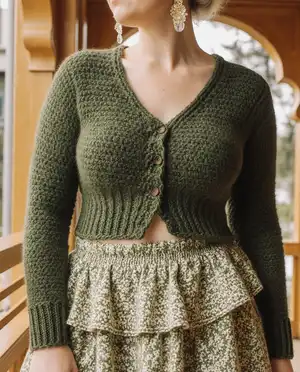
The Linneacardi is an elegant cropped cardigan that showcases beautiful cable details along the raglan lines and V-neck shaping. This pattern is worked seamlessly from the bottom up in the round, incorporating strategic waist shaping for a flattering fit. The steeking technique allows you to create a cardigan without the bulk of working back and forth, resulting in a professional finish with clean button bands.

Linneacardi Cropped Cardigan Knitting Pattern crochet pattern - detailed view of completed project

This versatile pattern includes eight size options and features customizable length adjustments at the hem and sleeves. The combination of ribbed edges, stockinette body, and cabled raglan details creates a timeless piece perfect for layering.

Why You'll Love This Linneacardi Cropped Cardigan Knitting Pattern

I absolutely love this pattern because it's a perfect introduction to steeking for knitters ready to expand their skills. The cabled raglan details add such elegant visual interest without being overwhelming, and I appreciate how the waist shaping creates a truly flattering silhouette. The pattern is clearly written with detailed instructions for every step, making advanced techniques feel achievable. I also love that you can customize the hem and sleeve lengths to suit your body perfectly, and the range of sizes means almost everyone can create their ideal cropped cardigan.

Linneacardi Cropped Cardigan Knitting Pattern step 1 - construction progress Linneacardi Cropped Cardigan Knitting Pattern step 2 - assembly progress Linneacardi Cropped Cardigan Knitting Pattern step 3 - details and accessories Linneacardi Cropped Cardigan Knitting Pattern step 4 - final assembly and finishing

Switch Things Up

I love experimenting with this pattern to make it uniquely mine! For a completely different look, I sometimes work the entire body in a textured stitch pattern like seed stitch or moss stitch instead of plain stockinette - it adds incredible dimension and makes the cables pop even more.

Color blocking is another favorite modification of mine. I'll work the body in one color, then switch to a contrasting shade for the sleeves and button bands. The steek technique makes this especially easy since you're working in the round.

If I'm feeling adventurous, I'll add additional cables along the front panels or incorporate a different cable pattern altogether. The beauty of this design is that the raglan construction provides a perfect canvas for customization.

For a more dramatic look, I sometimes lengthen the body to create a longer cardigan that hits at the hip rather than being cropped. I just continue the waist shaping for a few extra inches before starting the armhole bind-offs.

I've also played with the button band by adding decorative crochet edging or working it in a contrasting color. These small details can completely transform the final look while keeping the core structure intact.

Common Mistakes & How to Fix Them

โœ— Forgetting to maintain the steek stitches in the correct pattern throughout the yoke which can cause unraveling after cutting โœ— Not placing stitch markers correctly at the beginning which leads to misaligned raglan decreases and uneven sleeve caps โœ— Neglecting to work buttonholes at regular intervals resulting in mismatched button placement and an unprofessional finish โœ— Pulling too tightly during the V-neck decreases causing the neckline to pucker instead of lying flat and smooth

Linneacardi Cropped Cardigan Knitting Pattern

Create a stunning cropped cardigan featuring elegant cabled raglan sleeves and a flattering V-neck design. This beautiful pattern is knitted from the bottom up in the round, then steeked for a professional finish. The Linneacardi offers customizable sizing from XS to XXXL with detailed waist shaping and a classic button-front closure. Perfect for knitters ready to try steeking techniques while creating a versatile wardrobe staple that combines traditional craftsmanship with modern silhouette.

Advanced 35-45 Hours

Materials Needed for Linneacardi Cropped Cardigan Knitting Pattern

โ€” Main Fabric

  • 01
    Sport weight yarn approximately 550-1250 meters depending on size
  • 02
    Ystabรธ Gull Arvesรธlv in Skog color for sample shown (101 cm size)

โ€” Tools Required

  • 01
    3 mm (US 2.5) circular needles 80 cm (32 inches)
  • 02
    3 mm (US 2.5) double-pointed needles
  • 03
    3.5 mm (US 4) circular needles 60 cm (24 inches)
  • 04
    3.5 mm (US 4) circular needles 80 cm (32 inches)
  • 05
    3.5 mm (US 4) double-pointed needles
  • 06
    Approximately 7-10 buttons 12-15 mm diameter
  • 07
    Crochet hook for crochet steek (optional)
  • 08
    Scrap yarn or stitch holders
  • 09
    Stitch markers
  • 10
    Tapestry needle
  • 11
    Scissors

Progress Tracker

0% Complete

โ€” HEM

Setup :

With 3 mm (US 2.5) needles, cast on 141 (165) 189 (201) 209 (233) 257 (273) sts

Row 1 (RS) :

Sl1, [p1, k1] to end

Row 2 (WS) :

Sl1, [k1, p1] to end

Info :

Slip all stitches purlwise unless otherwise specified. Repeat Rows 1-2 until piece measures 1.5 cm (0.5 inches) finishing on WS row

Buttonhole Row (RS) :

Sl1, k4 (4) 4 (4) 6 (6) 6 (6), k2tog, yo, continue in pattern to end

Info :

Work a buttonhole on RS every 4 cm (1.5 inches). Continue until garment measures approximately 12 cm (4.75 inches), adjusting length to fit your upper body and waist

โ€” ADDING STEEK

Setup :

Slip first and last 9 (9) 11 (11) 13 (13) 15 (15) sts onto stitch holder for button bands. Cast on 5 sts for steek and work as: p2, k1, p2

Info :

First stitch after steek is now BOR; round ends before steek. Steek sts not included in overall stitch count. You should have 123 (147) 167 (179) 183 (207) 227 (243) sts excluding 5 steek sts

Next :

Switch to 3.5 mm (US 4) needles and join to work in the round. Work 1 cm (0.5 inches) in stockinette stitch

โ€” INCREASE FOR THE BUST

Place Markers :

Sl10 (11) 13 (14) 15 (17) 18 (19), pm, sl39 (48) 53 (57) 57 (65) 73 (78), pm, sl25 (29) 35 (37) 39 (43) 45 (49), pm, sl39 (48) 53 (57) 57 (65) 73 (78), pm, sl10 (11) 13 (14) 15 (17) 18 (19) sts plus 5 steek sts

Increase Round :

[K to marker, m1R, sm, k1, m1L, k to 1 st before next marker, m1R, k1, sm, m1L] twice, k to end then work steek in pattern (8 sts increased)

Info :

Work Increase Round every 1.5 cm (0.5 inches) for a total of 6 (6) 6 (6) 7 (7) 7 (8) times. You should have 171 (195) 215 (227) 239 (263) 283 (307) sts excluding 5 steek sts

Next :

Work another 2 cm (0.75 inches) after final increase. Stockinette section should measure approximately 10.5 (10.5) 10.5 (10.5) 12 (12) 12 (13.5) cm or 4.25 (4.25) 4.25 (4.25) 4.75 (4.75) 4.75 (5.25) inches

Bind Off for Sleeves :

Knit 41 (47) 52 (55) 58 (64) 68 (74) sts, bind off 6 (6) 6 (6) 6 (6) 8 (8) sts, knit 77 (89) 99 (105) 111 (123) 131 (143) sts, bind off 6 (6) 6 (6) 6 (6) 8 (8) sts, knit to end and work steek in pattern. Put body aside

โ€” SLEEVES

Info :

Make 2 sleeves. Sleeves have narrow cuff with increases toward shoulder. For wider cuffs, cast on more stitches and increase fewer times

Setup :

With 3 mm (US 2.5) needles, cast on 40 (42) 42 (44) 44 (46) 46 (48) sts. Join to work in round and mark BOR

Cuff :

Work 1x1 rib (k1, p1) in round until work measures 12 cm (4.75 inches) or preferred cuff length

Next :

Switch to 3.5 mm (US 4) needles

Increase Round :

M1L, k to end, m1R (2 sts increased)

Info :

Work Increase Round every 2.5 (2.5) 2 (2) 1.5 (1.5) 1 (1) cm or 1 (1) 0.75 (0.75) 0.5 (0.5) 0.25 (0.25) inches for total of 11 (12) 14 (16) 19 (22) 26 (29) times. You should have 62 (66) 70 (76) 82 (90) 98 (106) sts

Continue :

Work until sleeve measures approximately 44 (44) 45 (45) 46 (46) 47 (47) cm or 17.25 (17.25) 17.75 (17.75) 18 (18) 18.5 (18.5) inches or desired length

Bind Off :

Work to 3 (3) 3 (3) 3 (3) 4 (4) sts before marker on last round, bind off next 6 (6) 6 (6) 6 (6) 8 (8) sts. Work other sleeve in same manner

โ€” JOINING SLEEVES TO BODY

Joining Round :

K to 4 sts before underarm bind-off on Right Front, pm, k4, k4 on one sleeve, pm, k to 4 sts before end of Right Sleeve, pm, k4, k4 on Back, pm, k to 4 sts before other underarm bind-off on Back, pm, k4, k4 on other sleeve, pm, k to 4 sts before end of Left Sleeve, pm, k4, k4 on Left Front, pm, k to end, work steek in pattern

Info :

You should now have 271 (303) 331 (355) 379 (419) 447 (487) sts excluding 5 steek sts

โ€” RAGLAN DECREASES WITH CABLES

Info :

Work Fronts, Back, Sleeves, and Raglan Cables as follows: Right Front, Cable A, Right Sleeve, Cable B, Back, Cable A, Left Sleeve, Cable B, Left Front

Cable A :

C8B - slip 4 sts purlwise onto cable needle held behind work, k4, then k4 sts from cable needle

Cable B :

C8F - slip 4 sts purlwise onto cable needle held in front of work, k4, then k4 from cable needle

Info :

Work cables every 4th round. Knit the 8 sts the other 3 rounds. Begin with raglan decreases only on front and back pieces. Slip all markers as you come to them

Decrease Round :

K to 2 sts before 1st marker, k2tog, k to 4th marker, sm, ssk, k to 2 sts before 5th marker, k2tog, k to 8th marker, sm, ssk (4 sts decreased)

Next Round :

K to end

Info :

Work previous 2 rounds another 2 times

Decrease Round :

[K to 2 sts before marker, k2tog, work in cable pattern to next marker, ssk] 4 times, k to end and work steek in pattern (8 sts decreased)

Next Round :

K to end

Info :

Work previous 2 rounds total of 8 (6) 5 (6) 9 (11) 13 (15) times. You should have 195 (243) 279 (295) 295 (319) 331 (355) sts excluding 5 steek sts

โ€” V-NECK SHAPING

Info :

From here on, include decrease for V-neck on every other row while continuing raglan decreases and cables

Decrease Round :

Ssk, [k to 2 sts before marker, k2tog, work in cable pattern to next marker, ssk] 4 times, k to 2 sts before end, k2tog, work steek in pattern (10 sts decreased)

Next Round :

K to end

Info :

Work previous 2 rounds total of 12 (16) 19 (20) 20 (22) 23 (25) times. On last round, bind off steek stitches

Final Count :

There should be 2 sts remaining on each front piece and total of 75 (83) 89 (95) 95 (99) 101 (105) sts on needle

Info :

Reinforce steek by machine sewing, hand sewing or crochet before separating fronts along center column of stitches of steek

โ€” BUTTON BAND AND BUTTONHOLE BAND

Setup :

Place 9 (9) 11 (11) 13 (13) 15 (15) sts set aside after ribbed hem back onto 3 mm (US 2.5) needle. Cast on 6 extra sts on cardigan side for facing to cover steeked edge later

Facing Stitches :

Work these 6 sts in Stockinette st - purl on right side row and knit on wrong side row. Rest of band worked in 1x1 rib following established pattern

Buttonhole Band :

Add buttonhole every 4 cm (1.5 inches) on band same way as for ribbed hem, up to where decreases for neck shaping begins, approximately 8 (7) 7 (8) 8 (8) 9 (10) holes total

Button Band :

Simply work in pattern and do not forget to cast on extra stitches for facing

Info :

Work both bands same length as steek, stretch bands little before measuring. Bind off sts for facing and place ribbed sts on needle with rest of sts (fronts, sleeves, back)

Tip :

Sew bands to cardigan before completing neck portion of band to make sure length is correct

โ€” THE REST OF THE NECK BAND

Info :

Button band and buttonhole band worked back and forth and joined to rest of garment as you go (knitting last st from band together with live st from yoke once every 2 rows). Knit neck bands onto each front one at a time and finish by joining two bands together at back of neck using kitchener stitch

Row 1 :

Work 8 (8) 10 (10) 12 (12) 14 (14) sts in pattern, k2tog/p2tog last st on band with first st on garment, turn work

Row 2 :

Sl1, work 8 (8) 10 (10) 12 (12) 14 (14) in pattern, turn work

Info :

Work last 2 rows until first 10 neck sts are attached to band (when you have just passed first cable)

Continue :

[Sl1, work 7 (7) 9 (9) 11 (11) 13 (13) sts in pattern, k2tog/p2tog according to pattern, slide st back to left needle, k2tog/p2tog. Turn work. Work remaining 8 (8) 10 (10) 12 (12) 14 (14) in pattern, turn work] until you reach center of back piece

Repeat :

Repeat on other side

Final Join :

You should now have 9 (9) 11 (11) 13 (13) 15 (15) sts left on each band. Using kitchener stitch, sew last sts together

โ€” FINISHING

Final Steps :

Sew gap at underarms together and weave all ends. Tack down button band and buttonhole band if not already done, and fasten facing of button and buttonhole band loosely. Sew buttons in place

Assembly Instructions

  • After completing all knitting, carefully reinforce the steek using your preferred method (machine sewing, hand sewing, or crochet) before cutting
  • Cut the steek open along the center column of stitches using sharp scissors, being careful not to cut the reinforcement
  • Pick up and knit the button band stitches from the stitch holder and work with the 6 additional facing stitches as instructed
  • Sew the button bands to the cardigan fronts, stretching slightly to ensure they lie flat and match the length of the steeked edge
  • Work the neck band by joining it to the live stitches of the yoke as you knit, ensuring even tension throughout
  • Use kitchener stitch to graft the two neck band sections together at the center back for an invisible seam
  • Sew the small gaps at the underarms closed using mattress stitch or your preferred seaming method, then weave in all loose ends securely

Important Notes

  • ๐Ÿ’กMaintain consistent tension on the steek stitches throughout the project to ensure clean cutting later
  • ๐Ÿ’กUse stitch markers liberally to track your place in the pattern, especially during the complex raglan decreases
  • ๐Ÿ’กBlock your finished cardigan before wearing to even out stitches and ensure proper drape of the fabric
  • ๐Ÿ’กIf you're new to steeking, practice on a swatch first to build confidence before cutting your actual garment
  • ๐Ÿ’กConsider the button placement carefully and pin buttons in place before sewing to ensure even spacing
  • ๐Ÿ’กThe waist shaping is crucial for fit - adjust the number of increases if you prefer a looser or tighter silhouette
  • ๐Ÿ’กTake accurate body measurements before starting and choose your size based on the finished measurements with suggested ease

The Linneacardi pattern brings together classic knitting techniques with modern design sensibility to create a truly special garment. The combination of cables, steeking, and thoughtful shaping results in a cardigan that's both beautiful and functional. This pattern is perfect for knitters looking to challenge themselves while creating a versatile piece they'll wear for years. The detailed instructions and multiple size options ensure success for every knitter ready to take on this rewarding project. Happy knitting! ๐Ÿงถโœจ

You ask,

we answer.

FAQs

What is steeking and do I have to use this technique?

Steeking is a technique where you knit a cardigan in the round (which is faster and easier), then cut it open at the end. The pattern mentions you can work back and forth instead if you prefer not to steek, though specific instructions for this alternative aren't included in the pattern.

How do I choose the right size for this cardigan?

Measure your bust circumference and compare it to the finished bust measurements in the pattern. The suggested ease is -5 to +5 cm (-0.75 to +0.75 inches), meaning you can choose a size slightly smaller or larger than your actual bust measurement for your preferred fit.

Can I adjust the length of the cardigan or sleeves?

Yes! The pattern specifically mentions adjusting the hem length before adding the steek to fit your upper body and waist. You can also customize the sleeve length by working to your desired measurement before binding off for the underarm.

What is the gauge and why is it important?

The gauge is 23 stitches = 10 cm (4 inches) in stockinette stitch. Matching this gauge is crucial to ensure your finished cardigan matches the pattern's measurements. Always knit a gauge swatch and adjust needle size if necessary.

How much yarn do I need for my size?

Yarn requirements range from 550 meters for the smallest size (XS) to 1250 meters for the largest size (XXXL). Always buy a little extra to account for tension differences and to ensure you have enough from the same dye lot.

What does the cable pattern look like and how difficult is it?

The cables run along the raglan lines and consist of 8-stitch cables (C8B and C8F) worked every 4th round. If you've worked basic cables before, these will be straightforward - they're worked over just 8 stitches and create elegant lines along the shoulders.