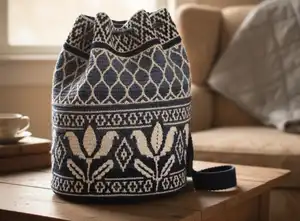
Create your own stunning Lili Backpack with this intermediate-level crochet pattern featuring beautiful overlay mosaic crochet techniques. This stylish and functional backpack measures 35cm x 34.5cm and showcases an intricate floral design worked in complementary colors. The pattern includes detailed instructions for the bag body, straps, lining, and finishing touches to create a professional-looking handmade accessory perfect for everyday use or special occasions.
Progress Tracker
0% Complete
— Bag Bottom:
Round 1 (RS):
with A make 32sts of foundation cord, turn, ch1, 3sc in same st, 30sc, 3sc in last st, other side of foundation cord: 30sc, ss in 1st sc (66sc)
Round 2:
ch1, *3inc, pm, 30sc, pm, rep from * except don't pm at the end of rnd, ss (72sc)
Round 3:
ch1, *[inc, sc]x3, 30sc, rep from *, ss (78sc)
Round 4:
ch1, *[2sc, inc]x3, 30sc, rep from *, ss (84sc)
Round 5:
ch1, *[inc, 3sc]x3, 30sc, rep from *, ss (90sc)
Round 6:
ch1, *3sc, [inc, 4sc]x2, inc, sc, 30sc, rep from *, ss (96sc)
Round 7:
ch1, *sc, [inc, 5sc]x2, inc, 4sc, 30sc, rep from *, ss (102sc)
Round 8:
ch1, *[6sc, inc]x3, 30sc, rep from *, ss (108sc)
Round 9:
ch1, *4sc, [inc, 7sc]x2, inc, 3sc, 30sc, rep from *, ss (114sc)
Round 10:
ch1, *[inc, 8sc]x3, 30sc, rep from *, ss (120sc)
Round 11:
ch1, *7sc, [inc, 9sc]x2, inc, 2sc, 30sc, rep from *, ss (126sc)
Round 12:
ch1, *3sc, [inc, 10sc]x2, inc, 7sc, 30sc, rep from *, ss (132sc)
Round 13:
ch1, *7sc, [inc, 11sc]x2, inc, 4sc, 30sc, rep from *, ss (138sc)
Round 14:
ch1, *[12sc, inc]x3, 30sc, rep from *, ss (144sc)
Round 15:
ch1, *5sc, [inc, 13sc]x2, inc, 8sc, 30sc, rep from *, ss (150sc)
Round 16:
ch1, *sc, [inc, 14sc]x2, inc, 13sc, 30sc, rep from *, ss (156sc)
Round 17:
ch1, *10sc, [inc, 15sc]x2, inc, 5sc, 30sc, rep from *, ss (162sc)
Round 18:
ch1, *4sc, [inc, 16sc]x2, inc, 12sc, 30sc, rep from *, ss (168sc)
Round 19:
ch1, *15sc, [inc, 17sc]x2, inc, 2sc, 30sc, rep from *, ss (174sc)
Round 20:
ch1, *10sc, [inc, 18sc]x2, inc, 8sc, 30sc, rep from *, ss (180sc)
Round 21:
ch1, *5sc, [inc, 19sc]x2, inc, 14sc, 30sc, rep from *, ss (186sc)
Round 22:
ch1, *15sc, [inc, 20sc]x2, inc, 5sc, 30sc, rep from *, ss (192sc)
Round 23:
ch1, *11sc, [inc, 21sc]x2, inc, 10sc, 30sc, rep from *, ss (198sc)
Round 24:
ch1, *[inc, 22sc]x3, 30sc, rep from *, ss (204sc). Fasten off.
Info:
Wash and dry according to Care section. Measure length (L=26cm/10.25 inches) and width (W=16cm/6.25 inches). Trace bag bottom to paper and cut template for lining.
— Bag Body:
Info:
Join B: fold bottom in half width-wise, join B in fold at the long side (the one with rounds joining line)
Rounds 1-3:
with B ch1, 204sc, ss. Switch to C at end of Round 3
Round 4:
with C ch1, 204sc, with B ss
Round 5:
with B ch1, 204sc, with C ss
Round 7:
with B *sc, 3dc, [3sc, dc]x6, 3sc, 3dc, rep from * x5, with C ss
Round 8:
with C *dc, 3sc, dc, sc, dc, [2sc, dc, 2sc, dc, sc, dc]x3, 3sc, rep from * x5, with B ss
Round 9:
with B *sc, 2dc, [2sc, dc, 2sc, dc, sc, dc]x3, 2sc, dc, 2sc, 2dc, rep from *x5, with C ss
Round 10:
with C *dc, 2sc, dc, [3sc, dc]x7, 2sc, rep from * x5, with B ss
Round 11:
with B *sc, 2dc, [2sc, dc, 2sc, dc, sc, dc]x3, 2sc, dc, 2sc, 2dc, rep from * x5, with C ss
Round 12:
with C *dc, 3sc, dc, sc, dc, [2sc, dc, 2sc, dc, sc, dc]x3, 3sc, rep from * x5, with B ss
Round 13:
with B *2sc, 2dc, [3sc, dc]x7, dc, sc, rep from * x5, with C ss
Round 14:
with C *dc, dc2inc, sk dc, 29sc (1st in 2nd of 2dc, last in 1st of 2dc), sk dc, dc2inc, rep from * x5, with B ss
Round 15:
with B *sc, FPhdc, 4sc, 2dc, 19sc, 2dc, 4sc, FPhdc, rep from * x5, with C ss
Round 16:
with C *dc, sc, dc, sc, dc, dc2inc, sk dc, 21sc (1st in 2nd of 2dc, last in 1st of 2dc), sk dc, dc2inc, dc, sc, dc, sc, rep from * x5, with B ss
Round 17:
with B *sc, dc2inc (in FPhdc), sk dc, 2sc, tr (in sc below 2nd st back), 3sc (1st in 2nd dc of dc2inc), dc2tog (1st leg in sc below prev sc), 15dc, dc2tog, 3sc (1st above 2nd leg of prev st, last in 1st dc of dc2inc), tr (in sc below 3rd st forward), 2sc (1st in dc, 2nd in sc), sk dc, dc2inc (in FPhdc), rep from * x5, with C ss
Round 18:
with C *dc, 2sc, dc2tog (1st leg in dc below prev st), dc, sc (in tr), 3dc (1st in 2nd dc of dc2inc), 17sc (1st and last in dc2tog), 3dc (last in 1st dc of dc2inc), sc (in tr), dc (in dc), dc2tog (2nd leg in dc), 2sc, rep from * x5, with B ss
Round 19:
with B *sc, 2dc, 4sc (1st in dc2tog), FPtr in tr, 2sc (1st in dc), dc2tog (1st leg in dc2tog or below prev st), 6dc, sc, 6dc, dc2tog (2nd leg in dc2tog), 2sc (1st in sc made in same dc2tog), FPtr in tr, 4sc (last in dc2tog), 2dc, rep from * x5, with C ss
Round 20:
with C *dc, 4sc, dc2tog (1st leg in dc below prev sc), dc (in 1st of 3dc), sc (in FPtr), dc (in 3rd of 3dc), dc2inc (in next sc), sk dc2tog, 6sc (1st in next dc after dc2tog), dc, 6sc (last in dc before dc2tog), sk dc2tog, dc2inc (in sc below next sc after dc2tog), dc (in 1st of 3dc), sc (in FPtr), dc (in 3rd of 3dc), dc2tog (1st leg in sc, 2nd leg in dc), 4sc (1st in st above prev leg), rep from * x5, with B ss
Round 21:
with B *sc, 3dc, dc2inc, sk dc2tog, 3sc (2nd in sc above FPtr), FPtr (in FPtr), sc (in 2nd dc of dc2inc), 5dc, 3sc (2nd in dc), 5dc, sc (in 1st dc of dc2inc), FPtr (in FPtr), 3sc (2nd in sc above FPtr), sk dc2tog, dc2inc (in next sc), 3dc, rep from * x5, with C ss
Round 22:
with C *dc, 6sc, dc2tog (1st leg in dc below prev st, 2nd in sc), dc (in dc), sc (in FPtr), dc2inc (in 2nd dc of dc2inc), sk dc, 4sc, dc, sc, dc, 4sc, sk dc, dc2inc (in 1st dc of dc2inc), sc (in FPtr), dc (in dc), dc2tog (1st leg in sc, 2nd leg in dc), 6sc (1st in sc above prev leg), rep from * x5, with B ss
Round 23:
with B *2sc, 4dc, dc2inc (in sc after dc2inc), sk dc2tog, 4sc (2nd in sc above FPtr), 3dc, 2sc, dc, 2sc, 3dc, 4sc (3rd in sc above FPtr), sk dc2tog, dc2inc (in sc), 4dc, sc, rep from * x5, with C ss
Round 24:
with C *2dc, 7sc, dc2tog (1st leg in dc below prev st, 2nd leg in sc above FPtr), 2dc, 3sc, dc, 3sc, dc, 3sc, 2dc, dc2tog (1st leg in sc above FPtr), 7sc (1st in st above prev leg), dc, rep from * x5, with B ss
Round 25:
with B *4sc, 6 left-slanted dc (in 5dc and sc; 1st in dc below prev sc), sk dc2tog, 2sc, 2dc, 2sc, dc, sc, dc, 2sc, 2dc, 2sc, sk dc2tog, 6 right-slanted dc (1st in sc after dc2tog, each in st below next st), 3sc (1st in st above st with prev dc), rep from * x5, with C ss
Round 26:
with C *3sc, dc2tog (1st leg in st below prev sc), 2FPhdc (in 1st and 2nd of 6 dc), 8sc, dc, 2sc, dc, 2sc, dc, 8sc, 2 FPhdc (in last 2dc of 6), dc2tog, 2sc (1st in st above st with prev leg), rep from * x5, with B ss
Round 27:
with B *sc, 2dc, 6sc (1st in dc2tog), dc2tog (1st leg in st below prev sc), 3dc, 2sc, dc, 3sc, dc, 2sc, 3dc, dc2tog, 6sc (1st in st above prev leg, 4th and 5th in FPhdc, 6th in dc2tog), 2dc, rep from * x5, with C ss
Round 28:
with C dc2inc, *sk dc, 2sc (1st in dc, 2nd in sc), 6 left-slanted dc (1st in dc2tog below prev sc), sk dc2tog, 3sc, dc, 2sc, dc, sc, dc, 2sc, dc, 3sc, 6 right-slanted dc (1st in sc after dc2tog, 4th and 5th in FPhdc), 2sc (1st in sc above dc2tog with last dc), sk dc**, dc3inc in sc, rep from * x4, rep from * to **, dc in same st as beg dc2inc (tog count as dc3inc), with B ss
Round 29:
with B *2sc, dc, dc2inc, sk dc, 5sc, dc2tog (1st leg in dc2tog), 2dc, 2sc, dc, 3sc, dc, 2sc, 2dc, dc2tog (2nd leg in dc2tog), 5sc, sk dc, dc2inc, dc, sc, rep from * x5, with C ss
Round 30:
with C *dc, dc2inc, sk dc, 2sc (in dc2inc), 4dc, dc2inc, sk dc2tog, 3sc, dc, 2sc, dc, 2sc, dc, 3sc, sk dc2tog, dc2inc (in next dc), 4dc, 2sc (in dc2inc), sk dc, dc2inc, rep from * x5, with B ss
Round 31:
with B *3sc, 2dc, 6sc, 3dc (2 in dc, last in sc), 2sc, dc, sc, dc, 2sc, 3dc, 6sc, 2dc, 2sc, rep from * x5, with C ss
Round 32:
with C *2dc, dc2inc, 2 left-slanted sc (in 2dc), 6dc, sk dc, 3sc, dc, 3sc, dc, 3sc, sk dc, 6dc, 2 right-slanted sc (in 2dc), dc2inc, dc, rep from * x5, with B ss
Round 33:
with B *4sc, 2dc, 6sc, 3dc (2 in dc, last in sc), 2sc, dc, 2sc, 3dc, 6sc, 2dc, 3sc, rep from * x5, with C ss
Round 34:
with C *4dc, 2sc, 6dc, 4sc, dc, sc, dc, 4sc, 6dc, 2sc, 3dc, rep from * x5, with B ss
Round 35:
with B *4sc, 2dc, 6sc, 4dc, 3sc, 4dc, 6sc, 2dc, 3sc, rep from * x5, with C ss
Round 36:
with C *4dc, 3sc, 6 left-slanted dc (1st in st below prev sc), sk dc, sc, FPhdc, 2sc, dc, 2sc, FPhdc, sc, sk dc, 6 right-slanted dc (in 6 dc), 3sc (1st in sc above st with prev dc), 3dc, rep from * x5, with B ss
Round 37:
with B *3sc, sk dc, dc2inc, dc, dc2inc, sk dc, 7sc (last in FPhdc), 2dc, sc, 2dc, 7sc (1st in FPhdc), sk dc, dc2inc, dc, dc2inc, sk dc, 2sc, rep from * x5, with C ss
Round 38:
with C *2dc, dc2tog, 6sc (in 5dc, last in sc), dc2tog (1st leg in dc below prev sc), 3dc, dc2tog (2nd leg in FPhdc), 7sc (1st in sc above FPhdc), dc2tog (1st leg in FPhdc), 3dc, dc2tog, 6sc (1st in sc above dc with prev leg), dc2tog (1st leg in 1st of 7dc), dc, rep from * x5, with B ss
Round 39:
with B *2sc, sk dc2tog, dc2inc, 5dc (4 in dc, last in sc), 5sc (1st and last in dc2tog), 7dc, 5sc (1st and last in dc2tog), 5dc (1st in sc, 4 in dc), dc2inc, sk dc2tog, sc, rep from * x5, with C ss
Round 40:
with C *dc, dc2tog (2nd leg in dc2tog), 31sc, dc2tog (1st leg in dc2tog), rep from * x5, with B ss
Round 41:
with B *sc, sk dc2tog, dc2inc (in 1st dc of dc2inc), dc, 27sc, dc, dc2inc (in 2nd dc of dc2inc), sk dc2tog, rep from * x5, with C ss
Round 42:
with C sc2tog (2nd leg in dc2tog), [33sc, sc3tog (1st and 3rd legs in dc2tog)]x5, 33sc, sc in dc2tog, but do not finish: with 2 lps on hook, with B ss
Round 43:
with B *FPsc (in sc3tog), 3dc, [3sc, dc]x6, 3sc, 3dc, rep from * x5, with C ss
Rounds 44-52:
Continue mosaic pattern as written in pattern, maintaining color changes and stitch pattern through Round 52
Round 53 (Dec):
with B [49dc, dc2tog]x4, with C ss (200 sts)
Rounds 54-55:
Continue pattern maintaining 200 sts
Rounds 56-106:
Continue following pattern instructions for mosaic design and upper edge
Round 107 (Dec):
with A [23sc blo, sc2tog blo]x8, ss (192sc)
Rounds 108-120:
with A 192sc blo, ss. Fasten off after Round 120.
— Strap Loop:
Step 1:
Facing RS of bag back side, skip 1 rhombus to right from rounds beginning point, join A in upper edge, ch16
Step 2:
Turn, skip 1 rhombus to left from rounds beginning point, ss in upper edge, turn, ch16, ss in starting point, turn, ch16, ss in finishing point, turn, ch16, ss in starting point (4x ch-16sps)
Step 3:
Make approximately 22sc to cover loop entirely. Make sc in all four ch-16sps at same time, placing sc close together. Fasten off.
— Straps:
Row 1:
leave 50cm tail, make 10 sts of foundation cord, turn, ch1, sc in each foundation st, turn
Rows 2-367:
or to 75cm or desired length: ch1, 9sc (each made in upside-down V), sk 2lps after last upside-down V, sc in spot after 2lps, turn. Fasten off leaving 50cm tail.
— Lining:
Step 1:
Measure straight part of bag excluding bottom and upper edge backing: 34.5cm. Add 2cm for adjustment and 1.5cm for seam allowance: 38cm total
Step 2:
Measure bag width (35.12cm), multiply x2 (70.24cm), add 3cm for seam allowance (73.24cm). Cut rectangle 73.24cm x 38cm
Step 3:
Cut bottom using previously made template, adding 1.5cm around for seam allowance. Baste side seam with 1.5cm seam allowance
Step 4:
Fold piece in half, place seam in middle of one side. Insert lining into bag, check fit, make adjustments. Make side seam, overcast edges separately, press open
Step 5:
Fold bottom in half both ways and mark folds to create 4 equal parts
Step 6:
Fold lining at side seam, mark fold on other side. Align side seam and marker, mark folds on both sides for 4 equal parts
Step 7:
Place lining and bottom right sides together. Align side seam with middle mark of bottom long side, pin and baste together
Step 8:
Stitch pieces together with 1.5cm seam allowance. Overcast edges together, fold towards bag bottom and hand-stitch allowances to bag bottom with whip-stitch
The Lili Backpack pattern brings together timeless crochet techniques and modern design to create a truly stunning accessory. With its intricate overlay mosaic floral motifs and practical construction featuring a quilted lining and adjustable straps, this backpack is both beautiful and functional. The pattern includes comprehensive video support and detailed instructions to guide you through each step. Whether you're looking to expand your crochet skills or create a unique handmade piece, this pattern offers the perfect blend of challenge and reward. Happy crocheting! 🧶✨