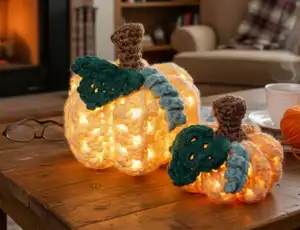
Create enchanting lighted pumpkins perfect for autumn décor with this delightful granny square pattern! Available in three sizes (small, medium, and large), these charming pumpkins feature beautiful granny square texture and are designed to hold battery-operated LED fairy lights inside. Complete with adorable stems, curly vines, and leaves, they bring a warm, cozy glow to any space. Whether you're decorating your home for fall or creating heartfelt handmade gifts, these lighted pumpkins are sure to brighten everyone's day with their magical illumination and handcrafted charm.
Progress Tracker
0% Complete
— LARGE PUMPKIN :
Row 1 :
sc in second chain from hook and in next st, 2 sc, sc, [2 sc in next 2 st, sc] 2 times, 2 sc, sc in last 2 st. Ch 1, turn. (19 st)
Row 2 :
sc in first two st, ch 1, sk st, [3 dc in next st, ch 1, sk 2 st] 4 times, 3 dc in next st, ch 1, sk st, sc in last 2 st. Ch 1, turn. (2 sc on each end + 5 granny clusters)
Row 3 :
sc in first two st, ch 1, dc in first ch-1 space, ch 1, [sk 3 st, 3 dc in next ch-1 space, ch 1] 4 times, sk 3 st, dc in last ch-1 space, ch 1, sc in last two st. Ch 1, turn. (2 sc on each end + 4 granny clusters)
Row 4 :
sc in first two st, ch 1, sk first ch and dc st, [3 dc in next ch-1 space, ch 1, sk 3 st] 4 times, 3 dc in next ch-1 space, ch 1, sk last dc and ch-1 space, sc in last 2 st. Ch 1, turn. (2 sc on each end + 5 granny clusters)
Row 5 :
sc in first two st, ch 1, dc in first ch-1 space, ch 1, [sk 3 st, 3 dc in next ch-1 space, ch 1] 4 times, sk 3 st, dc in last ch-1 space, ch 1, sc in last two st. Ch 1, turn. (2 sc on each end + 4 granny clusters)
Row 6 :
sc in first 2 st, [sc2tog, sc] 5 times, sc in last st. Ch 1, turn. (13 stitches)
Info :
For this decrease row, do not count ch-1 spaces as stitches; skip over them as though they don't exist
Row 7 :
working in front loops only — sc in first 2 st, 2 sc, sc, [2 sc in next 2 st, sc] 2 times, 2 sc, sc in last 2 st. Ch 1, turn. (19 st)
Row 8 :
working in both loops from now on — sc in first two st, ch 1, sk st, [3 dc in next st, ch 1, sk 2 st] 4 times, 3 dc in next st, ch 1, sk st, sc in last 2 st. Ch 1, turn. (2 sc on each end + 5 granny clusters)
Row 9 :
sc in first two st, ch 1, dc in first ch-1 space, ch 1, [sk 3 st, 3 dc in next ch-1 space, ch 1] 4 times, sk 3 st, dc in last ch-1 space, ch 1, sc in last two st. Ch 1, turn. (2 sc on each end + 4 granny clusters)
Row 10 :
sc in first two st, ch 1, sk first ch-1 space and dc st, [3 dc in next ch-1 space, ch 1, sk 3 st] 4 times, 3 dc in next ch-1 space, ch 1, sk last dc and ch-1 space, sc in last 2 st. Ch 1, turn. (2 sc on each end + 5 granny clusters)
Row 11 :
sc in first two st, ch 1, dc in first ch-1 space, ch 1, [sk 3 st, 3 dc in next ch-1 space, ch 1] 4 times, sk 3 st, dc in last ch-1 space, ch 1, sc in last two st. Ch 1, turn. (2 sc on each end + 4 granny clusters)
Row 12 :
sc in first 2 st, [sc2tog, sc] 5 times, sc in last st. Ch 1, turn. (13 stitches)
Row 13 :
working in front loops only — sc in first 2 st, 2 sc, sc, [2 sc in next 2 st, sc] 2 times, 2 sc, sc in last 2 st. Ch 1, turn. (19 st)
Row 14 :
working in both loops from now on — sc in first two st, ch 1, sk st, [3 dc in next st, ch 1, sk 2 st] 4 times, 3 dc in next st, ch 1, sk st, sc in last 2 st. Ch 1, turn. (2 sc on each end + 5 granny clusters)
Row 15 :
sc in first two st, ch 1, dc in first ch-1 space, ch 1, [sk 3 st, 3 dc in next ch-1 space, ch 1] 4 times, sk 3 st, dc in last ch-1 space, ch 1, sc in last two st. Ch 1, turn. (2 sc on each end + 4 granny clusters)
Row 16 :
sc in first two st, ch 1, sk first ch-1 space and dc st, [3 dc in next ch-1 space, ch 1, sk 3 st] 4 times, 3 dc in next ch-1 space, ch 1, sk last dc and ch-1 space, sc in last 2 st. Ch 1, turn. (2 sc on each end + 5 granny clusters)
Row 17 :
sc in first two st, ch 1, dc in first ch-1 space, ch 1, [sk 3 st, 3 dc in next ch-1 space, ch 1] 4 times, sk 3 st, dc in last ch-1 space, ch 1, sc in last two st. Ch 1, turn. (2 sc on each end + 4 granny clusters)
Row 18 :
sc in first 2 st, [sc2tog, sc] 5 times, sc in last st. Ch 1, turn. (13 stitches)
Row 19 :
working in front loops only — sc in first 2 st, 2 sc, sc, [2 sc in next 2 st, sc] 2 times, 2 sc, sc in last 2 st. Ch 1, turn. (19 st)
Row 20 :
working in both loops from now on— sc in first two st, ch 1, sk st, [3 dc in next st, ch 1, sk 2 st] 4 times, 3 dc in next st, ch 1, sk st, sc in last 2 st. Ch 1, turn. (2 sc on each end + 5 granny clusters)
Row 21 :
sc in first two st, ch 1, dc in first ch-1 space, ch 1, [sk 3 st, 3 dc in next ch-1 space, ch 1] 4 times, sk 3 st, dc in last ch-1 space, ch 1, sc in last two st. Ch 1, turn. (2 sc on each end + 4 granny clusters)
Row 22 :
sc in first two st, ch 1, sk first ch-1 space and dc st, [3 dc in next ch-1 space, ch 1, sk 3 st] 4 times, 3 dc in next ch-1 space, ch 1, sk last dc and ch-1 space, sc in last 2 st. Ch 1, turn. (2 sc on each end + 5 granny clusters)
Row 23 :
sc in first two st, ch 1, dc in first ch-1 space, ch 1, [sk 3 st, 3 dc in next ch-1 space, ch 1] 4 times, sk 3 st, dc in last ch-1 space, ch 1, sc in last two st. Ch 1, turn. (2 sc on each end + 4 granny clusters)
Row 24 :
sc in first 2 st, [sc2tog, sc] 5 times, sc in last st. Ch 1, turn. (13 stitches)
Row 25 :
working in front loops only — sc in first 2 st, 2 sc, sc, [2 sc in next 2 st, sc] 2 times, 2 sc, sc in last 2 st. Ch 1, turn. (19 st)
Row 26 :
working in both loops from now on — sc in first two st, ch 1, sk st, [3 dc in next st, ch 1, sk 2 st] 4 times, 3 dc in next st, ch 1, sk st, sc in last 2 st. Ch 1, turn. (2 sc on each end + 5 granny clusters)
Row 27 :
sc in first two st, ch 1, dc in first ch-1 space, ch 1, [sk 3 st, 3 dc in next ch-1 space, ch 1] 4 times, sk 3 st, dc in last ch-1 space, ch 1, sc in last two st. Ch 1, turn. (2 sc on each end + 4 granny clusters)
Row 28 :
sc in first two st, ch 1, sk first ch-1 space and dc st, [3 dc in next ch-1 space, ch 1, sk 3 st] 4 times, 3 dc in next ch-1 space, ch 1, sk last dc and ch-1 space, sc in last 2 st. Ch 1, turn. (2 sc on each end + 5 granny clusters)
Row 29 :
sc in first two st, ch 1, dc in first ch-1 space, ch 1, [sk 3 st, 3 dc in next ch-1 space, ch 1] 4 times, sk 3 st, dc in last ch-1 space, ch 1, sc in last two st. Ch 1, turn. (2 sc on each end + 4 granny clusters)
Row 30 :
sc in first 2 st, [sc2tog, sc] 5 times, sc in last st. Ch 1, turn. (13 stitches)
Row 31 :
working in front loops only — sc in first 2 st, 2 sc, sc, [2 sc in next 2 st, sc] 2 times, 2 sc, sc in last 2 st. Ch 1, turn. (19 st)
Row 32 :
working in both loops from now on — sc in first two st, ch 1, sk st, [3 dc in next st, ch 1, sk 2 st] 4 times, 3 dc in next st, ch 1, sk st, sc in last 2 st. Ch 1, turn. (2 sc on each end + 5 granny clusters)
Row 33 :
sc in first two st, ch 1, dc in first ch-1 space, ch 1, [sk 3 st, 3 dc in next ch-1 space, ch 1] 4 times, sk 3 st, dc in last ch-1 space, ch 1, sc in last two st. Ch 1, turn. (2 sc on each end + 4 granny clusters)
Row 34 :
sc in first two st, ch 1, sk first ch-1 space and dc st, [3 dc in next ch-1 space, ch 1, sk 3 st] 4 times, 3 dc in next ch-1 space, ch 1, sk last dc and ch-1 space, sc in last 2 st. Ch 1, turn. (2 sc on each end + 5 granny clusters)
Row 35 :
sc in first two st, ch 1, dc in first ch-1 space, ch 1, [sk 3 st, 3 dc in next ch-1 space, ch 1] 4 times, sk 3 st, dc in last ch-1 space, ch 1, sc in last two st. Ch 1, turn. (2 sc on each end + 4 granny clusters)
Row 36 :
sc in first 2 st, [sc2tog, sc] 5 times, sc in last st. Ch 1, turn. (13 stitches)
Finish :
Finish off, leaving 14 inch yarn tail
— MEDIUM PUMPKIN :
Row 1 :
sc in second ch from hook and in next st, 2 sc, sc, 2 sc in next 3 st, sc, 2 sc, sc in last 2 st. Ch 1, turn. (16 st)
Row 2 :
sc in first two st, ch 1, sk st, [3 dc in next st, ch 1, sk 2 st] 3 times, 3 dc in next st, ch 1, sk st, sc in last 2 st. Ch 1, turn. (2 sc on each end + 4 granny clusters)
Row 3 :
sc in first two st, ch 1, dc in first ch-1 space, ch 1, [sk 3 st, 3 dc in next ch-1 space, ch 1] 3 times, sk 3 st, dc in last ch-1 space, ch 1, sc in last two st. Ch 1, turn. (2 sc on each end + 3 granny clusters)
Row 4 :
sc in first two st, ch 1, sk first ch and dc st, [3 dc in next ch-1 space, ch 1, sk 3 st] 3 times, 3 dc in next ch-1 space, ch 1, sk last dc and ch-1 space, sc in last 2 st. Ch 1, turn. (2 sc on each end + 4 granny clusters)
Row 5 :
sc in first 2 st, sc2tog, sc, sc2tog 3 times, sc, sc2tog, sc in last two st. Ch 1, turn. (11 stitches)
Info :
For this decrease row, do not count ch-1 spaces as stitches; skip over them as though they don't exist
Row 6 :
working in back loops only — sc in next 2 st, 2 sc, sc, 2 sc in next 3 stitches, sc, 2 sc, sc in last 2 st. Ch 1, turn. (16 st)
Row 7 :
working in both loops from now on — sc in first two st, ch 1, sk st, [3 dc in next st, ch 1, sk 2 st] 3 times, 3 dc in next st, ch 1, sk st, sc in last 2 st. Ch 1, turn. (2 sc on each end + 4 granny clusters)
Row 8 :
sc in first two st, ch 1, dc in first ch-1 space, ch 1, [sk 3 st, 3 dc in next ch-1 space, ch 1] 3 times, sk 3 st, dc in last ch-1 space, ch 1, sc in last two st. Ch 1, turn. (2 sc on each end + 3 granny clusters)
Row 9 :
sc in first two st, ch 1, sk first ch and dc st, [3 dc in next ch-1 space, ch 1, sk 3 st] 3 times, 3 dc in next ch-1 space, ch 1, sk last dc and ch-1 space, sc in last 2 st. Ch 1, turn. (2 sc on each end + 4 granny clusters)
Row 10 :
sc in first 2 st, sc2tog, sc, sc2tog 3 times, sc, sc2tog, sc in last two st. Ch 1, turn. (11 stitches)
Row 11 :
working in front loops only — sc in next 2 st, 2 sc, sc, 2 sc in next 3 stitches, sc, 2 sc, sc in last 2 st. Ch 1, turn. (16 st)
Row 12 :
working in both loops from now on — sc in first two st, ch 1, sk st, [3 dc in next st, ch 1, sk 2 st] 3 times, 3 dc in next st, ch 1, sk st, sc in last 2 st. Ch 1, turn. (2 sc on each end + 4 granny clusters)
Row 13 :
sc in first two st, ch 1, dc in first ch-1 space, ch 1, [sk 3 st, 3 dc in next ch-1 space, ch 1] 3 times, sk 3 st, dc in last ch-1 space, ch 1, sc in last two st. Ch 1, turn. (2 sc on each end + 3 granny clusters)
Row 14 :
sc in first two st, ch 1, sk first ch and dc st, [3 dc in next ch-1 space, ch 1, sk 3 st] 3 times, 3 dc in next ch-1 space, ch 1, sk last dc and ch-1 space, sc in last 2 st. Ch 1, turn. (2 sc on each end + 4 granny clusters)
Row 15 :
sc in first 2 st, sc2tog, sc, sc2tog 3 times, sc, sc2tog, sc in last two st. Ch 1, turn. (11 stitches)
Row 16 :
working in back loops only — sc in next 2 st, 2 sc, sc, 2 sc in next 3 stitches, sc, 2 sc, sc in last 2 st. Ch 1, turn. (16 st)
Row 17 :
working in both loops from now on — sc in first two st, ch 1, sk st, [3 dc in next st, ch 1, sk 2 st] 3 times, 3 dc in next st, ch 1, sk st, sc in last 2 st. Ch 1, turn. (2 sc on each end + 4 granny clusters)
Row 18 :
sc in first two st, ch 1, dc in first ch-1 space, ch 1, [sk 3 st, 3 dc in next ch-1 space, ch 1] 3 times, sk 3 st, dc in last ch-1 space, ch 1, sc in last two st. Ch 1, turn. (2 sc on each end + 3 granny clusters)
Row 19 :
sc in first two st, ch 1, sk first ch and dc st, [3 dc in next ch-1 space, ch 1, sk 3 st] 3 times, 3 dc in next ch-1 space, ch 1, sk last dc and ch-1 space, sc in last 2 st. Ch 1, turn. (2 sc on each end + 4 granny clusters)
Row 20 :
sc in first 2 st, sc2tog, sc, sc2tog 3 times, sc, sc2tog, sc in last two st. Ch 1, turn. (11 stitches)
Row 21 :
working in front loops only — sc in next 2 st, 2 sc, sc, 2 sc in next 3 stitches, sc, 2 sc, sc in last 2 st. Ch 1, turn. (16 st)
Row 22 :
working in both loops from now on — sc in first two st, ch 1, sk st, [3 dc in next st, ch 1, sk 2 st] 3 times, 3 dc in next st, ch 1, sk st, sc in last 2 st. Ch 1, turn. (2 sc on each end + 4 granny clusters)
Row 23 :
sc in first two st, ch 1, dc in first ch-1 space, ch 1, [sk 3 st, 3 dc in next ch-1 space, ch 1] 3 times, sk 3 st, dc in last ch-1 space, ch 1, sc in last two st. Ch 1, turn. (2 sc on each end + 3 granny clusters)
Row 24 :
sc in first two st, ch 1, sk first ch and dc st, [3 dc in next ch-1 space, ch 1, sk 3 st] 3 times, 3 dc in next ch-1 space, ch 1, sk last dc and ch-1 space, sc in last 2 st. Ch 1, turn. (2 sc on each end + 4 granny clusters)
Row 25 :
sc in first 2 st, sc2tog, sc, sc2tog 3 times, sc, sc2tog, sc in last two st. Ch 1, turn. (11 stitches)
Row 26 :
working in back loops only — sc in next 2 st, 2 sc, sc, 2 sc in next 3 stitches, sc, 2 sc, sc in last 2 st. Ch 1, turn. (16 st)
Row 27 :
working in both loops from now on — sc in first two st, ch 1, sk st, [3 dc in next st, ch 1, sk 2 st] 3 times, 3 dc in next st, ch 1, sk st, sc in last 2 st. Ch 1, turn. (2 sc on each end + 4 granny clusters)
Row 28 :
sc in first two st, ch 1, dc in first ch-1 space, ch 1, [sk 3 st, 3 dc in next ch-1 space, ch 1] 3 times, sk 3 st, dc in last ch-1 space, ch 1, sc in last two st. Ch 1, turn. (2 sc on each end + 3 granny clusters)
Row 29 :
sc in first two st, ch 1, sk first ch and dc st, [3 dc in next ch-1 space, ch 1, sk 3 st] 3 times, 3 dc in next ch-1 space, ch 1, sk last dc and ch-1 space, sc in last 2 st. Ch 1, turn. (2 sc on each end + 4 granny clusters)
Row 30 :
sc in first 2 st, sc2tog, sc, sc2tog 3 times, sc, sc2tog, sc in last two st. Ch 1, turn. (11 stitches)
Finish :
Finish off, leaving 14 inch yarn tail
— SMALL PUMPKIN :
Row 1 :
sc in second chain from hook, 2 sc in next 2 st, sc, 2 sc in next 2 st, sc in last st. Ch 1, turn. (11 st)
Row 2 :
sc, ch 1, sk st, [3 hdc in next st, ch 1, sk 2 st] 2 times, 3 hdc in next st, ch 1, sk st, sc in last st. Ch 1, turn. (1 sc in each end + 3 granny clusters)
Row 3 :
sc in first st, ch 1, hdc in first ch-1 space, ch 1, [sk 3 st, 3 hdc in next ch-1 space, ch 1] 2 times, sk 3 st, hdc in last ch-1 space, ch 1, sc in last st. Ch 1, turn. (1 sc on each end + 2 granny clusters)
Row 4 :
sc, ch 1, sk first ch-1 space and hdc, [3 hdc in next ch-1 space, ch 1, sk 3 st] 2 times, 3 hdc in next ch-1 space, ch 1, sk last hdc and ch-1 space, sc in last st. Ch 1, turn. (1 sc in each end + 3 granny clusters)
Row 5 :
sc in first st, sc2tog 2 times, sc, sc2tog 2 times, sc in last st. Ch 1, turn. (7 stitches)
Info :
For this decrease row, do not count ch-1 spaces as stitches; skip over them as though they don't exist
Row 6 :
working in back loops only — sc, 2 sc in next 2 st, sc, 2 sc in next 2 st, sc in last st. Ch 1, turn. (11 st)
Row 7 :
sc, ch 1, sk st, [3 hdc in next st, ch 1, sk 2 st] 2 times, 3 hdc in next st, ch 1, sk st, sc in last st. Ch 1, turn. (1 sc in each end + 3 granny clusters)
Row 8 :
sc in first st, ch 1, hdc in first ch-1 space, ch 1, [sk 3 st, 3 hdc in next ch-1 space, ch 1] 2 times, sk 3 st, hdc in last ch-1 space, ch 1, sc in last st. Ch 1, turn. (1 sc on each end + 2 granny clusters)
Row 9 :
sc, ch 1, sk first ch-1 space and hdc, [3 hdc in next ch-1 space, ch 1, sk 3 st] 2 times, 3 hdc in next ch-1 space, ch 1, sk last hdc and ch-1 space, sc in last st. Ch 1, turn. (1 sc in each end + 3 granny clusters)
Row 10 :
sc in first st, sc2tog 2 times, sc, sc2tog 2 times, sc in last st. Ch 1, turn. (7 stitches)
Row 11 :
working in front loops only — sc, 2 sc in next 2 st, sc, 2 sc in next 2 st, sc in last st. Ch 1, turn. (11 st)
Row 12 :
sc, ch 1, sk st, [3 hdc in next st, ch 1, sk 2 st] 2 times, 3 hdc in next st, ch 1, sk st, sc in last st. Ch 1, turn. (1 sc in each end + 3 granny clusters)
Row 13 :
sc in first st, ch 1, hdc in first ch-1 space, ch 1, [sk 3 st, 3 hdc in next ch-1 space, ch 1] 2 times, sk 3 st, hdc in last ch-1 space, ch 1, sc in last st. Ch 1, turn. (1 sc on each end + 2 granny clusters)
Row 14 :
sc, ch 1, sk first ch-1 space and hdc, [3 hdc in next ch-1 space, ch 1, sk 3 st] 2 times, 3 hdc in next ch-1 space, ch 1, sk last hdc and ch-1 space, sc in last st. Ch 1, turn. (1 sc in each end + 3 granny clusters)
Row 15 :
sc in first st, sc2tog 2 times, sc, sc2tog 2 times, sc in last st. Ch 1, turn. (7 stitches)
Row 16 :
working in back loops only — sc, 2 sc in next 2 st, sc, 2 sc in next 2 st, sc in last st. Ch 1, turn. (11 st)
Row 17 :
sc, ch 1, sk st, [3 hdc in next st, ch 1, sk 2 st] 2 times, 3 hdc in next st, ch 1, sk st, sc in last st. Ch 1, turn. (1 sc in each end + 3 granny clusters)
Row 18 :
sc in first st, ch 1, hdc in first ch-1 space, ch 1, [sk 3 st, 3 hdc in next ch-1 space, ch 1] 2 times, sk 3 st, hdc in last ch-1 space, ch 1, sc in last st. Ch 1, turn. (1 sc on each end + 2 granny clusters)
Row 19 :
sc, ch 1, sk first ch-1 space and hdc, [3 hdc in next ch-1 space, ch 1, sk 3 st] 2 times, 3 hdc in next ch-1 space, ch 1, sk last hdc and ch-1 space, sc in last st. Ch 1, turn. (1 sc in each end + 3 granny clusters)
Row 20 :
sc in first st, sc2tog 2 times, sc, sc2tog 2 times, sc in last st. Ch 1, turn. (7 stitches)
Row 21 :
working in front loops only — sc, 2 sc in next 2 st, sc, 2 sc in next 2 st, sc in last st. Ch 1, turn. (11 st)
Row 22 :
sc, ch 1, sk st, [3 hdc in next st, ch 1, sk 2 st] 2 times, 3 hdc in next st, ch 1, sk st, sc in last st. Ch 1, turn. (1 sc in each end + 3 granny clusters)
Row 23 :
sc in first st, ch 1, hdc in first ch-1 space, ch 1, [sk 3 st, 3 hdc in next ch-1 space, ch 1] 2 times, sk 3 st, hdc in last ch-1 space, ch 1, sc in last st. Ch 1, turn. (1 sc on each end + 2 granny clusters)
Row 24 :
sc, ch 1, sk first ch-1 space and hdc, [3 hdc in next ch-1 space, ch 1, sk 3 st] 2 times, 3 hdc in next ch-1 space, ch 1, sk last hdc and ch-1 space, sc in last st. Ch 1, turn. (1 sc in each end + 3 granny clusters)
Row 25 :
sc in first st, sc2tog 2 times, sc, sc2tog 2 times, sc in last st. Ch 1, turn. (7 stitches)
Row 26 :
working in back loops only — sc, 2 sc in next 2 st, sc, 2 sc in next 2 st, sc in last st. Ch 1, turn. (11 st)
Row 27 :
sc, ch 1, sk st, [3 hdc in next st, ch 1, sk 2 st] 2 times, 3 hdc in next st, ch 1, sk st, sc in last st. Ch 1, turn. (1 sc in each end + 3 granny clusters)
Row 28 :
sc in first st, ch 1, hdc in first ch-1 space, ch 1, [sk 3 st, 3 hdc in next ch-1 space, ch 1] 2 times, sk 3 st, hdc in last ch-1 space, ch 1, sc in last st. Ch 1, turn. (1 sc on each end + 2 granny clusters)
Row 29 :
sc, ch 1, sk first ch-1 space and hdc, [3 hdc in next ch-1 space, ch 1, sk 3 st] 2 times, 3 hdc in next ch-1 space, ch 1, sk last hdc and ch-1 space, sc in last st. Ch 1, turn. (1 sc in each end + 3 granny clusters)
Row 30 :
sc in first st, sc2tog 2 times, sc, sc2tog 2 times, sc in last st. Ch 1, turn. (7 stitches)
Finish :
Finish off, leaving 14 inch yarn tail
— STEM (FOR ALL PUMPKIN SIZES) :
Info :
Stem is worked in a spiral. Do not turn or join at the end of each round
Rnd 1 :
6 sc in magic circle
Rnd 2 :
2 sc in each st around. (12 st)
Rnd 3 :
in back loops only — [sc in next 2 st, sc2tog] 3 times. (9 st)
Rnd 4 :
in both loops from now on — [sc2tog, sc in next st) 3 times. (6 st)
Rnd 5-6 :
sc in each st around. (6 st)
Rnd 7 :
2 sc in each st around. FO, leaving about 14 inch tail. (12 st)
Info :
Stuff a quarter-size bit of stuffing up into stem. Use yarn end to sew opening of stem to indented top of pumpkin
Note :
If a longer stem is desired, add another sc around round after Round 6, especially for Large Pumpkin
— CURLY VINE :
For Large Pumpkin :
Begin by working ch 21. Row 1: 2 sc in second ch from hook and in each ch across. FO, leaving 10 inch tail. (40 st)
For Medium Pumpkin :
Begin by working ch 17. Row 1: 2 sc in second ch from hook and in each ch across. FO, leaving 10 inch tail. (32 st)
For Small Pumpkin :
Begin by working ch 13. Row 1: 2 sc in second ch from hook and in each ch across. FO, leaving 10 inch tail. (24 st)
Info :
Using tapestry needle, attach curly vine near base of stem
— LEAF (FOR ALL PUMPKIN SIZES) :
Info :
Turn work at the end of each row. There are NO turning chains
Row 1 :
ch 2, in second ch from hook, work the following — sc, hdc, 5 dc, hdc, sc. Do NOT join. Turn. (9 st)
Row 2 :
sl st in first st, [skip st, 5 hdc in next st] 3 times, skip st, sl st in last st. Turn. (17 st)
Row 3 :
sl st in first st, sc in next 3 st, (2 dc, ch 2, sl st in second ch from hook, dc) in next st, sl st, sc in next 2 st, (2 dc, ch 2, sl st in second ch from hook, 2 dc) in next st, sc in next 2 st, sl st, (dc, ch 2, sl st in second ch from hook, 2 dc) in next st, sc in next 3 st, sl st in last st, sl st in beginning center ring. Ch 1. FO, leaving 12 inch yarn tail
Info :
Using tapestry needle, attach leaf near base of stem
This enchanting Lighted Granny Pumpkin pattern beautifully combines traditional granny square techniques with innovative functional design to create stunning autumn décor that glows from within. Perfect for crocheters who love projects that are both decorative and practical, these charming pumpkins bring warmth and handmade magic to any space. The clever construction method and detailed assembly instructions ensure your finished pumpkins maintain their beautiful shape while safely housing battery-operated lights. Whether you're crafting for your own seasonal display or creating thoughtful handmade gifts, these illuminated pumpkins will brighten hearts and homes all autumn long. Happy crocheting! 🎃✨🧶